


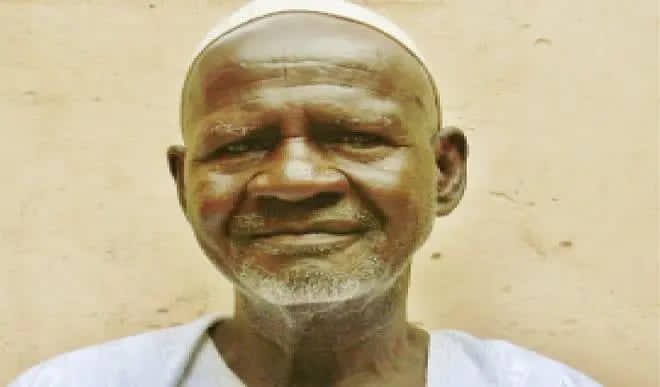
Innā lillāhi wa innā ilayhi rājiʿūn.
I received an SMS from one of my colleagues, Malam Dayyabu Ahmad at about 1:25pm informing me of the death of BK Gabari.
The name B. K. Gabari occupies a distinguished place in the history of journalism in Kano and Northern Nigeria at large. The initials B. K. stood for Bakin Kasuwa, a common identifier among the nationalist generation, individuals were often known by their place of residence, town, or city. His given name was Adamu.
I first came to know Alhaji B. K. Gabari through late Malam Magaji Dambatta, OFR, in 2008 during my undergraduate research titled “Some Influence of Pan-Africanism on Local Politics: A Case Study of the West African Pilot in Kano, 1937–1966. Subsequently, I had the privilege of maintaining close contact with him throughout my postgraduate years.
B. K. Gabari belonged to the first generation of Kano and perhaps Northern journalists. His contemporaries included the late Magaji Dambatta, OFR; Mustapha Dambatta; Audi Howedy; Malam Ibrahim Dantiye; Alhaji Tanko Yakasai; Mansur Kankarofi; Muhammad Ayama; and Muhammad Danjani Hadejia, among others.
He ventured into journalism in 1955, initially serving as a correspondent in the Hausa section in Kano of Dr. Nnamdi Azikiwe’s Daily Comet Newspaper. But the paper was originally acquired by Zik from one of the crusading Pan-African journalists, Duse Mohamed Ali. In due course, he rose to become the editor of the Hausa section. His motivation stemmed from a strong desire to use the press as a tool for public enlightenment, especially in exposing and resisting danniya da zaluncin Turawa da ’yan baran su, masu mulkin sarauta gargajiya — the oppression and injustice perpetuated by colonial authorities and their local collaborators within the traditional ruling system.
Like many pioneer journalists of his generation, B. K. Gabari acquired his professional training through close interaction with southern Nigerian journalists. Among them were Philip Iheyere, editor of the Daily Comet (English section); Razak Arewu, who later joined the Daily Mail, Kano; Mr. Adedoyin of the Northern Star; and *Adewole Giwa. Following the departure of Alhaji Tanko Yakasai as the Hausa Editor, Gabari rose to become the Hausa Editor of the Comet between 1959 and 1961.
Gabari’s life was marked by sustained struggles against oppression and injustice inflicted upon the masses by the combined actions of the Kano Native Authority and the ruling aristocracy. Alongside a few others, such as Malam Aminu Kano and Alhaji Yusuf Maitama Sule, he was often denied the comfort of his family home and was compelled to seek refuge either at the residence of Mr. Bello Ijumu or at the NEPU headquarters in Sabon Gari, Kano.
Over the years, he worked with several newspapers, including the Northern Star and the Daily Mail, where he served as the Hausa section editor. His commitment to NEPU activities led to repeated arrests and periods of imprisonment at the hands of traditional elites. One notable incarceration took place in Gusau, from where he and other NEPU activists were eventually granted bail through the intervention of Alhaji Aminu Dantata.
B. K. Gabari served as Assistant Secretary of NEPU at its headquarters located at No. 2, Yoruba Road, Sabon Gari, Kano.
Following the 1966 military coup and counter-coup, many nationalist journalists withdrew from the press. However, Gabari remained steadfast and went on to establish his own bilingual newspaper, Kano Express. As he often remarked, journalism was everything to him: it began as a means of political agitation and ultimately became his life’s vocation.
His humility and kindness were remarkable. I was always warmly received in his home, a testament to his generosity of spirit.
Alhaji B. K. Gabari lived a fulfilled life and passed away at the age of 95. He was an enlightened man who courageously encouraged his daughters to pursue higher education, despite prevailing conservative attitudes within the walled city of Kano, particularly in the Gabari and Bakin Kasuwa axis.
Allah ya yi masa rahma ya gafar ta masa, ameen.
Murtala Mustapha, PhD
Department of History and International Studies
Kano, Nigeria.
murtalamustapha222@gmail.com