

By Mariya Shuaibu Suleiman
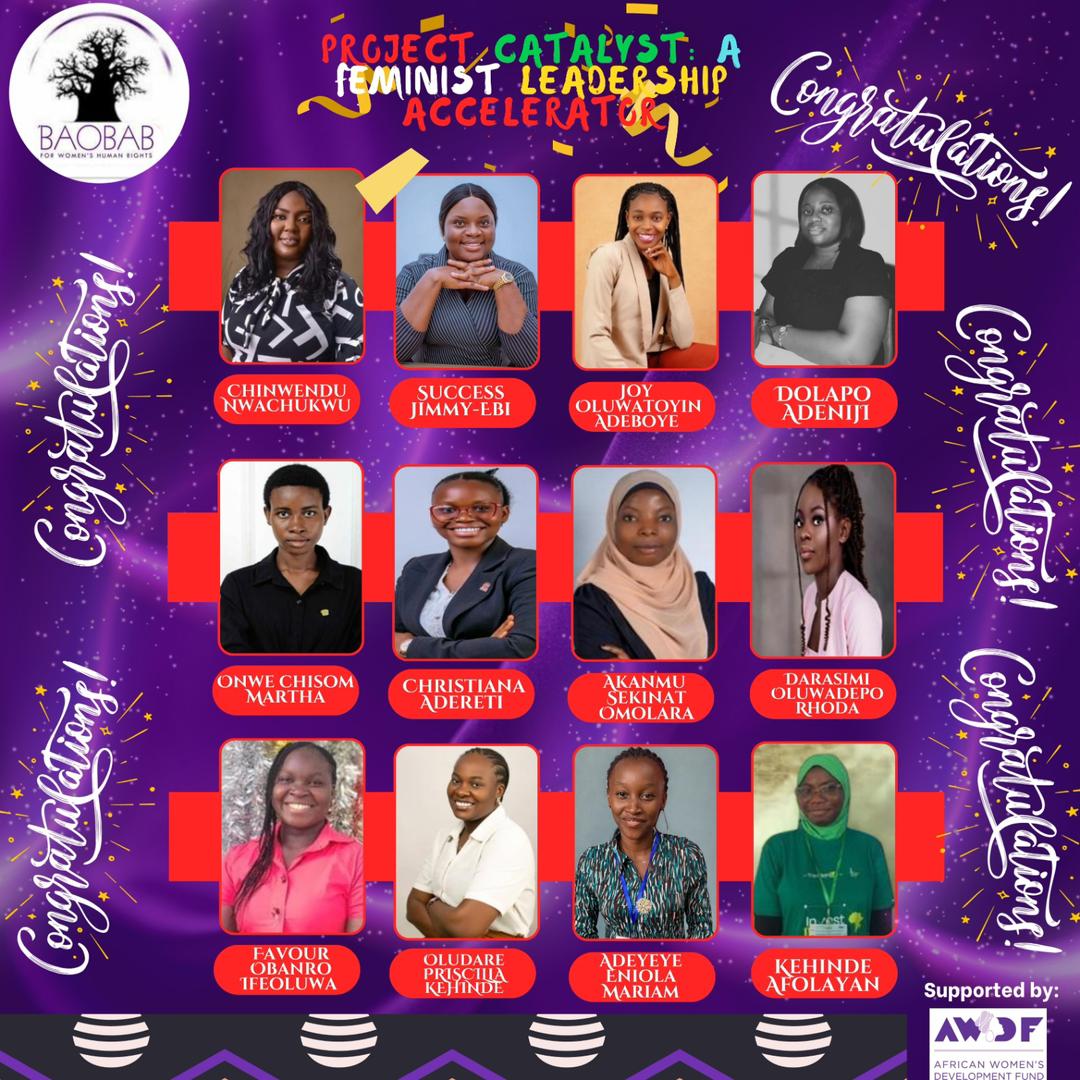
Twelve young feminists from across Nigeria have graduated from Project Catalyst: A Feminist Leadership Accelerator, a 12-week virtual mentorship programme organised by BAOBAB for Women’s Human Rights, with support from the African Women’s Development Fund (AWDF).
The graduation and award ceremony, held on Tuesday, 16 December 2025, also formally inducted participants into the Pan-African Feminist Solidarity (PAFSO) Network, a continental platform advancing the African Union Convention on Ending Violence Against Women and Girls (AU-CEVAWG).
The programme was designed to equip young feminist leaders with advanced leadership skills, practical advocacy experience, and access to a supportive feminist network. According to Baobab, the programme builds on the earlier Sexual Violence Response Leadership and Advocacy (SVRLA) institute, ensuring knowledge gained through training translates into actionable community-level interventions.
In her welcome address, Yèyé Bunmi Dipo-Salami, Executive Director of BAOBAB, congratulated the mentees on their commitment over the twelve weeks. She highlighted the importance of mentorship and intergenerational learning in sustaining feminist leadership.
“Feminist leadership and learning are continuous, lifelong processes,” she said, urging the graduates to view the ceremony not as an endpoint, but as a transition into long-term activism and continental solidarity.
The Project Officer and Programme Coordinator, Ms. Chisom Akwue, described the mentorship as a bridge between feminist knowledge and practical action. Over the programme period, mentees designed and implemented advocacy projects addressing sexual and gender-based violence (SGBV) within their communities. These projects ranged from virtual legal literacy webinars to survivor-led advocacy and technology-facilitated campaigns.
Among the highlighted initiatives was Chiwendu Augusta Nwachukwu’s “Voices Against Violence”, a webinar that created a safe space for survivors and increased awareness on GBV in Edo State. Dolapo Adeniji challenged victim-blaming narratives through online panel discussions, while Favour Obanro led community-based interventions addressing harmful traditional practices. Collectively, these projects demonstrated the practical application of feminist principles and the potential for digital and community engagement to advance SGBV advocacy.

Mentors, including Dr. Ejiro Otive Ogbuozor and Ambassador Chikas Kumle, praised the mentees for their resilience, strategic thinking, and the tangible impact of their initiatives.
Dr. Ogbuozor described the mentorship as a mutually enriching process, emphasizing that “mentees were already feminist actors, not beginners. Mentorship sharpened strategy, not just knowledge.”
A central highlight of the ceremony was the formal induction of graduates into the PAFSO Network, which will coordinate continental advocacy for AU-CEVAWG ratification, provide mentorship, and support women human rights defenders. Participants committed to the Pan-African Feminist Solidarity Pledge, centering survivors in advocacy, holding governments accountable, and strengthening intergenerational movements across Africa.
During the ceremony, mentees reflected on the programme’s impact, citing increased confidence in challenging institutional and cultural barriers, enhanced ability to navigate legal and policy systems, and strengthened access to advocacy platforms.
Joy Adeboye, a survivor-advocate, shared how mentorship support enabled her to advance a campus-based GBV case into formal legal channels despite institutional resistance.
The graduation concluded with a call for sustained feminist action. Ms. Dipo-Salami noted that the programme had provided “the tools and the network,” emphasizing that the task ahead is to ensure governments act and survivors see real change. The ceremony reinforced BAOBAB’s commitment to long-term mentorship, movement-building, and the development of a new generation of Pan-African feminist leaders.
