


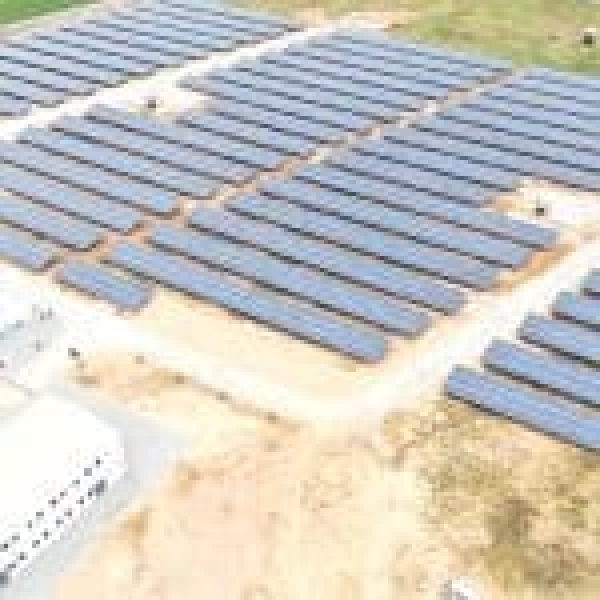
Barely two years after commissioning in 2019, the N5.6 billion solar hybrid power plant at the Bayero University, Kano (BUK), has stopped working, leaving students and staff to grapple with unstable electricity supply and rising bills.
The 3.5 megawatt project, unveiled in September 2019 by the then Vice President Yemi Osinbajo, was celebrated as the largest off‑grid solar plant in Africa and expected to provide uninterrupted power to lecture halls, offices, students’ hostels and staff quarters.
But by 2021, the facility developed faults and was eventually shut down, forcing the university to return to diesel generators and the national grid. The collapse has now prompted the Rural Electrification Agency (REA) to announce plans to revive and expand the plant to 6MW under a N100bn federal solarisation programme of Nigerian institutions.
The old project, which is an off-grid solar hybrid plant, has a total of 10,680 solar panels, each with 320 watts and 3.5 megawatt capacity peak; solar PV section, with string inverters, a total of 52 spread all over the plant; and a small sub-station, which has a common box.
It powered the entire new campus of the institution, including lecture halls, offices, staff quarters and even students’ hostels throughout daytime, while the institution relied on the traditional national grid and diesel generators in the night.
The N5.6 billion project was also carried out by the REA, which contracted the project out to a Greek company known as METKA. It was done under the Energising Education Programme (EEP) of the then federal government.
‘How the project brought succour before collapse’
Records show that the project, at the time it came to life, saved the university over 60 per cent of the money it used to spend on powering its generators and settling monthly electricity bills, which is presently in hundreds of millions.
A non-academic staff of the institution, Ibrahim Garba, said that before its subsequent collapse in 2020, the project powered the entire school; and the institution has saved a lot of money and improved efficiency as the light was never interrupted during the day.
He said, “We used it for over a year and it powered everywhere. It wasn’t full solar, it was a hybrid plant without storage facilities. We had an uninterrupted power throughout the school from 8am to 6pm daily. You can imagine the millions the school saved then.
On his part, a lecturer in the school, Dr Musa Bala, also confirmed that the project powered everywhere in the school, including the staff quarters, where he stays with his family on the campus.
“You can imagine how much would be saved if you had stable electricity from 8am till 6pm everyday. There was a sigh of relief and we hope to see those good old days revisited soon. Now, we are battling with exorbitant electricity charges and unstable supply,” he said.
The don said that when it started developing faults, the school started rationing the solar power supply, giving administrative offices and academic areas during the day, while staff quarters and students’ hostels got it in the night, before it eventually collapsed entirely.
Aisha Muhammad, who presently runs her master’s degree programme in the school, recalled that she was running her undergraduate degree when the project was commissioned and the supply was steady and had improved the campus security and made their learning environment conducive.
Baba Musa, who has a photocopy joint in one of the school’s departments, said he had saved a lot as a result of the stable light.
“My photocopy shop recorded more profit as I didn’t buy fuel as I do now. There was always light during the day. It was just unfortunate. It wasn’t supposed to collapse within that time. But we are glad that another project is coming; we pray for this to stand,” he prayed.
Solar plant inactive since early 2021
When our correspondent visited the place, he found it under lock with the school security guarding it. However, he observed that most of the panels were dusty while the rooms housing the solar inverters have obviously not been used for long.
A staff member who works close to the place said it had been inactive since it developed fault in 2021. He explained that it developed fault due to overuse, adding that it was suspected that the energy need of the institution was underestimated during the conception of the project.
He said, “It is only the security man guarding the place that is here. It has not been active since that fault. But we are glad that the federal government is finally coming to the school’s aid after five years. We hope the project would commence soon.”
Another staff member of the school, Adamu Aminu, recalled how the plant gradually developed faults and eventually collapsed.
He said, “The plant started developing fault when students returned from break and started abusing it. The university had to later ration students’ hostels and staff quarters.
“When it developed the fault, the school reached out to the manufacturers of the facilities, a German firm, via the REA.
“The company wanted to send their engineers from Germany to Kano to fix it, but the German Embassy in Nigeria advised them that it wasn’t safe for them to travel to Kano. That was how the fault was not fixed until it grew and necessitated the plant to be temporarily shut until it was to be fixed.
“And, subsequently, inflation kept pushing the prices of things to be fixed until the needed facilities became exorbitant and unaffordable.
“Also, you know electric materials depreciate daily when they are not in use for long. But that notwithstanding, the amount spent by the school on diesel and electricity since then could have been enough to fix the faulty plant,” Aminu added.
REA’s 6MW renewed initiative
On Thursday, November 20, 2025, the REA managing director, Dr Abba Aliyu Abubakar, launched the 6MW upgrade of the solar project at the institution.
Abubakar said that under the 2025 budget, President Bola Tinubu had approved N100 billion for the National Public Centre of Solarisation Initiative, a programme designed to provide clean electricity, reduce dependence on fuel and cut operational cost across major public institutions.
He announced that BUK is one of the beneficiaries of the programme, explaining that under the intervention, the plant will experience complete overhaul and is expected to provide stable light 24/7.
Abubakar said, “We are to fix the existing 3.5MW infrastructure, and at the same time, increase the capacity to 6 megawatts. What this means in turn is to change the entire storage system that exists, bringing in new LED iron batteries, upgrading the inverters, upgrading the distribution network, segregating critical and non-critical areas, and at the same time, increasing the panels by additional 2.5MW capacity.
“This is what BUK is going to benefit from. And it is just one of the 26 universities that would benefit from this.”
On what the agency will do to prevent the previous collapsing experience, the managing director assured the university community that the federal government had already established a strong and sustainable maintenance mechanism, with technical, operational and financial structures in place to ensure a long-term viability of the project.
Why the previous plant collapsed – VC
Speaking to Weekend Trust, the vice chancellor of BUK, Professor Haruna Musa, lamented that the previous fault was as a result of not involving the university team of experts in the implementation.
This, according to him, made it difficult for them to maintain it easily when it developed the fault and eventually stopped working.
Asked what they would do differently to avert the past experience, Professor Musa said, “This time around, our team of experts will be fully involved in the implementation of the project. We are hopeful that the configuration that will be put in place would differ from the previous one.
“And with the involvement of our team of experts, it has now become very easy to manage the facility in line with international best practices.”
He also expressed confidence that once completed, the project would significantly address the school’s energy challenges and help it save its monthly electricity bills, which he said was in the tune of over N130 million.
Professor Musa highlighted the financial strain of powering the institution, revealing that monthly electricity bills are that high, even with rationing. This figure, he noted, excluded diesel purchases and generator maintenance costs.
He thanked the federal government for its commitment to reviving and upgrading the plant, saying it will greatly reduce the school’s energy bills and ensure stable power supply in the campus, and at the same time, promote green practices.
Recalling the good old days of the former project, staff and students who spoke to Weekend Trust expressed happiness with the renewed effort, while calling on the agency to ensure accountability in the new project.
[Daily Trust]