


Women constitute nearly 50% of Nigeria’ s population, yet they hold only 4–6% of legislative seats nationwide. Just 21 of the 469 members of the National Assembly are women a mere 4.5%.
Representation at the State Assembly level is similarly low, with women occupying approximately 5.5% of the 990 seats across the country. Since the return to democracy in 1999, men have won 2,657 National Assembly seats, compared to just 157 won by women.
Nigeria’ s record falls far below global and regional standards. The global average for women’ s representation in national legislatures stands at 22.5%, Africa at 23.4%, and West Africa well above Nigeria’ s figures.
This persistent gap remains despite Nigeria’s ratification of international treaties and adoption of domestic policies such as the National Gender Policy that commit the country to increasing women’s political participation.
Extensive empirical research worldwide demonstrates that meaningful participation of women in legislatures improves governance outcomes, promotes more inclusive policy priorities particularly in education, health, and social welfare and strengthens democratic institutions.
Yet, in Nigeria, women’ s representation has remained largely stagnant after decades of democratic rule, reflecting sustained exclusion, underutilization of talent, and continued marginalization. With global and regional benchmarks rising, Nigeria risks falling further behind accepted democratic norms of inclusion.
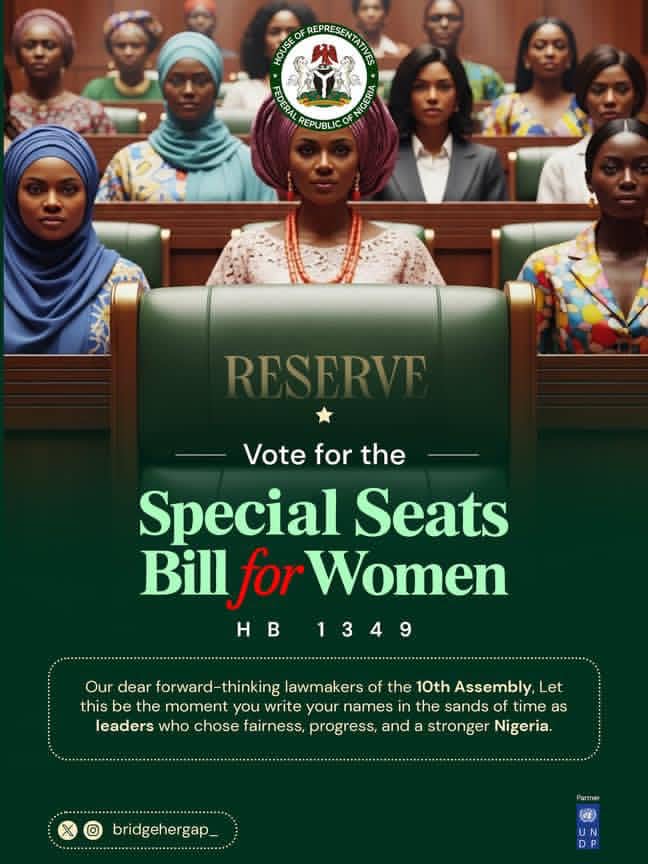
The proposed Reserved Special Seats Bill aligns with global best practices and offers a necessary corrective to entrenched structural barriers that hinder women’ s electoral success.
These barriers include socio-cultural constraints, party-level exclusion, the monetization of politics, patronage systems, and systemic discrimination.
Reserved seats are designed to address these long-standing disadvantages and create a more equitable pathway for women’ s participation in governance.
By ensuring broader and more inclusive representation, the Bill will strengthen Nigeria’ s democracy, increase public trust in political institutions, and enrich lawmaking through diverse perspectives.
It will also prevent political dominance by a single demographic group, which has often resulted in the neglect of issues affecting women, families, and social development.
As Nigeria confronts deepening challenges rising inequality, poverty, insecurity, and pressure on social services diverse representation, including women’ s leadership, becomes essential to crafting responsive and sustainable solutions.
We therefore urge Nigeria’ s legislators to act swiftly in passing and implementing this Bill, transforming commitments to gender equality into tangible policy outcomes.
Civil society organizations and women’ s rights groups must intensify public awareness, mobilize citizens, educate voters on the importance of representation, and hold decision-makers accountable.
Public institutions, labour unions, and professional bodies should publicly endorse the Bill, affirming that equitable representation is not merely a women’ s issue, but a foundation of fair and inclusive governance.
Political parties must commit to supporting women candidates in both reserved and competitive seats by dismantling financial and structural barriers and mentoring aspiring leaders.
Media organizations and opinion leaders should elevate the discourse, highlight the long-term democratic benefits, and frame the Reserved Special Seats policy as a necessary corrective not a privilege.