


By Hajara Abdullahi
Women, who make up a significant portion of Nigeria’s voting population, remain underrepresented in political participation due to social, economic, and cultural factors. Although there has been improvement in women’s political involvement in Nigeria and other developing countries, data reveals that progress remains minimal still below the 35% international target.
According to the Inter-Parliamentary Union, a Paris-based international organization of national parliaments, Nigeria ranks 179 out of 183 countries globally in women’s representation in national parliaments, despite being Africa’s most populous nation.
Nigeria’s democratic system grants citizens the right to choose their leaders at local, state, and federal levels. However, women continue to be marginalized at all tiers of governance due to entrenched social, economic, and cultural barriers.
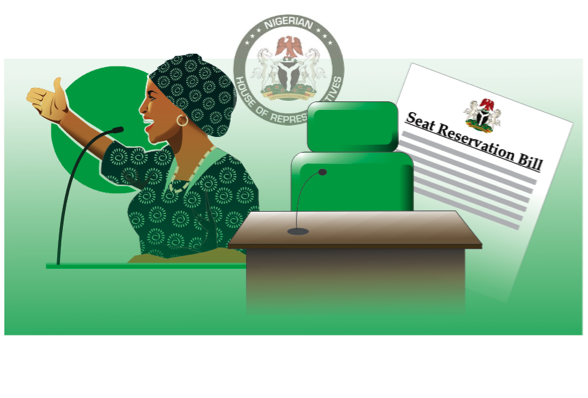
The Reserved Seat Bill gained traction in September 2025 during a national public hearing on the Constitution Review held at the National Assembly. The Speaker of the House of Representatives, Tajudeen Abbas, alongside the EU, UK, women leaders, rights groups, and civil society organizations, commended the move, describing it as a milestone in Nigeria’s political development—one that promotes gender equality, inclusion, and greater participation of women in decision-making processes.
Current Reality
In the current 10th National Assembly, only 21 out of 469 members are women, representing just 4.5 percent. In the House of Representatives, only 16 women sit among 360 members, while in the Senate there are only 4 women among 109 senators. At the state level, only 54 women occupy the 990 available seats, with 15 State Assemblies having no female lawmakers at all.
This stark imbalance underscores women’s exclusion in the political arena of the most populous Black nation, where decisions affecting them are made without their adequate representation.
What the Bill Entails
The bill proposes to create 36 additional seats for women in both the House of Representatives and the Senate, allocating one seat per state, including the FCT.
At the state level, three additional “reserved exclusively” seats for women would be created in each senatorial district.
In total, the bill would create 182 new seats for women at both state and national levels boosting participation from below 5% to at least 40%.
This is a temporary measure, subject to review or removal after four election cycles.
Women Speak
During a stakeholders’ interactive session organized by the Legislative Advocacy Committee in November, Mrs. Kafilat Ogbara, Chairperson of the House Committee on Women Affairs, stated:
“The time is ripe for Nigeria to take a bold step toward gender inclusion by passing the Constitution Alteration Bill seeking special reserved seats for women in the National and State Houses of Assembly.”
Mrs. Ogbara noted that despite discouraging historical trends, there is now strong political will across the Executive and Legislative arms to change the narrative.
Amb. Maryam Ibrahim Sani, Founder/CEO of Her Voice Initiative, emphasized that the bill would dismantle long-standing psychological and structural barriers in Nigeria’s male-dominated, capital-intensive, and often violent political landscape.
“By limiting competition for designated seats to women, the bill reduces campaign costs, political violence, and dependence on patronage networks and godfatherism,” she said.
She added that it would also encourage political parties to invest in female candidates, paving the way for complementary reforms such as reduced nomination fees, public campaign financing, and enhanced party-level support systems.
Addressing concerns about the cost of governance, Amb. Maryam argued that: “The creation of additional legislative seats may marginally increase expenditure, but the democratic gains substantially outweigh the financial implications. Inclusive representation strengthens democratic legitimacy, enhances citizen trust, and improves policy responsiveness.”
She further noted that increased women’s representation would significantly influence policies on Gender-Based Violence (GBV), women’s empowerment, and gender-responsive budgeting.
Similarly, Aisha Haruna Kabuga, Executive Director of Women for Education and Empowerment, described the bill as “a beacon of hope” for aspiring young women, saying it would raise women’s representation from below 5% to over 30%, fostering inclusive governance and inspiring a new generation of female leaders.
How It Will Change the Narrative
If passed, the bill would pave the way for greater women’s participation in politics and strengthen gender inclusion in Nigeria. Years of underrepresentation have sidelined women in policymaking, especially on issues that directly affect them.
The bill would also allow Nigerian women parliamentarians to vote and participate effectively in global women’s parliamentary platforms, meeting international representation quotas. It would empower them to shape national development through laws and policies that protect both women and society at large.
The passage of the bill would mark a historic milestone in Nigeria’s nearly 30-year democratic journey, advancing equity and fairness for a group long silenced by systemic exclusion.
Though critics argue it undermines meritocracy, Nigeria’s politically hostile environment toward vulnerable groups calls for decisive and corrective action. Reserving seats for women is a necessary step to redress decades of neglect and underrepresentation.
Nigeria boasts outstanding women who have excelled globally, including Dr. Ngozi Okonjo-Iweala, Director-General of the World Trade Organization and former two-time Minister of Finance; Amina J. Mohammed, United Nations Deputy Secretary-General; Victoria Akayi, Managing Director of TVC News; Folorunsho Alakija, Africa’s richest Black woman; and Mo Abudu, a globally recognized media entrepreneur. Their achievements reflect the immense potential Nigerian women bring to leadership.
Countries such as Kenya, Tanzania, Uganda, Lesotho, Burundi, and Rwanda have successfully implemented similar models, resulting in greater female political participation and the birth of more gender-inclusive governance systems.
In conclusion, the Reserved Seats Bill represents a timely and transformative effort to correct historical imbalances and promote a fairer, more inclusive political future for Nigerian women.