

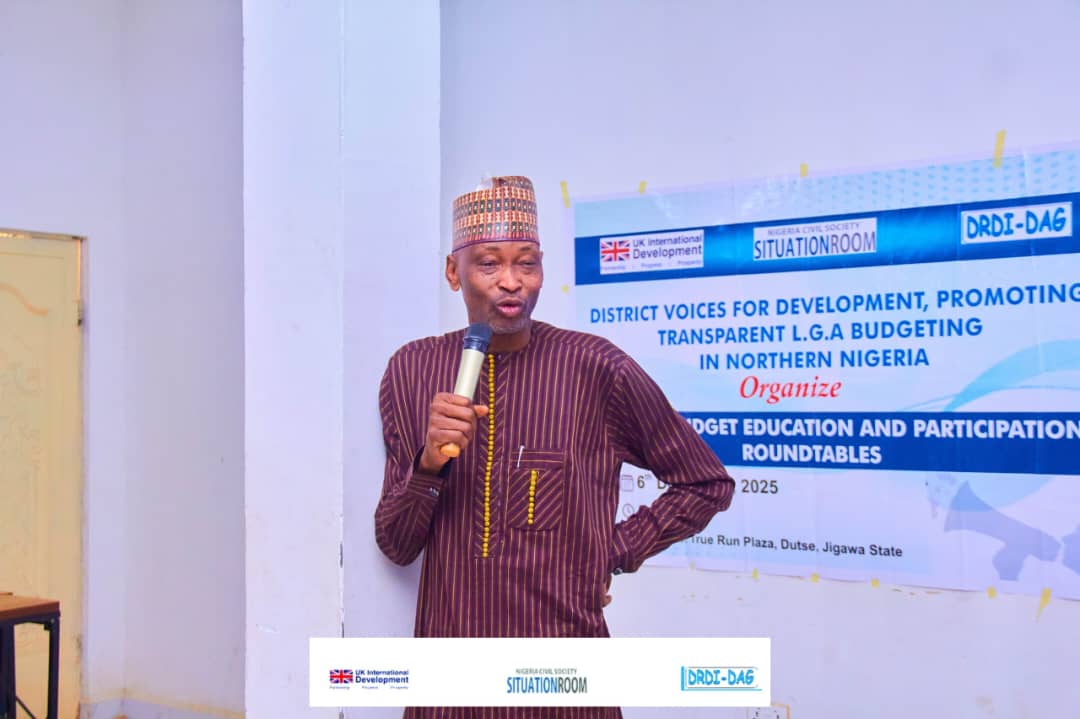
By Mustapha Salisu
The Dispute Resolution and Development Initiative (DRDI) has called for urgent fiscal reforms, improved budget execution, and enhanced transparency across local government councils in Kano State following the release of its five-year budget analysis covering 2020 to 2024.
The Executive Director of DRDI, Dr. Muhammad Mustapha Yahaya, in a press statement signed and issued to newsmen in Kano on Thursday, revealed that the report analyzed six local governments, Bichi, Dambatta, Fagge, Karaye, Tudun-Wada, and Kano Municipal and discovered that over 70 percent of their total allocations were spent on recurrent expenditures, leaving limited funds for capital projects in key sectors such as education, health, agriculture, and gender/WASH.
Conducted using data from the Kano State Ministry for Local Government and Chieftaincy Affairs, audit records, and other reliable sources, the study assessed allocations, releases, and expenditures while identifying fiscal challenges that weaken transparency and accountability at the grassroots level.
The analysis according to the Executive Director, showed that all six LGAs relied heavily on recurrent spending, leaving little for capital projects as education, health, and agriculture suffered low funding and poor implementation despite rising allocations between 2020–2024. Most LGAs depended almost entirely on federal allocations, with IGR below 10% due to weak systems and leakages.
“Poor documentation, limited transparency, and disruptions from COVID-19 and subsidy removal further hindered budget performance and project execution” he added.
Dr. Yahaya emphasized the urgent need for deliberate and coordinated action among all relevant stakeholders to strengthen fiscal responsibility and governance across Local Government Areas (LGAs) in Kano State. While noting that it was imperative to rebalance spending toward capital and social sectors by reducing recurrent expenditures and channeling more funds into critical areas such as education, health, and agriculture.
According to him, LGAs must improve their budget execution mechanisms by ensuring timely releases of funds and conducting quarterly monitoring to reduce the incidence of unspent allocations
“For the sake of transparency and public disclosure, it is important for all LGAs to regularly publish approved budgets, releases, and expenditure performance reports. Because, Kano Municipal and Fagge LGAs, due to their urban character, could serve as pilots for open-budget dashboards that would allow citizens to access and track government spending” Dr. Yahaya pointed.
He also highlighted the need to strengthen internally generated revenue (IGR), explaining that commercial LGAs like Fagge and Kano Municipal Council should automate local tax collection, regulate informal markets, and tighten enforcement to reduce leakages. For rural LGAs such as Karaye and Tudun-Wada, he recommended harnessing agricultural produce markets and rural levies in a transparent and efficient manner.
Dr. Yahaya however, lamented the persistent underperformance in LGAs like Karaye and Bichi and called on them to prioritize the completion of stalled educational and healthcare projects, ensuring that budgetary releases directly translate into improved service delivery.
Speaking on agricultural development, He urged that support programs should not be limited to fertilizer and tractor procurement but should include input distribution, irrigation assistance, and farmer training especially in Tudun-Wada and Dambatta as he advocated for the institutionalization of participatory and performance-based budgeting that involves citizens in consultations and sets measurable indicators for accountability while equally so encouraging Civil Society Organizations (CSOs) to actively monitor budget implementation at the ward level.
Dr. Yahaya emphasized the importance of capacity building within budget and planning units, stressing the need for regular training in data management, monitoring and evaluation, and fiscal analysis to strengthen evidence-based decision-making “LGAs should adopt peer-learning platforms where councils with strong fiscal practices such as Dambatta’s capital investment drive could share experiences and strategies with others lagging in performance” he suggested.
Concluding, Dr. Yahaya called for the full implementation of Public Finance Management (PFM) laws, urging the Kano State House of Assembly to ensure strict compliance with provisions mandating the public dissemination of financial documents while maintaining that only through transparency, accountability, and collaboration could the LGAs achieve sustainable development and improved governance.