

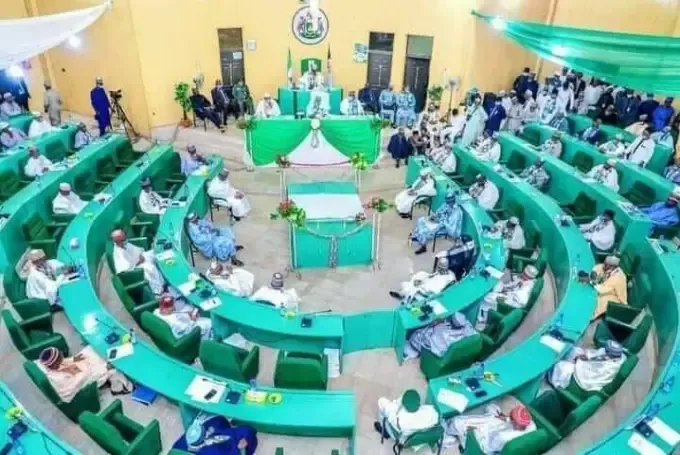
The Kano State House of Assembly has described 2025 as a watershed year in its quest for consistent and quality legislation, citing far-reaching legislative output, robust oversight, and institutional reforms under the leadership of Speaker, Rt. Hon. Jibril Ismail Falgore.
A statement issued by the Chief Press Secretary to the House, Kamaluddeen Sani Shawai, said the 10th Assembly, made up of 40 lawmakers representing the state’s 44 local government constituencies, remained active and cohesive throughout the year, with the House leadership providing strategic coordination and administrative direction.
Between January and December 2025, the Assembly adopted more than 700 motions and passed 15 bills aimed at strengthening governance, public institutions, and service delivery. Among the landmark legislations passed were the Kano State Geographical Information System Law, Kano State Centre for Disease Control Law, Kano State Electricity Law, Kano State Security Law, Kano State Social Protection Law, Motor Vehicle Administration Law, and the Kano State Neighbourhood Security Corps Law 2025, among others. The House also considered a bill to establish the Kano State Electricity Agency.
The Assembly further deliberated on several motions of urgent public importance, including calls for immediate action to curb insecurity in Tsanyawa and Bagwai local government areas, intervention for victims of the Shuwaki Market fire in Gwarzo, and support for communities affected by a windstorm in Kiru. Other resolutions focused on reviving vocational training centres, rehabilitating rural roads, upgrading health facilities, and reviewing the 2025 Nigeria Customs Service recruitment exercise.
In the area of oversight, standing committees undertook extensive monitoring of ministries, departments, and agencies to ensure transparency, accountability, and effective implementation of the 2025 budget. Committees also carried out field visits across constituencies to assess ongoing projects and government programmes.
The Assembly also commenced the renovation of its complex, with the support of Governor Abba Kabir Yusuf, to address years of infrastructural decay. According to the statement, the project has reached over 75 per cent completion and is expected to be inaugurated in early 2026.
As part of capacity building, the House organised a legislative retreat themed “The Role of the State Legislature in the Review of the Constitution and Effective Oversight Functions of MDAs.” Development partners engaged lawmakers on issues including maternal mortality reduction. During the year, the Assembly suspended a local council chairman over alleged diversion of fertiliser, raised concerns over child trafficking, screened commissioner nominees, and approved a supplementary budget of ₦215.37 billion. It also reaffirmed its commitment to reducing road crashes in collaboration with the Federal Road Safety Corps.
Speaker Falgore, according to the statement, commended media organisations for their role in promoting public understanding of legislative processes.
However, the year was also marked by tragedy with the death of two serving lawmakers — the Chairman, House Committee on Appropriation, Alhaji Aminu Sa’adu Ungogo, and the Chairman, Committee on Hajj Affairs, Alhaji Sarki Aliyu Daneji. Ungogo died shortly after participating in the 2026 budget public hearing.
The Assembly expressed condolences to the families and constituents of the deceased lawmakers and joined Nigerians in mourning other notable figures, including philanthropist Aminu Alhassan Dantata, former President Muhammadu Buhari, and other citizens who passed away during the year.
The House reaffirmed its commitment to people-centred legislation and effective oversight in the coming years, the statement added.