

By Mustapha Salisu
Participants in the Resilient Opportunities for Outreach, Trade and Sustainability (ROOTS) project, implemented by AHIP through the IOM training programme, have described the initiative as a major catalyst for enhancing food security by promoting climate-smart and urban farming practices among smallholder farmers.
The theoretical training was conducted at the Adolescent Health and Information Projects (AHIP) Human Development Institute, while the practical component took place at the Centre for Dryland Agriculture, Bayero University Kano (BUK).
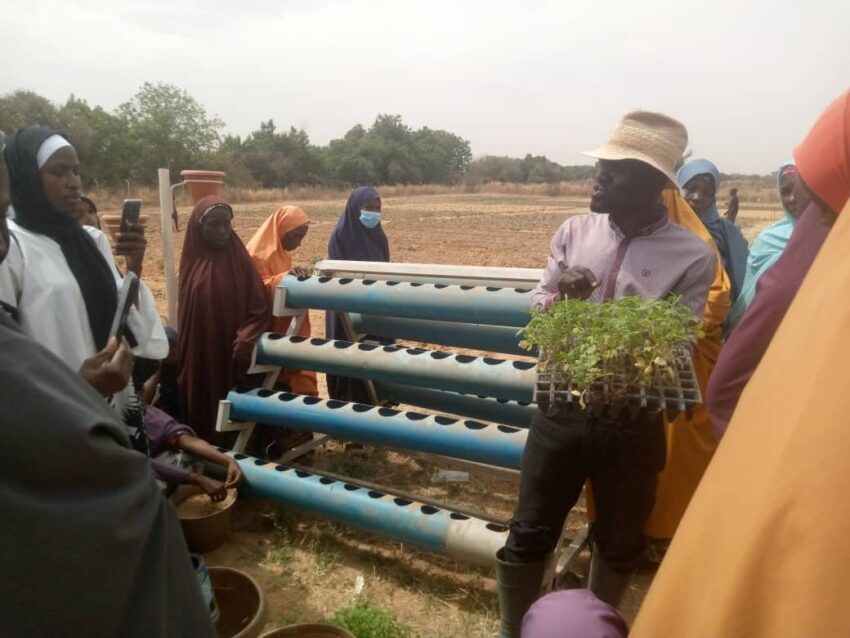
A participant, Fatima Sani from Bunkure Local Government Area, said the training exposed them to modern farming techniques ranging from nursery establishment to harvesting.
According to her, the programme emphasized backyard and sack farming, enabling participants to grow crops within limited spaces.
Another participant, Rabi Lawan from Hotoro in Tarauni LGA, said she received hands-on training on manure application, sack planting, and transplanting seedlings to farms.
She added that participants were also taught irrigation using pipes, farm sanitation, rice cultivation, and the use of neem seeds as organic pesticides to control pests.
The training, held under the AHIP ROOTS Project, focused on practical urban and peri-urban farming methods aimed at improving household food production and resilience.
Participants were also educated on the effects of climate change on crop production and strategies for growing cereal crops under changing climatic conditions.
Speaking during the training, Professor Aminu Alhassan Fagge, a Professor of Agronomy at the Centre for Dryland Agriculture, Bayero University Kano (BUK), said the second phase of the programme concentrated on climate change and its impact on agriculture.
He explained that the training demonstrated how crops could be successfully cultivated in backyards and sacks, while urging the public to support and encourage female farmers.
In her remarks, the ROOTS Programme Officer, Halima Kasim Usman, disclosed that the programme is funded by the European Union and implemented by the Adolescent Health and Information Projects(AHIP) through the International Organization for Migration (IOM) for returnees and internally displaced persons (IDPs).
She said the ROOTS project targets returnees and IDPs in Ungogo, Dala, and Bunkure LGAs, noting that Bunkure was selected due to the high number of smallholder farmers in the area. According to her, AHIP partnered with the Centre for Dryland Agriculture, BUK, to train women in climate-smart agriculture from nursery to harvest.
“ROOTS aims to empower women smallholder farmers to improve their livelihoods by forming cooperatives, working together to generate income, and promoting food security,” she said.
The project is implemented by the Adolescent Health and Information Projects (AHIP) in partnership with the International Organisation for Migration (IOM), with support from the European Union (EU) and the Free Movement of Persons and Migration in West Africa Phase II (FM West Africa II) Programme.