

From Alhaji Yusuf, Damaturu
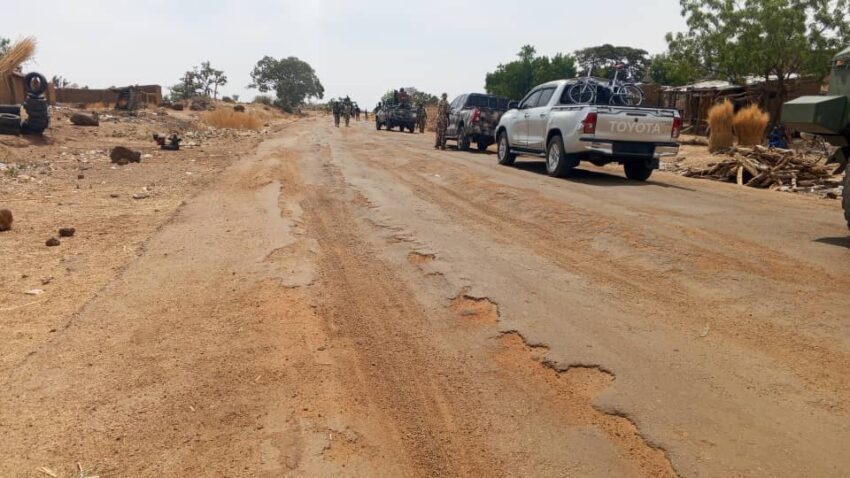
For thousands of travellers and commercial drivers who ply the 134-kilometre Damaturu–Buni Yadi–Biu federal highway daily, the road has become a death trap — both due to its crumbling infrastructure and the insurgents who exploit its neglect to abduct and kill innocent citizens.
On Wednesday, journalists accompanied by armed troops embarked on a media tour of the strategic corridor, witnessing firsthand the deplorable state of a highway meant to serve as a vital link between Yobe, Borno, and Gombe States.
What they found was a stretch of despair — gaping potholes, stranded vehicles, and commuters moving in palpable fear.
Malama Fatima, a passenger travelling from Damaturu to Gombe, voiced frustration shared by many road users.
“The road is very bad. It became necessary for me to follow this route because I don’t have the means to take the longer and safer one. We are begging the authorities to repair this road for us,” she pleaded.
Her concern was echoed by Abdullahi Umar, a traveller from Buni-Gari to Biu, who has endured the road’s condition for over two decades.
“This is my usual road; it’s the only one I know. It’s a key logistics route for moving farm produce from rural areas to major markets like Damaturu. It connects Yobe, Borno, Gombe, Adamawa, and Taraba, and reduces vehicle operating costs and transport expenses,” he said.
He added that despite years of hardship, commuters continue using the road because they have no alternative.
“We’ve been managing this road for the past 20 years. It’s our daily means of survival. We urge the government to fix this long-neglected route to prevent further attacks by insurgents on civilians and security forces,” he appealed.
Commercial drivers, whose livelihoods depend on the highway, painted an even grimmer picture.
Ali Hassan, who has ferried passengers between Maiduguri and Biu for six years, described the road as “completely dilapidated with huge potholes.”
“If repairs are carried out, even minimally, it will reduce the level of insecurity along this route,” he noted.
Another driver, Abdullahi Hussaini, who has plied the Biu–Buni Yadi–Damaturu route for more than seven years, said navigating the road has become a daily struggle.
“Following this road is not easy. It’s completely damaged. We’re calling on the Federal and State Governments to come to our aid. This road plays a significant role in our lives, especially for us drivers,” he said.
Alhaji Mohammad Mai Yadi, travelling from Potiskum to Mubi, urged the Federal Government to act swiftly “for the safety of the people of the North-East and Nigeria at large.”
Findings by our Correspondent revealed that the poor state of the road has provided a strategic advantage for insurgents operating in the area. Troops now conduct early morning patrols daily to clear improvised explosive devices (IEDs) before allowing commuters to ply the route.
“The insurgents take advantage of the bad road to abduct innocent people and bury IEDs,” a security source confirmed.
The 132-kilometre corridor is not just a transport route but also an economic lifeline — driving local trade in towns such as Damaturu, Buni Yadi, Buratai, Miringa, and Biu. It serves as an alternative freight channel for trucks conveying goods from Borno to other parts of the country.
There is, however, a glimmer of hope. On November 13, 2025, the Federal Government, through the North East Development Commission (NEDC), officially handed over the site for the reconstruction of the 25-kilometre Damaturu–Gujba section to an indigenous contractor, with a 12-month completion timeline.
Further findings indicate that the NEDC’s full road project spans 77 kilometres, extending from Damaturu to Magza, a border community between Yobe and Borno States.
Yet, residents fear that piecemeal interventions may not be enough to tackle the full extent of the problem.
Experts believe that rehabilitating the highway will not only reverse years of insurgency-induced damage but also restore safe movement for farmers, traders, and commuters — revitalising economic activities across the region.
As travellers continue to risk their lives daily on this treacherous route, the haunting question remains: how many more lives must be lost before this critical artery is restored to dignity?