

The Informal Economy’s Backbone: How Women in a Rural Community of Kano State Are Reshaping Narratives for Survival
By Hajara Abdullahi
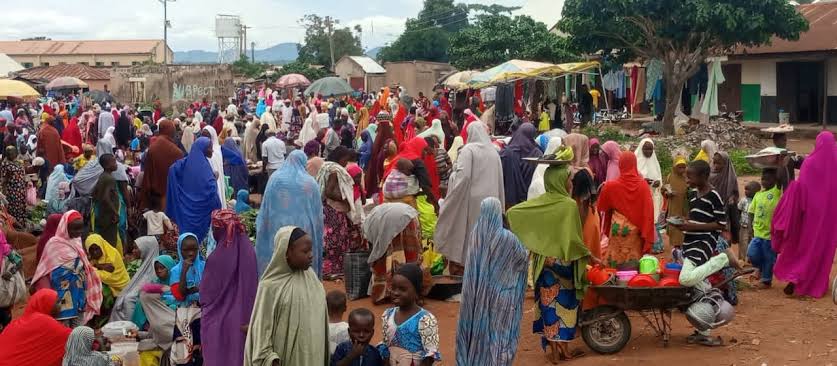
Larabar Mata, a community market in Kumbotso LGA, Kano State, is providing women entrepreneurs an avenue to change the narrative of the business atmosphere in the historic city of Kano, predominantly dominated by men.
The market, which was established nearly two decades ago, was initially dominated by male traders who sold their wares to women—making up 80% of the market’s visitors. But in recent years, things have changed as women are now renting shops and stalls to sell their wares to fellow women who patronize the market.
The market serves the needs of residents in Magadawa, Mariri, Tsamiya, Zara, Yalman Fulani, and Jumar Galadima, which are local communities in Kumbotso, Warawa, and Dawakin Kudu LGAs.
During a tour on Wednesday, our reporter spoke with a few women traders and buyers within the market who sell staple food, household items, plastics, and aphrodisiacs. They narrated how the current economic situation had pushed them to bring their goods to Larabar Mata, adding that the need to assist their husbands with household responsibilities, as well as become self-reliant instead of being beggars, motivated them to bring their wares to the market.
“As a woman, it’s good to have a business or job where you will be earning from because it will help you in assisting your husband,” said Hauwa Kulu, an elderly woman who sells plastics.
“People who think women doing business are wayward should stop it because it’s better to have something doing than resorting to begging,” Hauwa added.
She further stated that what motivated her to bring her goods to the market was the experience she had after her husband’s death—most of her customers collected goods on credit and never paid back. So, she decided to improve her business by bringing her goods to Larabar Mata, adding that it’s good for a woman to have a source of income.
Having A Source Of Income Will Help You As A Woman — Market Women Speak
Women traders in Larabar Mata have decried that having a source of income as a woman is vital in today’s world, stressing that owning a business enables a woman to assist her husband and prevents her from being vulnerable to abuse and exploitation.
Zainab Niger, a woman who owns a shop where she sells aphrodisiacs, narrated how in recent years, women come to Larabar Mata not only as buyers but also as sellers, as women traders have flooded the market with their wares.
“As a woman, you need to struggle to make ends meet because now even men don’t marry an idle woman,” she said.
“I’ve been in this shop for four years, but the current hardship has affected my sales because now, instead of coming to buy goods, most women come to sell their own goods. But I thank God that I still make profit,” Zainab said.
She added that she rented the shop following advice from a family friend and also took her goods to trade fairs in other states, which has made her self-reliant.
Another market woman, Hadiza Hajiyar Makka, said she decided to come to the market because, as a woman, staying idle is uncalled for. Considering the current economic situation, women need to assist their husbands with household responsibilities such as feeding, rent, and paying school fees.
“The challenge I face is with debt—if we give people goods on credit, they don’t pay back. Last month, I gave a customer goods worth ₦60,000, but she refused to pay me,” she lamented.
Hadiza also expressed her dissatisfaction with women and children roaming about and begging for assistance instead of engaging in menial jobs or starting a business.
Hauwa Abdullahi, the leader of the women who sell their goods in a part of the market, lamented how they face many challenges in their business. She narrated how a fellow market woman was sentenced to prison even when she was innocent.
“What motivated me to start this business was that initially, I sold scrap and later switched to women’s clothes. I advise married women to hold their integrity because, whatever people will say, if you’re committed to what you’re doing and assisting your husband, you won’t derail,” Hauwa disclosed.
Market Leader Speaks
The market leader called on the Kano State Governor, Alhaji Abba Kabir Yusuf, to assist the market women with funds to expand their businesses, as most of them are divorced or have orphans to cater for.
Hajiya Fatima, the leader of the market women’s association, said:
“The current economic situation forced women to come to this market to start selling their wares.
We used to face a lot of problems, but the security officials are trying. We don’t buy goods from children because most of them stole them.
The government needs to assist women with funds to improve their businesses.”
Data Reveals Millions In Extreme Poverty With Women Mostly Affected
In Northern Nigeria, patriarchy, limited access to education, lack of access to resources, poverty, and gender inequality have pushed millions of women into untold hardship as they struggle to provide for themselves and their children—amidst unsustained interventions from both state and federal governments.
According to the World Bank’s April 2025 Poverty and Equity Brief for Nigeria, over 54% of Nigerians, particularly in rural communities, are living in poverty.
The recent rise in the cost of living across Nigeria—following the removal of fuel subsidy and unification of exchange rates by President Bola Ahmed Tinubu—has pushed millions of Nigerians deeper into poverty, with women mostly affected.
The Minister of Finance and Coordinating Minister of the Economy, Wale Edun, during a press briefing at the conclusion of the 2024 IMF and World Bank Spring Meetings held in Washington, D.C., noted that Nigeria’s economy grew at an average of 3.4% in 2024, adding that this level of growth is insufficient to lift millions of Nigerians out of poverty.
According to Matthew Verghis, World Bank Country Director for Nigeria, as of 2025, 139 million Nigerians are living in extreme poverty, with 63.9% of females classified as poor at the $3.65 per day lower-middle-income poverty line.
To promote sustainable growth and development and eradicate gender-based violence across Nigeria, women need to be educated and empowered. Therefore, relevant stakeholders—including government, parents, traditional leaders, and civil society organizations—must renew their commitments towards providing a safe and secure environment for women to thrive and excel.