

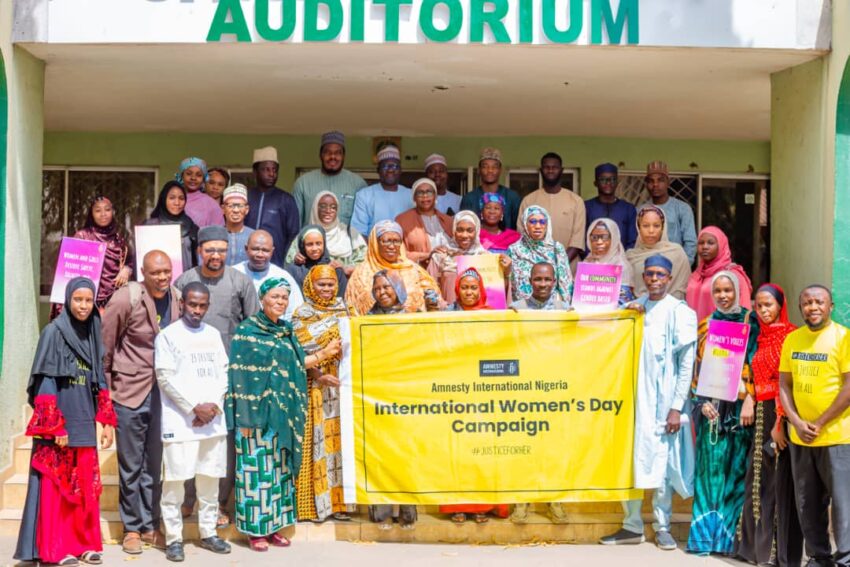
As the world marks International Women’s Day (IWD) 2026, Amnesty International has called on the Kano State Government to strengthen protection mechanisms for women and girls against Gender-Based Violence (GBV).
The Deputy Coordinator of Amnesty International, Kano State, Comrade Abba Bello, made the call during a roundtable discussion held to commemorate the annual event at Mambayya House, Kano.
Speaking at the event, Bello described gender-based violence as a global crisis that cuts across societies and sectors, disproportionately affecting women, young girls, and children.
Amnesty International Urges Kano Government to Strengthen Protection Against Gender-Based Violence
As the world marks International Women’s Day (IWD) 2026, Amnesty International has called on the Kano State Government to strengthen protection mechanisms for women and girls against Gender-Based Violence (GBV).
The Deputy Coordinator of Amnesty International, Kano State, Comrade Abba Bello, made the call during a roundtable discussion held to commemorate the annual event at Mambayya House, Kano.
Speaking at the event, Bello described gender-based violence as a global crisis that cuts across societies and sectors, disproportionately affecting women, young girls, and children.
He noted that women and girls continue to face various forms of violence, including domestic abuse, sexual assault, forced marriage, and other harmful practices that undermine their rights and dignity.
Amnesty International therefore urged the Kano State Government to domesticate the Violence Against Persons (Prohibition) Act (VAPP Act) and the Child Protection Law in order to strengthen legal protection for vulnerable groups.
According to available national data, one in every three women in Nigeria has experienced some form of gender-based violence, highlighting the alarming scale of the problem.
The organization further emphasized that many cases remain unreported due to stigma, fear of retaliation, and limited access to justice, particularly in rural communities.
Amnesty International also called on the government to strengthen the Sexual Assault Referral Centre (SAR-WARAKA Centre) located at Murtala Muhammad Specialist Hospital, noting that the centre currently faces manpower and resource challenges.
The organization further recommended the establishment of a dedicated GBV desk office at the Kano State Ministry of Women Affairs, stronger implementation of protective laws, increased public awareness, and improved support systems for survivors, including access to legal assistance, healthcare, and psychosocial services.
Furthermore, Amnesty International urged authorities to collaborate with civil society organizations, women’s groups, and community leaders in Kano to challenge harmful social norms that perpetuate violence against women and girls.
The organization stressed that ending gender-based violence requires sustained commitment from governments, institutions, and communities.
He noted, that women and girls continue to face various forms of violence, including domestic abuse, sexual assault, forced marriage, and other harmful practices that undermine their rights and dignity.
Amnesty International therefore urged the Kano State Government to domesticate the Violence Against Persons (Prohibition) Act (VAPP Act) and the Child Protection Law in order to strengthen legal protection for vulnerable groups.
The organization further emphasized that many cases remain unreported due to stigma, fear of retaliation, and limited access to justice, particularly in rural communities.
Amnesty International also called on the government to strengthen the Sexual Assault Referral Centre (SAR-WARAKA Centre) located at Murtala Muhammad Specialist Hospital, noting that the centre currently faces manpower and resource challenges.
The organization further recommended the establishment of a dedicated GBV desk office at the Kano State Ministry of Women Affairs, stronger implementation of protective laws, increased public awareness, and improved support systems for survivors, including access to legal assistance, healthcare, and psychosocial services.
Furthermore, Amnesty International urged authorities to collaborate with civil society organizations, women’s groups, and community leaders in Kano to challenge harmful social norms that perpetuate violence against women and girls.