

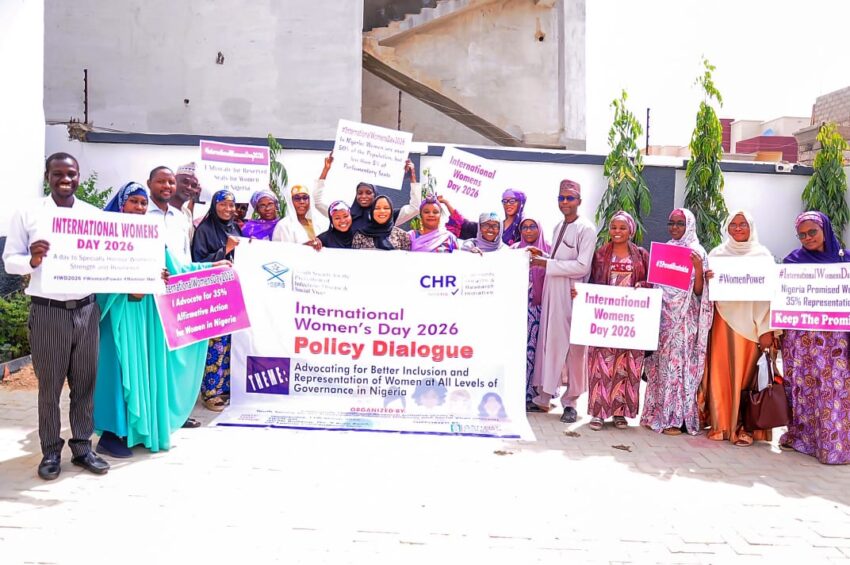
To commemorate International Women’s Day 2026, the Community Health and Research Initiative (CHR) and the Youth Society for the Prevention of Infectious Diseases and Social Vices (YOSPIS) convened a policy dialogue in Kano State, Nigeria.
This was contained in a statement that was jointly signed and issued to newsmen today by Nafisa Shehu Ibrahim of (CHR) and Zainab Nasir Ahmad of (YOSPIS).
The event, supported by the Aminu Magashi Garba Foundation, focused on the timely theme: “Advocating for Better Inclusion and Representation of Women at All Levels of Governance in Nigeria.”
The dialogue opened with an evidence-based presentation by Nafisa Shehu Ibrahim, Executive Administrator of CHR, who highlighted the persistent gender imbalance within Nigeria’s political and leadership landscape.

She noted that although women make up nearly half of the country’s population, this demographic reality is not reflected in positions of leadership. Since Nigeria’s return to democracy in 1999, no woman has been elected President, Vice President, or Governor of any state. Current data also shows that women occupy only 4.5 percent of seats in the 10th National Assembly, far below the global average of 27 percent and the Sub-Saharan African average of 26 percent.
Expanding on these findings, her presentation examined the continued decline in women’s representation across different levels of government. Within the executive arm, ministerial appointments currently stand at 15.6 percent, which is significantly below the 35 percent target set by Nigeria’s National Gender Policy.
At the state level, women hold only 5.5 percent of seats in State Houses of Assembly, while 13 states currently have no female legislators at all. A similar pattern exists at the local government level, where women secured only 23 out of 618 Chairperson positions during the 2024 local government elections.
Nafisa emphasized that these figures do not reflect the true capacity and potential of Nigerian women.
She noted that women are not merely meant to fill quotas but are capable leaders who bring transformation to institutions. To buttress this, she referenced prominent women in public service such as Ngozi Okonjo-Iweala, Amina J. Mohammed, and the late Dora Akunyili.
In the private sector, she highlighted the achievements of leaders including Adaora Umeoji of Zenith Bank, Owen Omogiafo of Transcorp Group, and Yemisi Edun of FCMB, alongside respected figures such as Folorunsho Alakija and Ibukun Awosika.
Building on the evidence presented, Zainab Nasir Ahmad, Executive Director of YOSPIS, delivered a strong Call to Action. She emphasized that International Women’s Day should inspire concrete steps toward improving opportunities for women.
She noted that although the 35 percent affirmative action target has been part of Nigeria’s National Gender Policy since 2006, progress toward achieving it has been extremely slow and deeply disappointing, with women still significantly underrepresented in leadership nearly two decades later.
She therefore called for stronger policy commitment and deliberate implementation of the 35 percent benchmark across government institutions. According to her, achieving this target requires clear policy reforms, accountability mechanisms, and sustained advocacy to ensure that gender inclusion becomes a measurable national priority rather than a long-standing promise that remains unfulfilled.
Nafisa Shehu Ibrahim and Zainab Nasir Ahmad, both leading prominent non-governmental organizations in Nigeria, emphasized that the time for conversations alone has passed.

They reaffirmed their commitment to strengthening advocacy efforts in collaboration with other organizations and stakeholders until the 35 percent affirmative action target becomes a reality.
The event later transitioned into an engaging panel discussion where panelists examined the key barriers limiting women’s inclusion in governance.
They identified several challenges while also proposing practical recommendations aimed at strengthening women’s participation in leadership.
Participants in attendance actively contributed their perspectives and suggestions alongside the panelists, enriching the conversation. By the end of the session, these collective inputs helped shape a set of practical and actionable steps aimed at strengthening advocacy and advancing the push for greater representation of women in governance.
The event drew a diverse group of participants, including representatives from the Kano State Ministry of Women Affairs, Children, and Persons with Special Needs, members of media unions such as the Nigeria Union of Journalists (NUJ) and the Nigeria Association of Women Journalists (NAWOJ), private media houses, and an extensive network of NGOs and civil society organizations.
Male leaders of these organizations present also actively participated, showing strong support for advancing women’s inclusion and representation in governance.
The dialogue concluded with a powerful and unified message: a government that represents only half of its population cannot fully meet the needs, priorities, and aspirations of the nation.