

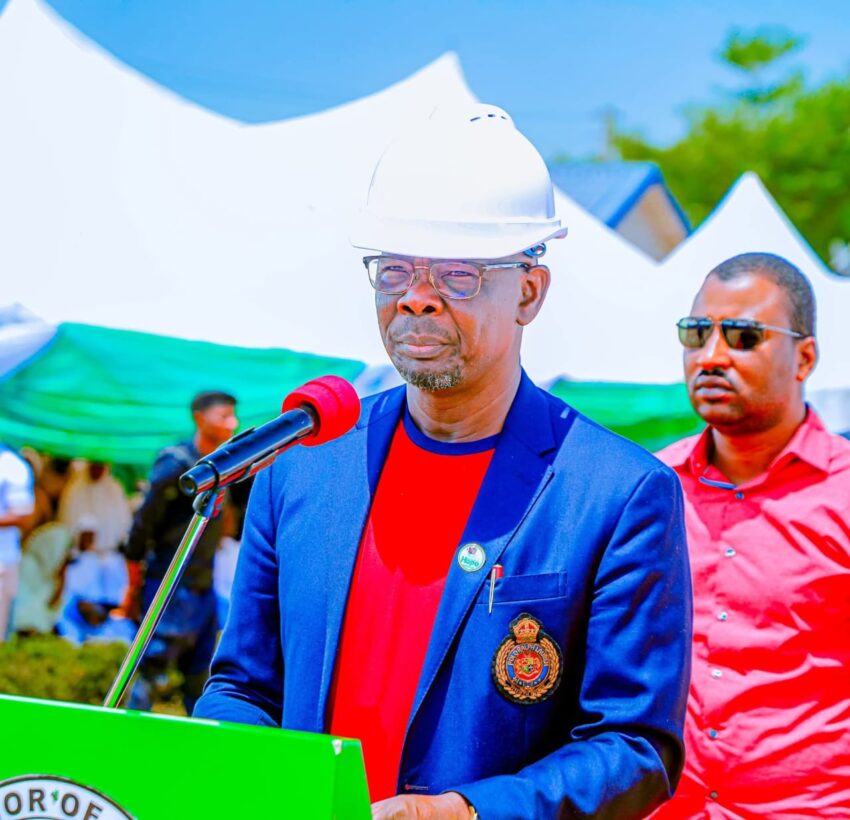
2027: As We Await Governor Sule To Show Us The Way
By Ali Abare
The dust has barely settled on the All Progressives Congress state congress in Nasarawa State, yet the political temperature is already rising. For those who have watched Governor Abdullahi Sule closely over the past six to seven years, the manner in which he managed the build-up to the congress came as no surprise.
It was measured, deliberate and guided by the kind of steady hand that has come to define his style of leadership.
But as any seasoned political watcher will tell you, the congress was only the beginning. The harder work lies ahead, and the people of Nasarawa State are watching.
To understand what Governor Sule has done, one must go back a little. When he came into office, Nasarawa State was not exactly a model of political harmony. Like many states across the country, it carried the weight of internal party divisions, competing interests and the usual pull-and-push that comes with managing a large political platform.
Yet the governor, drawing from decades of experience running some of the world’s most complex corporate organisations, approached governance and party management the way he once approached boardroom decisions — with patience, data and an eye for the long game.
The APC state congress in Nasarawa did not happen by accident. Behind what many observers saw as a relatively smooth exercise lay weeks, if not months, of quiet consultations, careful management of egos and the kind of behind-the-scenes diplomacy that rarely makes headlines but almost always determines outcomes.
The governor reportedly reached out to various stakeholders across the state’s thirteen local government areas, listening to complaints, smoothing ruffled feathers and ensuring that no group felt entirely left out of the process. This is not a small thing in Nigerian politics, where grievances left unaddressed have a way of growing into full-blown crises.
That the congress came and went without the kind of violence and acrimony that has marred similar exercises in other states speaks to something important about Governor Sule’s political management.
He is not a man who governs by noise. He is not given to the theatrics that many in his position often resort to. His instinct is always to build consensus, to find the middle ground and to bring people along rather than steamroll them into submission. Those who have worked with him in both the private and public sectors will tell you that this quality was always there, long before he entered the Government House in Lafia.
Now, however, the real examination begins. With the national convention of the APC on the horizon and primary elections following closely behind, the stage is set for what promises to be one of the most consequential political seasons in the state’s recent history.
And at the heart of it all is a question that citizens, party members and political observers are asking openly: how will Governor Sule manage the increasingly crowded field of aspirants for the governorship seat?
It is no secret that the number of individuals who have indicated interest in succeeding him is significant. This is, in one sense, a tribute to what the governor has built. When a government performs, when roads are constructed, when schools are rehabilitated, when investors begin to take a second look at a state they once ignored, it naturally raises the value of the office.
People want to be associated with success, and the governorship of Nasarawa State, which was not always seen as a prize worth fighting over, has become exactly that — a prize. The governor’s track record in attracting investment, rebuilding infrastructure and repositioning the state within Nigeria’s political and economic landscape has fundamentally changed the calculation for would-be aspirants.
But therein lies the challenge. A large number of aspirants, each with their own supporters, their own resources and their own ambitions, can either be an asset or a liability depending on how they are managed.
Nigerian political history is littered with examples of parties that collapsed under the weight of their own internal contradictions in the season before an election. Primaries have been known to produce more casualties than the general elections that follow them.
The bitterness that comes from feeling cheated in a primary has cost many a party dearly on election day, when aggrieved members either stay home or, worse, work quietly for the opposition.
Fortunately, Governor Sule knows this. More importantly, he has the tools to manage it. His experience running global conglomerates, where managing competing interests among shareholders, boards of directors and management teams was a daily reality, has given him a particular kind of skill that most politicians simply do not possess.
He understands that human beings, whether they are corporate executives or political aspirants, respond to being heard. They respond to transparency in process. They respond to the sense that even if they do not get exactly what they want, they were treated fairly and with respect.
The question of who the party will present as its governorship candidate in 2027 is, of course, ultimately Governor Sule’s to navigate as the leader of the APC in the state, simply because the Nigerian political structure places enormous weight on the role of a sitting governor in shaping his party’s direction, and he is no exception to this reality.
But what makes his situation different from many of his peers across the country is the expectation, based on his record, that he will handle this responsibility with a level of maturity and foresight that goes beyond personal interest or narrow political calculation.
The people of Nasarawa State have watched him transform a state that many had given up on. They have seen him sit across the table from foreign investors and speak their language, not just in English but in the language of numbers, plans and timelines.
They have watched him navigate national politics without losing his footing at home. And so when they say they are waiting for him to show the way forward, they are not simply making a polite political statement. They are expressing a genuine belief, built on six to seven years of evidence, that this is a man capable of making the right call even when the right call is difficult.
It is therefore little wonder that he has continiously emphasized that the process itself must be seen to be free and fair — not just by those who emerge victorious, but by those who do not.
Nasarawa State has made real progress in recent years, and that progress is fragile in the way that all political progress is fragile. It can be undone by a botched primary, by a party that goes into an election divided and resentful, by the kind of internal warfare that allows an opposition to walk through the door you have left open.
Governor Sule understands this better than most, and it is why the coming months will be his most important test yet — not as a governor managing roads and hospitals and investment deals, but as a political leader managing ambitions, egos and the very real stakes of 2027.
In the end, what Nasarawa State needs from its governor at this moment is not a miracle. It needs what Governor Sule has always delivered at his best: clear thinking, quiet diplomacy and the courage to make decisions that serve the larger interest even when they are personally costly.
The people are watching. The aspirants are watching. The party is watching. And when the history of this period is written, it will be judged not by how many aspirants came forward, but by how wisely and fairly their ambitions were reconciled in the service of a stronger, more united APC heading into the most consequential election Nasarawa State has faced in years.
Governor Sule has raised the bar. The task now is to clear it.