

By Hannatu Suleiman Abba, Kano
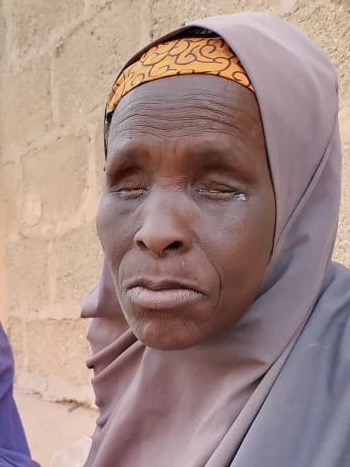
For Giye, life has been defined by pain, survival, and faith. She recalls how she cried day and night, wishing she could leave the world because of her severe health condition.
“I became totally blind at the age of six, and now in my sixties, I have been diagnosed with chronic diabetes and hypertension, which led to paralysis,” she said.
Giye has lived without sight since childhood after contracting measles at the age of six in Danbatta Local Government Area of Kano State.
While helping her parents on the farm, she fell ill. Days later, her younger brother, Muhammadu, also developed similar symptoms. Instead of seeking hospital care, their mother was discouraged by widespread community misconceptions about Western medicine for measles locally known as ‘Kyanda’ in Hausa Language.
“My mother, Inna, was told not to take us to the hospital. People believed it was forbidden,” she said.
As their condition worsened, with high fever, red eyes, coughing and rashes, they were taken to a traditional healer.
“The traditional doctor forced my eyes open and scratched inside with his long fingernails, saying that was the only way to heal my severe eye condition,” she recounted. “That was the day I lost my sight.”
Struggle to Survive on the Streets
In Kano, Giye turned to street begging for survival after marrying a visually impaired husband.
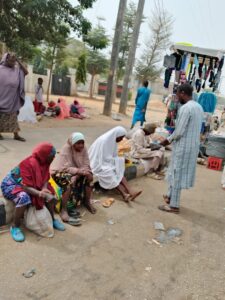
“I recall how we moved around with people who assist us, known as ‘Yan jagora’ in Hausa Language, under the scorching sun and heavy rainfall. We had no break to rest because that was our only means of survival,” she said.
Over time, she gave birth to three children who now assist her.
“We walked long distances daily across Kano metropolis amounting to nearly 10 kilometres every day,” she added.
Her children including Ummi, Musa, and Amina helped her stop at shops to beg, exposing them to stigma and harassment.
“Sometimes, people take advantage of our condition,” she said.
Illness and System Failure
In 2024, Giye collapsed at her usual begging spot and was diagnosed with hypertension and diabetes.
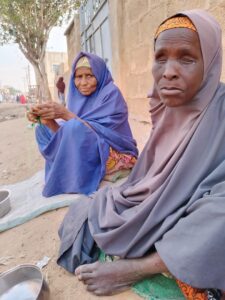
Since then, accessing healthcare even at public hospitals has remained difficult due to financial constraints.
With no consistent government support, her treatment depends largely on irregular family contributions.
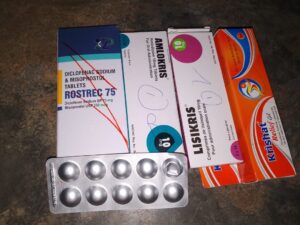
“My son, Musa, who is still a teenager, manages to raise between N10,000 and N15,000 for my monthly medication when possible. If he cannot afford it, it becomes a nightmare,” she said.
At one point, she spent three months without medication and had to sell her only asset, a plot of land to fund treatment.
“We have spent over N700,000 in two years on medication. Much of it also went into traditional remedies due to beliefs that the illness might be spiritual,” she added.
Relief and Government Intervention
Giye recalls a brief period of relief during the administration of Ibrahim Shekarau, when government intervention supported persons with disabilities.
“At that time, we received financial aid, food support, and free healthcare. That was the best time for me,” she said.
“I was even able to save money and buy land, which I have now sold for my medication. We didn’t struggle to eat or fear anything because the government supported us.”
Calls for Inclusive Health Insurance
Human rights activist, Comrade Barr. AA Ayagi, said the implementation of rights for persons with disabilities in Nigeria remains weak.
“It is the responsibility of the government to provide health insurance for people with disabilities. Access to affordable healthcare, social protection systems, and disability inclusion policies are rights not privileges,” he said.
Public health analyst, Dr Musa Abdullahi Sufi, also warned that poor immunisation coverage continues to drive preventable disabilities, especially in rural communities.
“In Nigeria, we have more than two million unimmunised children known as zero-dose children. This is alarming and calls for massive awareness,” he noted.
Giye’s Last Hope for Survival
Now, Giye depends entirely on her vulnerable children.
Every morning, her grandson (Ummi’s son), assists her to a begging spot where she sits for hours.
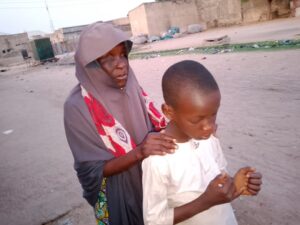
“I no longer have the strength to move from one community to another or walk long distances,” she said.
“The highest amount I get daily now is N500 after spending six hours from 6:00am to 12 noon and yet my health is at risk.”
Health Access for Persons with Disabilities
Recent data by the Joint National Association of Persons with Disabilities (JONAPWD) shows that Kano State has approximately 2.5 million persons with disabilities.
Nationwide, persons with physical disabilities constitute the largest group at about 8.2 million, followed by those with hearing impairment (7.7 million) and visual impairment (7.2 million). Other groups include persons affected by leprosy, albinism, spinal cord injuries, intellectual disabilities, deaf-blindness, and short stature.
Despite policy efforts, access to affordable healthcare remains a major challenge for persons with disabilities in Nigeria.
The National Health Insurance Authority (NHIA) Act of 2022 introduced a mandatory health insurance system aimed at reducing out-of-pocket spending and expanding access to care.
The Basic Health Care Provision Fund (BHCPF) and the Vulnerable Group Fund (VGF) were also established to support disadvantaged populations, including persons with disabilities, by subsidising or fully covering healthcare costs.
Kano Government’s Response
The Executive Secretary of the Kano State Contributory Healthcare Management Agency (KSCHIMA), Dr Rahila Aliyu Mukhtar, said the state has introduced targeted health insurance interventions for persons with disabilities.
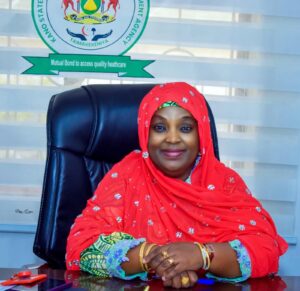
She noted that over 46,000 persons with disabilities have been enrolled under a broader vulnerable group scheme, though not a disability-specific package.
“We look forward to supporting persons with disabilities in the state to achieve universal health coverage,” she said.
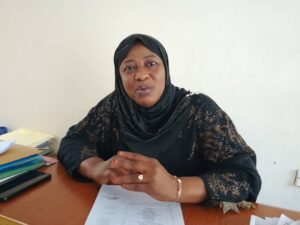
Also, the Kano State Director for Persons with Disabilities, Dr Binta Bala, stated that the government is gradually working to enrol all persons with disabilities into the health insurance scheme for greater inclusivity.
Lingering Challenges
Health accessibility for persons with disabilities in Kano State remains a critical issue, with persistent challenges in policy implementation, advocacy, and sustainable interventions.
This report is supported by HumAngle under the Strengthening Community Journalism and Human Rights Advocacy (SCOJA) Fellowship.