

By Hadiza Musa Yusuf
The Chairperson of the Nigeria Association of Women Journalists (NAWOJ), Lagos Chapter, Jumoke Falayi, has urged journalists to prioritise child protection in every report involving children.
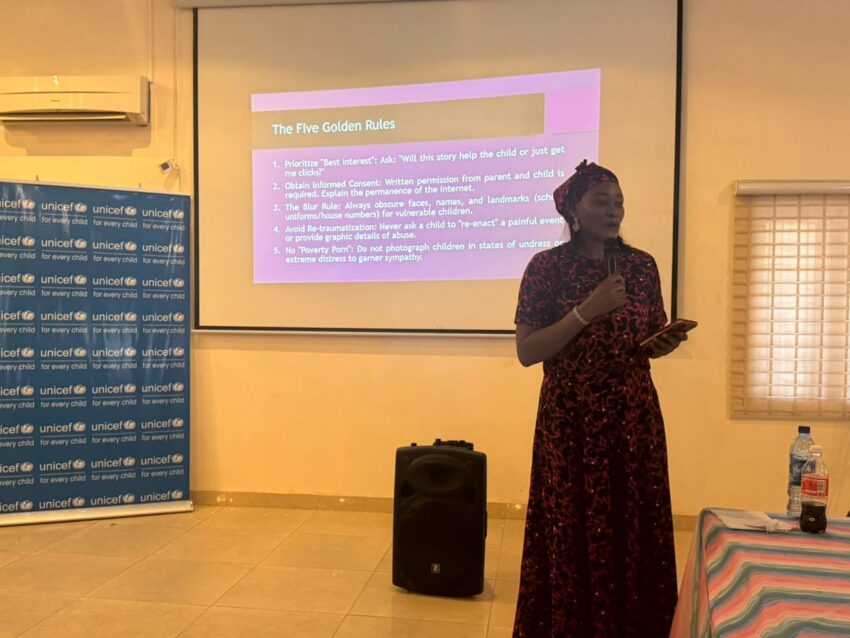
Falayi made the call during a two-day training on ethical reporting of children organised by Radio Kano in collaboration with UNICEF in Jigawa.
Speaking at the training, she stressed that reporting on children goes beyond routine journalism and must be handled with care to protect their dignity and future.
“The ultimate goal is to protect the dignity of the child and preserve the child,” she said.
“Yes, it is journalism we are practising, but in essence, what we are doing is safeguarding the future.”
She explained that every report involving a child should not only address the immediate situation but also help prevent future abuse.
“Every child-related case is not just restricted to that one child. It is a report that must go into the future to prevent a reoccurrence of that issue and protect other children,” she added.
Falayi also noted that journalists have a responsibility to ensure their reports do not harm children in the process of seeking justice.
“We must ensure that we do not re-traumatise a child or damage any child while trying to get justice,” she said.
While assessing the state of child protection reporting in Nigeria, she said there is still room for improvement, especially in applying existing laws.
“I would not say we are where we are supposed to be, considering the Child Rights Act. But it is an easy path if we get ourselves acquainted with the law and apply its principles to our reportage,” she noted.
According to her, reporting on children requires more sensitivity than regular journalism practices.
“When we are reporting on a child, it ceases to be just journalism. It is not a beat for everyone, and it cannot be handled the regular way,” she said.
Falayi called on participants at the training to take their responsibility seriously and ensure that every story involving children contributes to their protection and well-being.
Also speaking, Dr. Jide Johnson, called on governments at all levels to move beyond the domestication of the Child Rights Act and ensure its full implementation across the country.
He said while many states have adopted the Child Rights Act, more effort is needed to make its provisions work in practice.
“Almost all the states have, in one way or the other, domesticated the 2003 Child Rights Act, but there is the need for us to do more,” he said.
“Beyond domestication, we want full implementation of the provisions of this Act.”
He stressed that issues affecting children should be treated as a priority because they directly impact the nation’s future.
“Whatever affects the children affects the nation and affects the future of the nation,” he said.
Johnson also urged the government to invest more in key areas of child welfare, especially in ensuring children’s survival rights such as access to healthcare and vaccination.
Earlier, in his welcoming remarks, the UNICEF Chief of Field Office and Nutrition Manager Dr. Karanveer Singh, stressed that ethical reporting is crucial to protecting the future of children, especially in Northern Nigeria where many face difficult conditions.
“The North is passing through tough times and it is at such times that we have to ensure that children grow up in a positive environment and are given opportunities to become healthy and strong citizens,” Singh said.
He urged media practitioners to be sensitive and careful when reporting stories involving children.
“The most important thing is ‘do no harm’. When you are reporting about a child, don’t report anything that will aggravate the trauma,” he said.
According to him, children are vulnerable and can be affected by how they are portrayed in the media.