

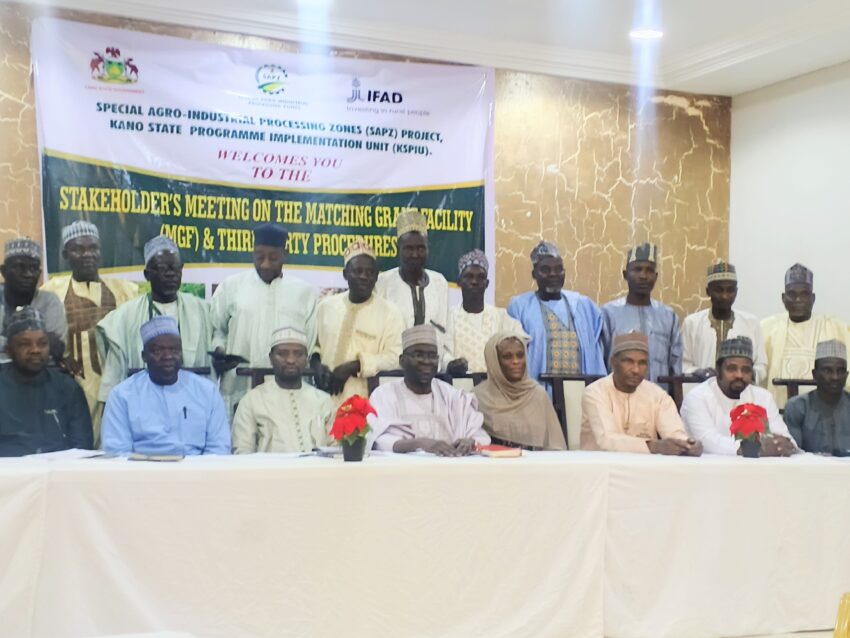
The Special Agro-Industrial Processing Zones (SAPZ) Programme is playing a central role in advancing agricultural transformation in Kano State, with the introduction of a Matching Grant Facility aimed at boosting productivity and strengthening value chains.
Speaking at a stakeholders’ meeting, the Permanent Secretary of the Kano State Ministry of Agriculture and Natural Resources, Alhaji Bashir Sanusi, said the facility is designed to provide targeted support to farmers, cooperatives, and agribusinesses. He noted that the initiative aims to enhance productivity, expand operations, and improve competitiveness across the agricultural value chain.
Sanusi emphasized that transparency and accountability remain central to the programme, highlighting the introduction of a third-party verification policy to ensure efficient implementation and proper utilization of resources. According to him, the mechanism is critical in guaranteeing that support reaches intended beneficiaries, particularly at the grassroots level.
He also commended the administration of Governor Abba Kabir Yusuf for prioritizing agriculture, citing increased investments, provision of subsidized inputs such as fertilizers, and ongoing efforts to transform the sector into a viable commercial enterprise.
The Permanent Secretary further expressed appreciation to development partners, including European institutions, for their collaboration and support toward advancing agricultural initiatives in the state.
In a separate address, the State Programme Coordinator of SAPZ, Aminu A. Iliyasu, described the programme as a strategic initiative of the Federal Government, implemented with support from international partners such as the International Fund for Agricultural Development (IFAD), African Development Bank (AfDB), and Islamic Development Bank (IsDB).
He explained that the SAPZ Programme aims to unlock Nigeria’s agricultural potential by developing agro-industrial hubs in high-production areas, strengthening value chains, and boosting both domestic food supply and export capacity.
Iliyasu stated that the Matching Grant Facility is tailored to empower smallholder farmers, agro-processors, traders, and service providers by improving access to inputs, modern technologies, and market opportunities. He added that the programme also promotes climate-resilient practices and value addition across key agricultural sectors.
According to him, the initiative is being implemented in Kano and Ogun States, targeting about 100,000 direct beneficiaries. He noted that 50 percent of beneficiaries are expected to be women, 40 percent youth, while provisions have also been made for persons with disabilities and internally displaced persons.
He reiterated that strict procedures have been established for grant application, selection, and disbursement, including the use of dual receipt systems and independent third-party verification processes to ensure compliance with global best practices.
Iliyasu called on stakeholders to actively participate and contribute to the successful implementation of the programme, expressing confidence that it would enhance productivity, improve farmers’ incomes, strengthen food security, and create stronger market linkages across the agricultural sector.