
One Seat, Two Unspoken Rivalries
By Adamu Aminu
As the delay in producing the Kano State deputy governor persists with no end in sight, a development which observers describe as either the result of power struggles among party stalwarts or a sign of governance incapacitation by the state’s chief executive, a separate political scenario has emerged.
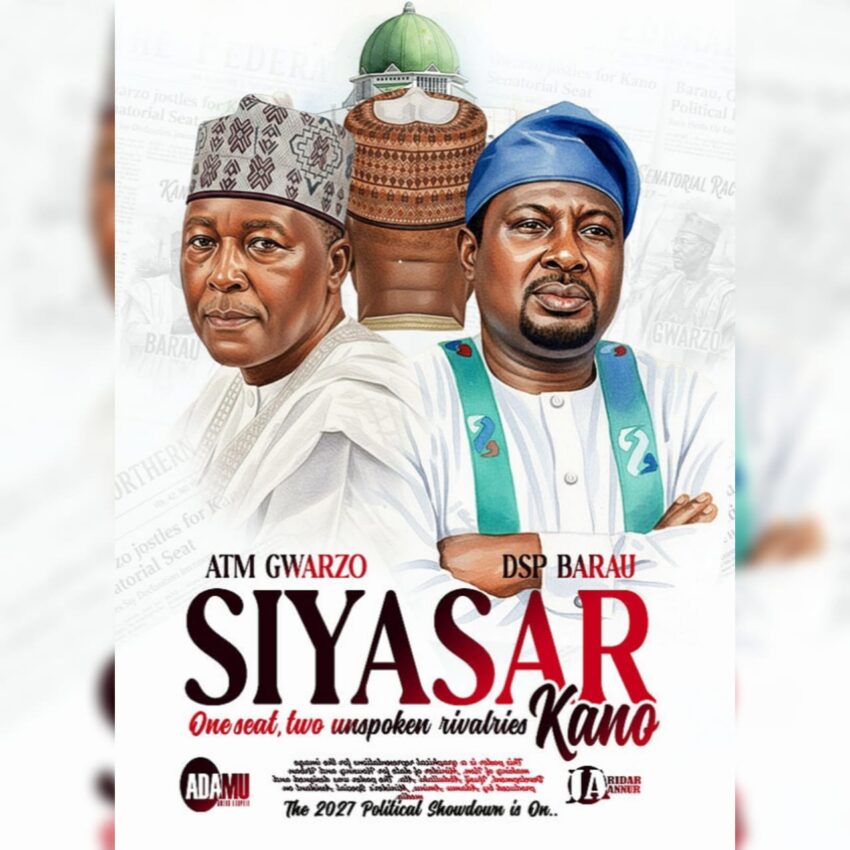
This scenario concerns the Kano North senatorial zone, where unfolding events will keep political pundits assessing likely outcomes in a seemingly unavoidable clash between two unspoken rivals from the same district.
The contest for the Kano North senatorial seat appears to be evolving into a test of political alignment and strategic influence, as two prominent figures — Barau Jibrin and Tijjani Muhammad Gwarzo — navigate what many observers describe as an unspoken rivalry.
Both actors come from the same senatorial zone, a factor that intensifies competition and concentrates political expectations.
While neither side has publicly framed the situation as a direct contest, developments in recent months suggest that underlying dynamics are shaping political calculations.
Some supporters of Gwarzo — widely called him as ATM — claim his short-lived tenure as Minister of State for Housing and Urban Development reflected internal political pressures.
Those claims remain unverified. Neither Gwarzo nor the Deputy Senate President has commented publicly on them.
Political actions, however, are defining the trajectory. Gwarzo’s declaration of interest in the Kano North senatorial seat introduces a measurable electoral dimension to what was previously a quiet, indirect rivalry.
The issue now shifts from speculation to observable political positioning.
Incumbency brings distinct advantages. As Deputy Senate President, Barau Jibrin holds institutional visibility, legislative influence, and established networks that can shape voter perception and political organisation.
Yet electoral outcomes rarely depend on incumbency alone. They reflect a broader interaction of grassroots mobilisation, party structure, voter sentiment, and a candidate’s ability to consolidate alliances across competing interests.
The situation reflects a wider pattern in Nigerian politics, where intra-party dynamics often shape electoral outcomes as much as formal campaigns.
When rivalry remains unspoken, it manifests through strategic actions — alliances, endorsements, calculated declarations — rather than open confrontation. This approach can preserve relationships while advancing individual ambitions.
The absence of explicit confrontation serves multiple purposes. It reduces the risk of party fragmentation and allows each actor to maintain a posture of restraint. But restraint does not eliminate competition; it reframes it within a more controlled, less visible structure.
The outcome remains uncertain. Much depends on how each actor – Barau Maliya and ATM Gwarzo builds support within party structures and engages constituents across the senatorial district.
The interplay between institutional influence and grassroots appeal will likely decide the result.
Ultimately, the Kano North senatorial contest extends beyond a routine electoral exercise. It raises a broader question about how silent rivalries influence political direction, decision-making, and representation in Kano State.
Unarguably, this is synonymous with the Hausa adage that asks: Idan Dutse da kwai suka yi karo, me ake zato zai faru? — literally means when stone and egg meet head-on, what outcome should be expected?
Adamu Aminu writes in from Kano