

By Mahamane Mamane
Nearly three years ago, soldiers of the National Council for the Safeguard of the Homeland (CNSP) overthrew Nigerien president Mohamed Bazoum and promised to return control of the country’s underground wealth to the people. Since then, announcements have followed in rapid succession, including the revocation of permits from French and Canadian corporate giants, the creation of state-owned companies, the inauguration of a national gold refinery, and agreements with Moscow.
The sovereignist discourse resonated deeply with a population that had long waited for its resources to finally benefit them. But behind the official fanfare, one insistent question remains: who is really winning in this reshuffling of the deck?
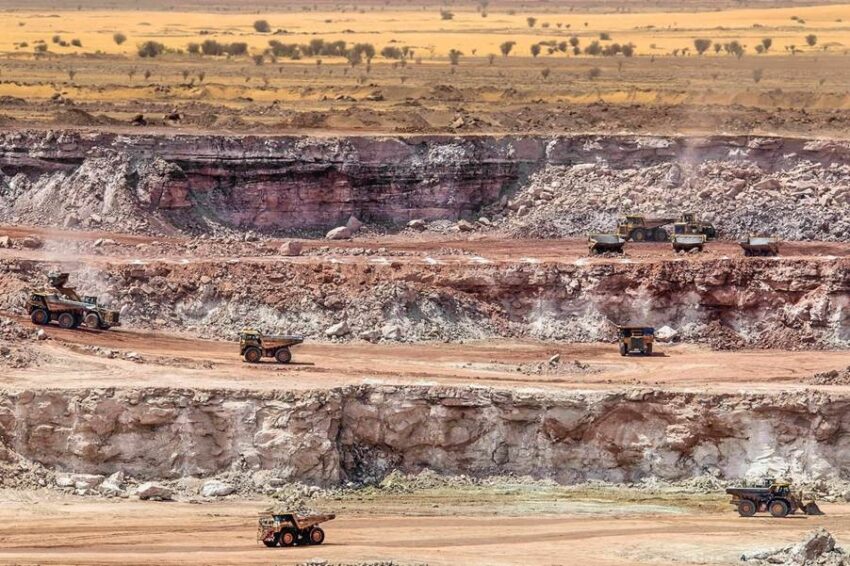
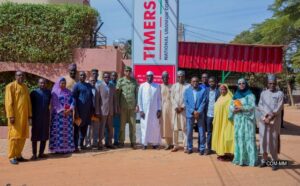
On March 18, 2024, the Nigerien government sent a formal notice to the French corporation Orano (formerly Areva), ordering it to begin exploiting the Imouraren deposit within three months. Estimated at over 200,000 tonnes of uranium, Imouraren is considered one of the world’s largest reserves. When the ultimatum expired, the permit was cancelled in June 2024. A few weeks later, in July, the Canadian company GoviEx had its licence revoked for the Madaouela deposit in northern Niger. In September 2024, the Council of Ministers created two state-owned companies: Timersoi National Uranium Company (TNUC) for uranium, and Mazoumawa for artisanal gold.
On paper, the picture is impressive. In practice, however, the story is more complex.
At the very moment Niamey was publicly breaking with Western partners, another door was opening toward Moscow. On December 9, 2025, TNUC and Uranium One Group, a subsidiary of Russian state company Rosatom, signed a cooperation memorandum in Niamey covering the exploration and exploitation of new deposits. As early as July 2025, Russia’s Minister of Energy, Sergei Tsivilev, had paid an official visit to Niamey, expressing his desire to “build an entire system of civilian nuclear development” in the country. Niger’s Minister of Mines openly discussed the construction of two 2,000-megawatt reactors in partnership with Rosatom.
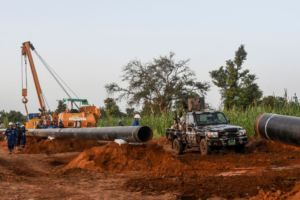
Since the July 2023 coup, Niger has undergone a rapid geopolitical and economic realignment. The junta expelled French troops, distanced itself from the ECOWAS regional bloc after sanctions and border closures, and moved to dismantle longstanding ties with Western mining interests. At the same time, it has deepened cooperation with Russia in both the security and energy sectors, while maintaining strategic oil partnerships, particularly through the Niger-Benin pipeline operated with Chinese backing.
However, the country’s extractive overhaul is producing a stark disconnect between political messaging and lived reality. Interviews with citizens, civil society actors and security observers reveal that while the reclaiming of mining permits and the break with Western companies are widely seen as legitimate, the promised dividends have yet to materialise. Jobs linked to mining have disappeared, revenues appear to be shrinking, insecurity persists, and new partnerships – particularly with Russian actors – remain as opaque as the ones they replaced.
‘Sovereignty does not pay salaries’
Many of the nationals interviewed acknowledge the significance of taking back control of the management of local resources so that they benefit Nigeriens more. But, they are also worried about the continued opacity of deals with foreign companies and say the expected benefits are not yet showing signs of materialising.
“What the CNSP has managed is a spectacular geopolitical recomposition. What it has not managed is to translate it into tangible improvements for Nigeriens,” said Saley Idrissa, an expert in security and public policy, who regularly publishes analyses on Sahelian governance.
“The CNSP exploited a genuine and legitimate sovereignist sentiment. The break with France, the withdrawal of foreign troops, and the denunciation of unbalanced contracts; all of these corresponded to real aspirations. But the sovereignist discourse also functioned as a shield against any criticism. Any challenge became ‘anti-patriotic.’ This is a classic drift of regimes that feed on an identitarian rhetoric.”
On extractive reforms, he distinguished symbolic acts from concrete results.
“The nationalisation of SOMAÏR [previously majorly owned by Orano], the withdrawal of Orano’s and GoviEx’s permits, these are powerfully symbolic acts of rupture. But the uranium remains in the ground. The new structures do not yet have the operational capacity to exploit these deposits. In the meantime, revenues are falling, and it is the Nigeriens who foot the bill.”
He noted the central contradiction of the model: “You expel the Westerners in the name of sovereignty, and you invite Rosatom under conditions whose terms Niger neither controls nor makes transparent. If Nigeriens could read the text of the memorandum signed in December 2025, they could judge for themselves. But they cannot. That is where sovereignty stops.”
Hassane Oumarou, a resident in Agadez, said that in his locality, “you can feel something moving in the mines. But we don’t know which way it’s going for us.” Hassane, 42, runs a small building materials shop in Agadez, a few dozen kilometres from the uranium zones of Arlit. He is perhaps better placed than anyone in this report to measure the concrete effects of mining policy at the local level.
“Before, it was Areva, then Orano. People in the neighbourhood worked there. Since the withdrawal, many have lost their jobs or their subcontracting work. They talk to us about Timersoi and national sovereignty. But Timersoi, for now, is an office building in Niamey and an agreement signed with Russians nobody has ever seen,” Hassane said. He does not express outright hostility toward the junta. He even says he understands the resentment against France. But he distinguishes between politics and everyday life.
“Sovereignty doesn’t replace a salary at the end of the month,” he remarked.
Abdoulaye Cissé, a trader who has run a shop at Niamey’s Grand Marché for fifteen years, also offered a comment that captures the gap between geopolitical discourse and people’s daily experiences.
“Sovereignty can’t be eaten. My business has suffered since the coup. The sanctions, the border closures, the rising prices,” he said. “In 2023, I believed in change like everyone else. But the ECOWAS sanctions, even after they were lifted, broke our supply chains. The closure of the Benin border made conditions harder for everyone. Food prices went up. And the oil revenues, I don’t see them arriving in my neighbourhood.”
For him, the debate about uranium and Rosatom has little concrete meaning. “What matters to me is: is Niger emerging from this crisis stronger? Are people eating better? For now, the answer in my market is no!” He is cautious when politics comes up because “it’s dangerous to talk”. He, however, makes it clear that his mistrust extends to all actors: “Neither the old ones nor the new ones have proven they govern for us.”
What about insecurity?
Saminou Maïkarfi Abdoul Razak, a 34-year-old teacher, said, “I trusted them at first. But today, when I see the price of rice and hear nothing about the oil billions, I start asking questions.” Saminou lives in a peripheral neighbourhood of Niamey. He remembers the enthusiasm of July 2023 as something self-evident: “Everyone was in the streets, everyone believed in it.” Three years later, he watches official announcements with growing caution.
For him, the recovery of mining permits is “legitimate in principle.” What he questions is what comes next. “They tell us Timersoi will exploit uranium for the benefit of Nigeriens. But who controls Timersoi? Who are its leaders? Where do the revenues go? Nobody answers these questions.”
He heard about an agreement with the Russians “on WhatsApp, not on national television.” He doesn’t know what to make of it, except that the lack of information fuels every rumour. On security, his assessment is unequivocal: “The airport attack shocked me. They’ve been telling us for months that the Russians are helping, that the situation is improving. And then terrorists arrive on motorcycles in the middle of the capital. We were lied to, or we lied to ourselves.”
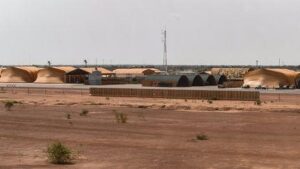
The airbase attack in January has made many people sceptical about the effectiveness of partnerships with Russian forces. An armed commando, claimed on January 30 by the Islamic State, had attacked Niamey’s Base Aérienne 101, the very location where Russian Africa Corps military advisers are stationed and where tonnes of uranium disputed with Orano are stored. Anti-aircraft fire, possibly targeting drones, lit up the sky over the capital. Satellite images reviewed by AFP showed partially burned areas near the runway and damaged rooftops. Two aircraft belonging to the airline ASKY were hit on the ground.
The official response was swift. The Ministry of Defence announced the neutralisation of twenty attackers and the arrest of eleven others, stating that the situation was “under control.” CNSP President General Abdourahamane Tiani visited the site in person. Popular rallies in support of the CNSP were organised in Niamey and Tahoua. And the junta’s “Russian partners” publicly named the presidents of France, Benin and Côte d’Ivoire as “sponsors” of the attack, accusations firmly rejected by Abidjan and Cotonou.
But the attack itself, the first to strike the capital since the coup, reveals a reality that the triumphalist discourse could barely conceal: two and a half to three years after the seizure of power, and despite the presence of the Africa Corps, terrorism has now struck at the heart of Niamey.
Souleymane Mahaman, a retired member of the Defence and Security Forces who served in the army for 22 years, believes that the airbase attack is a monumental failure on the part of the authorities and shows how the security threats are adapting.
“The Russians bring a capability, but they don’t bring an understanding of the local terrain,” he observed. “Attacks in Tillabéry, Tahoua, and Agadez continue. And now they’re reaching Niamey. The official discourse cannot hold much longer in the face of this reality.”
Sani Harouna, a 38-year-old farmer in the Tillabéry region, where jihadist attacks are most frequent and deadly, said his priority is not the competition over mineral resources, but security and the daily fear “of not making it home in the evening”.
He spoke with the restraint of someone afraid of being overheard. “We hear about the Russians, the uranium agreements. Here, what we see is that our villages are still being attacked. People are fleeing, women are widows, children have no father, education and health. Don’t even get me started. Sovereignty over uranium doesn’t protect me when I go to my fields.” He says what is being done is not enough, and that nobody has asked for his opinion. “Not the soldiers, not the state television journalists, nobody. We are numbers in a press release.” On oil and mining revenues, he is laconic: “Have you seen a new road in Tillabéry? A clinic? I haven’t.”
The unfindable accounts
Since the coup, the weakness of mining revenues in Niger contrasts sharply with much higher oil revenues, raising a fundamental question about resource governance, while criticism of opacity, corruption, and the weakening of budget oversight mechanisms is growing.
In 2024, official figures show 6.1 billion CFA francs in mining revenues for the combined gold and uranium sector, compared with 204 billion generated by the oil sector alone, driven by the Niger-Benin pipeline. The gap is staggering and raises legitimate questions about the true traceability of mining financial flows.
Transparency International Niger (ANLC-TI), in its 2024-2025 report, delivers a damning verdict: “institutionalised corruption, opaque management of extractive resources, public contracts awarded to shell companies.” The report notably flags Ordinance 2024-05, adopted in February 2024, which exempts military expenditure from any accounting oversight, opening the door, according to the organisation, to large-scale corruption.
The Extractive Industries Transparency Initiative (EITI) has placed Niger under enhanced monitoring since the coup. In May 2024, the validation process started under the previous regime was officially closed and declared void. A targeted assessment conducted in early 2025 concluded that Niger only “partially” met the requirements for multi-stakeholder governance and contract transparency.
As for the Commission de Lutte contre la Délinquance Économique et Financière (COLDEF), created in September 2023 to track the misappropriation of public funds, it has to date published no public activity report. This silence speaks volumes.
‘What’s missing is transparency’
Nouhou Garba Ali, a civil society actor, believes that the “sovereignist discourse has served to neutralise any criticism, as questioning the junta on mining contracts now means risking being labelled a foreign agent.” Nouhou Garba Ali coordinates an advocacy organisation on natural resource governance in Niamey. He speaks with caution; several of his colleagues have been arrested or forced into self-censorship in recent months. For him, the reality of extractive reforms is one of organised opacity.
“The permits were withdrawn from Orano and GoviEx. A sovereign act, fine! But the new conditions for awarding them, the partnerships signed with Uranium One-Rosatom, and the exact terms of the December 2025 memorandum, none of this is public. We have replaced one opacity with another.”
Nouhou highlights the COLDEF’s silence as a symptom of a deliberately closed system: “An anti-corruption commission that publishes nothing for two and a half years is a commission designed to reassure, not to control. And the EITI itself, with all its diplomatic caution, acknowledged that Niger only ‘partially’ meets its obligations.” On the civic space, his diagnosis is bleak: “The 2019 cybercrime law, strengthened in 2024, now applies to anyone who criticises resource management on social media. NGOs working on these issues face constant pressure. We live in a country where asking questions has become subversive.’’
Daouda Idrissa, another civil society actor in Niamey, observed that while there have been genuine disruptions and positive developments, “what is missing is transparency about what comes next.”
“I do not deny that some concessions were unbalanced in favour of foreign multinationals. Renegotiation was legitimate and necessary. What I criticise is that the new regime reproduces the same opaque behaviour it condemned. We have no access to the new contracts. We do not know what Rosatom is genuinely bringing, nor what Niger is ceding in return,” he explained.
On Ordinance 2024-34, which imposes new local content requirements in the oil sector, Daouda is sceptical: “On paper, it is an advance. In practice, the expulsion of Chinese CNPC (China National Petroleum Corporation) executives in March 2025 mainly served to settle a power conflict, not to guarantee lasting jobs for Nigeriens. And nobody outside can verify whether these obligations are being respected.”
What concerns Daouda most is the aftermath. “In ten years, if Niger has traded a French dependence for a Russian one, and in between the COLDEF has still published nothing, we will have squandered the historic opportunity this coup represented.”
Behind the announcements and controversies, a few certainties stand out, and as many enigmas remain.
Niger’s uranium, which accounted for rough 6% of global production in 2023, is today in dispute, in arbitration, and in opaque transit between several powers, each seeking its share. The 1,000 tonnes of yellowcake stored at Base 101, Orano’s arbitration proceedings, and the Timersoi-Uranium One memorandum are all signals of a destabilised sector whose long-term effects no one has yet measured.
On the oil front, the 204 billion CFA francs in 2024 revenues represent a genuine lifeline for a state suffocated by sanctions and the rupture with its traditional partners. But as the EITI’s 2025 targeted assessment notes, public debt is approaching 50% of GDP, the 400 million dollars in opaque loans extended by CNPC constitute a heavy mortgage, and more than 14 million Nigeriens, 52% of the population, have been living below the extreme poverty line since the coup.
The question running through all the testimonies gathered here is not whether Niger had the right to take back control of its resources. That legitimacy is not seriously contested by anyone. The question is: who has concretely benefited from this takeover? And for now, answers are sorely lacking, not for want of data, but for want of any will to make it public.
This article was produced with support from the African Academy for Open Source Investigations (AAOSI) and the African Digital Democracy Observatory (ADDO) as part of an initiative by Code for Africa (CfA). Visit https://disinfo.africa/ for more information.