

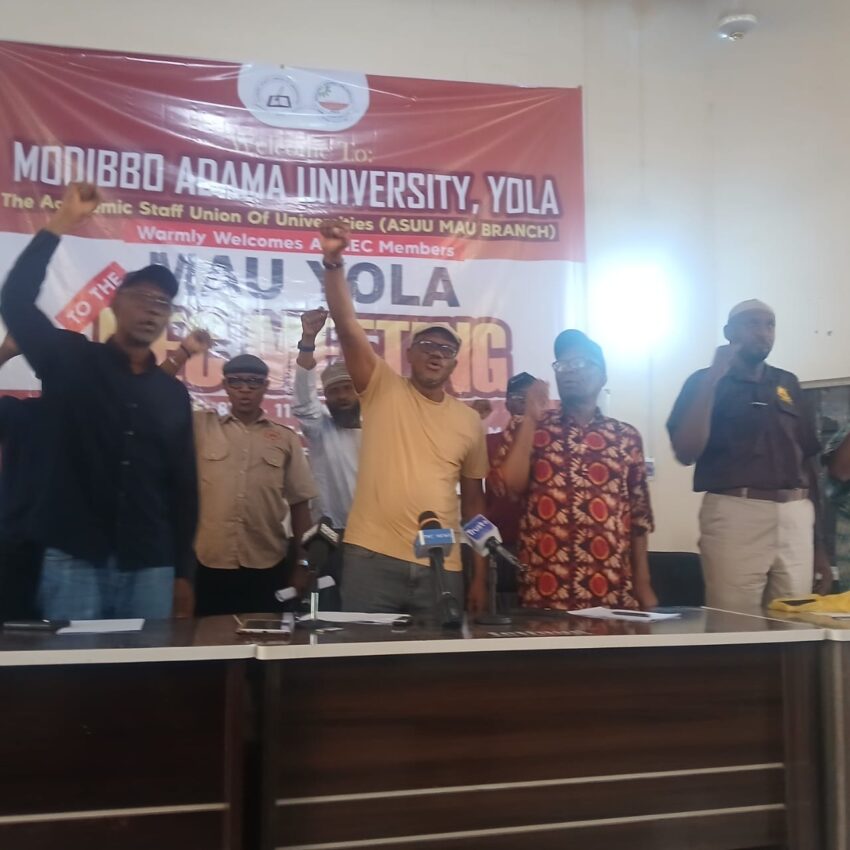
From Umar Dankano, Yola
The Academic Staff Union of Universities (ASUU) has accused the federal and state governments of failing to fully implement the December 2025 FGN-ASUU agreement.
President of the union, Christopher Piwuna, made the union’s position known during a press conference held after the National Executive Council (NEC) meeting at Modibbo Adama University on Monday.
He lamented that many issues captured in the agreement remain unresolved.
Professor Piwuna listed the outstanding issues to include arrears of the 25–35 percent salary award, promotion arrears, remittances of third-party deductions such as check-off dues, cooperative society deductions and pension contributions, salary shortfalls arising from the Integrated Personnel and Payroll Information System (IPPIS), as well as the withheld three-and-half months salaries resulting from the union’s 2022 industrial action.
He decried that the federal and state governments owe ASUU members over N5.2 billion in outstanding arrears, warning that the government’s nonchalant attitude could trigger another industrial action if the pending issues are not addressed as agreed.
ASUU noted that despite repeated engagements with government authorities, little progress has been made in resolving the concerns, describing the situation as a serious threat to industrial harmony within the nation’s university system.
“The increasing frustration occasioned by the seeming government’s disinterest in the welfare of Nigerian academics is brewing pent-up anger which could erupt into a new wave of industrial unrest if not addressed,” the ASUU president said.
The union also expressed displeasure over recent policy pronouncements in the education sector, particularly the Minister’s reversal of the mother-tongue policy in favour of the English language as the medium of instruction in early childhood education.
ASUU described the move as retrogressive and a setback to previous gains rooted in research findings.
The union argued that many technologically and industrially advanced countries such as China, Russia, Japan and South Korea use indigenous languages for teaching during the early years of schooling.
Professor Piwuna appealed to stakeholders in the education sector and well-meaning Nigerians to prevail on governments to fully implement agreements reached with ASUU and resolve all outstanding issues in the interest of students, parents and the nation.
“Our union’s doors remain open for working with governments to realise all our demands. At the same time, NEC directs that an emergency meeting of NEC be convened in the coming weeks to review the situation and take appropriate action as may be necessary,” he stated.
ASUU’s warning comes amid growing concerns over the state of Nigeria’s education sector, with experts urging the government to address the issues before the situation deteriorates further.