

By Zulaiha Danjuma
Ms Aisha Umar thought it was just a fever. For three days her 5-year-old daughter burned with heat and broke out in rashes.
By the time they got to the Ja’in Primary Health Care Center, the diagnosis was clear: Measles.
But unlike many children in the region, Aisha’s daughter walked out three weeks later. The reason, the nurse told her, was a small card in her bag. A child health card stamped 9 months earlier.
“That was why when she came down with Measles it was not severe,” Aisha said. “Immediately after her medication for 3 days she was free from Measles. Her rash wasn’t that messy, it was mild because she had been immunized.”
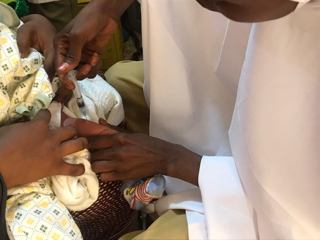
It is Tuesday morning around 8:30 am at the Kabuga Primary Healthcare Center. In less than an hour the waiting area is packed.
Most notable is the crowd of nursing mothers and their babies sitting on benches inside the facility. Four female healthcare providers take their seats in front of the crowd.
At 12:15 PM the scene is not different at the Ja’in Primary Health Care Center. It is immunization day.
Kano Focus reports 150 to 200 children and mothers visit the Ja’in Primary Health Care Center daily for immunization.
Vaccination is administered five days a week, from Monday through Friday at the Ja’in PHC.

According to the In-charge at the Ja’in primary health care center, Ahmed Adamu Diso, the center saw the need to increase the number of days they attended to infants and toddlers because of the crowd.
“Before vaccination was done three times a week now it’s been upscaled to 5 times to cater to the demand,” he said.
“The constant awareness raising and enlightenment of parents, especially mothers is the reason for the daily influx of patients we see for immunization,” Mr Adamu said.
Babies from birth to about age two are meant to receive several routine immunizations against vaccine preventable disease. Among these diseases is Measles.
What is Measles?

Photo caption: Image of boy with Measles
According to the World Health Organization, Measles is a highly contagious disease caused by a virus. The virus spreads through direct contact or through the air. It is solely a human virus, which is not found in animals.
Measles immunization is given at 9 months. Recently a second dose was introduced at 15 months. Health workers say this has proven to protect and prevent children from coming down with measles.
The stakes are high. Nigeria is ranked among the top 10 countries with Global Measles Outbreak according to the United States Center for Disease Control, CDC.
In a situation report by the Nigerian Center for Disease Control, NCDC, as of January 2022, Kano state had 9 suspected cases, with no laboratory confirmed case.
But neighboring states were seeing more. Jigawa had 94 suspected cases and 19 confirmed cases. Katsina, Kaduna, and Sokoto had 88, 18, and 34 suspected cases and 6, zero, and 6 confirmed cases respectively.
Kano is one of the most populous states in the country with an annual growth rate of more than 3%.
The Importance of Immunization in Decreasing Cases of Measles
According to the second in charge of the Outpatient department, OPD, Ubaidu Alhassan Yahaya at the Ja’in Primary Health Care center, cases of measles are still brought to the facility.
“I can tell you that the cases of measles are brought in here from time to time,” he said.
“Measles cases are some of the likely epidemic cases we get at this facility,” he said.
However, Mr Adamu said the cases are not as frequent or severe as a few years ago.
“Due to the level of public awareness people now take immunization more seriously now unlike years ago,” he said.
“The cases we see now are not as much as before and they are less severe in terms of the degree of the disease due to the fact that the children may have gotten some level of vaccination prior to getting the Measles disease,” he said.
The Ward Technical officer and In charge of the Kabuga primary health care center, Yusuf Adamu Muhammad, said prevention starts with showing up.
“This is part of the reasons why in the health talk session health workers have with expectant mothers the importance of immunization is emphasized,” he said.
“Being fully immunized as a child plays a major role in fighting most of these epidemic diseases,” he said.
Mr Yusuf added that the Kabuga primary health care center personnel engage in home visits as part of its awareness efforts on various vaccine-preventable diseases like Measles.
“The community is constantly sensitized to take the children for their doses of vaccines at the appropriate time, to get that full immunization status,” he said.
“Even the adults in the community are encouraged to get vaccinated whenever a vaccine-preventable disease has been recorded and people are advised to get the vaccine,” he said.
Mr Yusuf explained to Kano Focus that as part of the PHC’s preparedness strategies, they anticipate certain diseases that are prone in certain weather conditions and raise awareness about them.
“When it is cold, heat or raining we go into communities to enlighten the community of best practices to adopt or things to avoid in order to keep safe,” he said.
On her part, a disease surveillance officer, Zainab Aminu Graba at the Ja’in Primary Health Care Center said the center had recorded only 1 case of measles from the beginning of May.
“The case was recorded on the 10th of May,” she said.
According to Ms Zainab, measles cases during the hot weather are not high.
“We get more measles cases during cold weather. The case that we got last week was not a severe case, the girl received medical attention and was sent home,” she said.
Ms Zainab added that with every disease like measles the PHC follows strict documentation. They take down the child’s details, the parents home address, contact numbers and other personal data for reference and monitoring through the Center’s focal person, who acts as the center’s epidemiologist.
“When a case of measles or any other possible epidemic case is brought we have a register where we take down details,” she said.
How Immunization Helped My Daughter Fight Measles
Aisha Umar paid nothing for the shots that saved her daughter.
“When I gave birth to her, she was given a vaccine shortly after her birth at no cost,” she said.
“All other times we came to the PHC for the doses of her immunization shots I paid no money at all,” she said.
Aisha’s advice to other mothers is simple: “Come for your baby’s immunization. The process costs nothing.”
Reduction of Measles Cases in Kano
Compared to states like Jigawa, Zamfara, Kaduna and Sokoto, Kano state has seen a decrease in measles cases going by reports from the NCDC.
In 2019, the Epidemiological summary of suspected Measles cases from week 1 to week 52 showed Kano state having a total of 4,141 suspected Measles cases. In that same period Kano recorded 27 deaths.
By 2021, an NCDC situation report from January through August showed Kano state having 121 confirmed cases of measles. 60.3% of those confirmed cases were in children between the ages of 9 to 59 months.
By 2022, Kano seemed to have recorded fewer cases, both suspected and confirmed, in comparison to its neighbors Katsina and Jigawa.
Health workers at both PHCs link the reduction to rapid education and awareness around the importance of immunization for expectant mothers.

Photo caption: A copy of child health card for Vaccination
Immunization is Totally Free and Safe
Mr Yusuf said it is necessary for people to understand that immunization at Primary Healthcare Centers are absolutely free and of high quality.
“Prevention is always better than care. People need to understand that immunization is free at PHCs,” he said.
“Some people have a misperception of the quality of the drugs at primary health care centers, but I would like to enlighten people that all vaccines in private hospitals are distributed from Primary health centers,” he said.
Mr Yusuf said door-to-door immunization campaigns cost nothing to parents because health workers go straight into homes.
“Even coming to the primary health care center for immunization is free. Nobody is asked to pay anything unlike private clinics,” Mr Yusuf said.
He also called on community members to discard rumors about the unsafe nature of vaccines.
He noted that before any vaccine is approved for distribution it passes through a series of tests both globally and nationally to ascertain the safe nature of the vaccine.
Myths Hinder Immunization Exercise in Some Rural Communities
According to the Kano state Epidemiologist Dr. Abdullahi Isah-Kauran Mata, measles disease is a vaccine-preventable condition and is one of the routine immunizations that can be accessed across all health facilities in the state.

Caption: A vaccination cooler
However, he noted that despite the fact that Kano has 1,300 hospitals, ranging from primary health centers across the 484 political wards up to the level of teaching hospitals, there are still traditional beliefs that make people hesitate.
“Vaccine hesitancy is a global issue. Even in the most developed and educated or civilized people in the world, there are still people against vaccination,” he said.
“We call these people vaccine hesitant communities. In fact, currently there are people campaigning against vaccines in developed countries,” he said.
“Literacy levels are also factors that hinder vaccination, because there are people who still don’t believe in vaccines,” he said.
“The best we can do is to sensitize them and correct their misconceptions and provide the services close to their door steps,” he said.
“It has become everyone’s responsibility including the media to enlighten people to know that vaccines work and they prevent people from diseases and is the best way to take infectious diseases away,” he said.
Dr. Isah called on parents to immunize their children as this will save them time and money as well as ensure their children’s health.