

By Ahmad Tijani Lawal
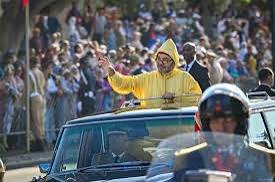
Morocco celebrates the 27th anniversary of the ascension to throne by King Mohammed VI.
It is a festivity that seeks to demonstrate the significant role being played to carry along more than 37 million people of Morocco by the Muhammad IVs empathetic Kingdom.
The socio-economic activities or performances of Morocco over these years have indicated an amazing transformation that has made the country noticeable not only in Africa where it ranks fourth on economic scale, but globally in terms of peace and diversity.
Great reforms have been successfully undertaken in political, economic and social fields and the country has made significant economic progress, with its GDP rising from 41.6 billion dollars in 1999 to 194.3 billion this year.
The impressive economic performance has been translated into a per capita income doubling in the two decades, from $ 1490 to $ 5,107. To attract Direct Foreign Investments, Morocco under King Muhammad vi gives infrastructural development the premium attention needed, resulting in putting in place the largest port in Africa and the Mediterranean Sea. The same earnest drive makes it possible for Morocco to have the first Very Fast Train line in Africa and in the Arab world, as well as the largest solar power plant in the world. These are in addition to an extensive network of highways, tramways and two of the biggest car manufactures in Africa in just a span of only two decades.
Internationally, Morocco is considered to be a reliable and exemplary partner in deploying its disciplined combatants to serve on various peace keeping and security missions across the globe as provided in relevant United Nations charters which it has ratified. King Muhammad’s humanitarian intervention in Gaza is exceptional.
King Muhammad VI has also demonstrated Morocco’s serious commitment to contribute to the development of Africa within the framework of South-South cooperation.
Morocco favours its cooperation policy, the training of managers and skilled workers. Technical assistance and experience sharing in all areas as it is the second most important pillar of the cooperation policy.
In this field more than 1700 cooperation agreements have been signed with more than thirty other African countries. Public and private corporations have also been firmly committed in recent years to this policy towards the rest of Africa. Morocco has become one of the most important African investor in the West Africa region and the 2nd largest African investor in the continent.
This presence involves telecommunications services with the Maroc Telecom mobile operator present in more than fifteen African countries, as well as in financial services with three Moroccan banks being present in more than thirty countries in Africa, as well as in the industrial sectors, and in the construction and public works sectors.
Morocco, the world’s largest exporter of phosphates, contributes to the development of African agriculture and the food security of the continent by providing cheap fertilizers adapted to the needs of farmers and to the nature of soil and crops.
This policy has enabled the Nigerian government to achieve a significant decrease in the price of fertilizer to farmers, and the rehabilitation of a large number of production units (blenders), creation of thousands of jobs and ultimately the improvement of agricultural yields.
Morocco and Nigeria have pledged to build an industrial compound for fertilizer production in Nigeria. Moreover, the construction of the pipeline that will link Nigeria to Morocco is a major flagship project of cooperation between the two countries whose spinoffs aim to benefit the entire region.
This multifaceted and multi-sectoral cooperation also includes the religious dimension. In order to fight Islamist radicalism, which is the ideology on which terrorism feeds, Morocco, which prides itself as a land of tolerance, hosts hundreds of preachers and students of theology at the Mohammed VI Institute for the training of Imams from several countries including Nigeria.
Morocco has also created the Mohammed VI foundation of African Ulamas in order to develop the peaceful and tolerant Islam through Africa.Nigeria and Morocco are two countries linked by multi-century human and cultural ties. When someone visits Sokoto, Kano, Zaria or Borno, one might believe he is in Morocco since there are huge similarities in terms of way of life, music, traditions, traditional architecture and in all aspects of culture. Morocco and Nigeria have the vocation to be strategic partners.
It continues to baffle outsiders how Morocco thrives so hugely despite its almost theocratic government and multiculturalism, especially in terms of internal security and sustainable social welfare.
A close look at its socio-political setup reveals that the system revolves around the leadership’s skill in ensuring that democracy only plays a catalytic role in governance. This approach to leadership trains and deploys erudite Islamic scholars to refute and confute claims of extremism, as well as disseminating the spirit of tolerance and the rejection of immoderation, that way meeting the various religious and cultural needs of citizens.
The Royal Palace full of scholars versed in Islamic and Western education, makes it binding on itself to handle orientation, reorientation and assignation of Imams and preachers, to mosques and other institutions to guide in managing public life according to what is not in contrast with the final rulings stipulated in the authentic Sharia texts, but guaranteeing peace and harmony within the multicultural setting.
In line with this broad policy, the state’s general budget is nine-tenths of that of religious affairs because it meets social needs while the revenues of religious endowment assets is one tenth of this budget.
The seat of the Ministry of Religious Endowments and Islamic Affairs, which manages the field of religious affairs, is in the royal palace, represented by eighty-two delegations in the country’s regions and provinces.
During the last three decades, a number of customs in the field of religious affairs have migrated from their oral customary form to an organized legal form which facilitates recourse to them in preserving the constants and managing religious services.
The foregoing might be due to how the Kingdom draws its strategy in the field of religious freedom and multiculturalism from the dynamism of its longstanding historical experience, its religious tenets calling for moderation and tolerance, and its royal institution which protects religion and interacts with the milieu and with international and UN conventions. Throughout history and across generations, Morocco’s distinctive characteristic has been the mixture of cultures, religions, peoples and races. It has demonstrated its inspiring ability to deal with diverse migrations.
Thus, the kingdom has, through its respect of specificities, provided space for coexistence and human interaction, which consolidates the principles of universality and human rights, giving way to developing altruistic values.
Morocco represents various cultures and human races, while preserving the specificities that enriched its human and non-material wealth.
Its unity, is forged by the convergence of its Arab-Islamist, Berber [Amazighe] and Saharan-Hassanic [saharo-hassanie] components, nourished and enriched by its African, Andalusian, Hebraic and Mediterranean influences [affluents].
The Royal Palace also controls establishment, distribution and maintenance of religious infrastructure.
Through closer and vigorous cultural relations with Morocco, Nigeria being diverse in nature, stands to learn and benefit a lot, about promotion of sustainable peace and harmony, in a multicultural setting. This is in addition to the already exponential beneficial economic relations between the two nations.
The dynamic and exceptional role played by Morocco in culture and sports has demonstrated its leadership position in Africa, showing the international community how far Africa has gone in competing with the rest of the world over global glory.
The achievements made by Morocco’s national soccer team in the Africa cup of Nations (Champions) and World Cup 2026 has proved to everyone that the country enjoys a rare dynamic leadership worthy of commendation.
Morocco’s infrastructural development under King Muhammad VI has demonstrated its great vision.
Statistics are recently showing that Morocco is the most visited country in Africa by tourists.
King Muhammad VI deserves high respect and special salutes.
May Allah continue to guard and guide him and increase in his health and bless him in abundance.
AHMAD TIJJANI LAWAL
+234-(0)8065592676
atijjanilawal@gmail.com