

By Abubakar Surunbai Naziru
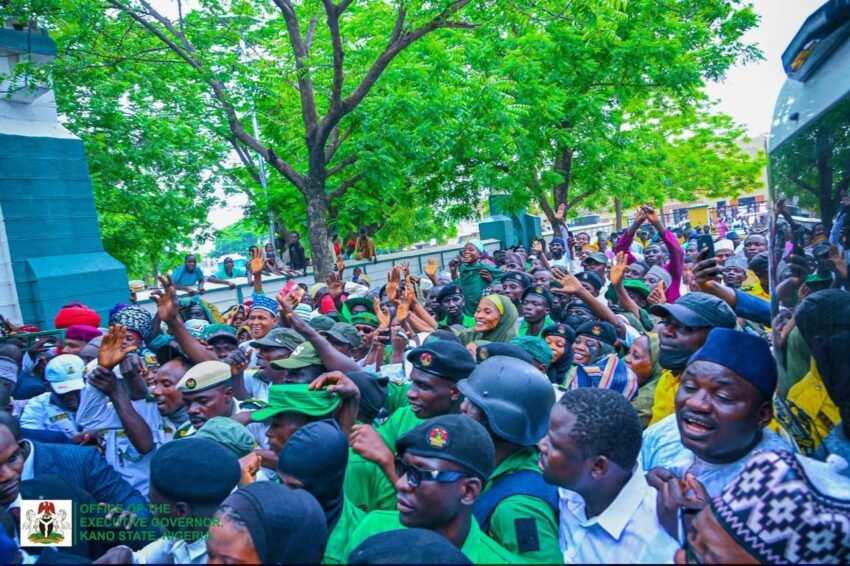
Mass wedding programmes in Kano State are described by some as a social intervention and by others as a misplacement of priorities. The practice is not new to Kano. Similar programmes have been organised in Zamfara and Jigawa. But this latest round has returned to public controversy, particularly because it involves hundreds of divorced couples being brought together in state-sponsored ceremonies.
Some argue that such programmes help protect vulnerable people from immoral relationships and provide an opportunity for couples to rebuild their families. Others, however, ask a more fundamental question: do the couples being married off have the economic means to sustain their households and provide for the children they may eventually raise?
That question becomes even more important when considered against the region’s wider challenges: out-of-school children, street begging, youth unemployment, poverty, and insecurity linked to mass illiteracy.
It is easier for a government to fund a wedding ceremony than to build the vocational training centres, employment pathways and support systems that citizens may need for years.
Recent reports indicate that ₦1.5 billion has been allocated to fund a mass wedding programme for 1,500 couples in Kano State roughly ₦1 million per couple. At the same time, education and health continue to face funding gaps, infrastructure deficits and staffing challenges.
This raises a legitimate policy question: what is the opportunity cost of this expenditure?
Across the region, intellectuals and young people have pointed to the contrast between states and institutions investing in youth through seed funding, skills development, mentorship and entrepreneurship support, and the relatively limited scale of similar interventions in Kano. Others have pushed back, arguing that the beneficiaries of the wedding programme are citizens and voters too, and therefore deserve government support.
That argument is valid. The question, however, is not whether these citizens deserve support. They do.
The question is what form of support gives them the greatest chance of building stable and productive families?
As a direct consequence of weak economic opportunities, the region remains full of graduates without jobs. Others have valuable skills but lack the capital, networks or mentorship required to turn those skills into livelihoods. Many more live in communities where access to training, finance and decent employment opportunities is severely limited.
Government intervention should therefore go beyond addressing the immediate social problem of marriage and begin addressing the economic conditions surrounding it.
This requires regular and transparent public needs assessments not assumptions made in Government House, but direct engagement with the communities these programmes claim to serve. Public spending should be guided by evidence of citizens’ needs and measurable outcomes, rather than by what appears attractive in a budget speech or at a public ceremony.
The mass wedding programme should therefore be scrapped in its current form or fundamentally restructured. If the government chooses to continue it, every participating couple should receive meaningful economic support alongside the ceremony: hands-on vocational training, financial literacy, access to healthcare and family support, and appropriate start-up capital or livelihood assistance.
A wedding without a livelihood attached to it is a ceremony, not a comprehensive social policy.
And whatever version of the programme survives, the budget behind it must be reasonable, transparent and evidence-based-not simply a large number designed for political optics.
Until Kano State learns to measure development by the skills its citizens acquire, the businesses they build, the children they keep in school and the livelihoods they sustain, it risks mistaking celebration for development.
The question is not whether people deserve to get married. They do. The question is whether government has done enough to ensure that they can afford the life that comes after the wedding.