

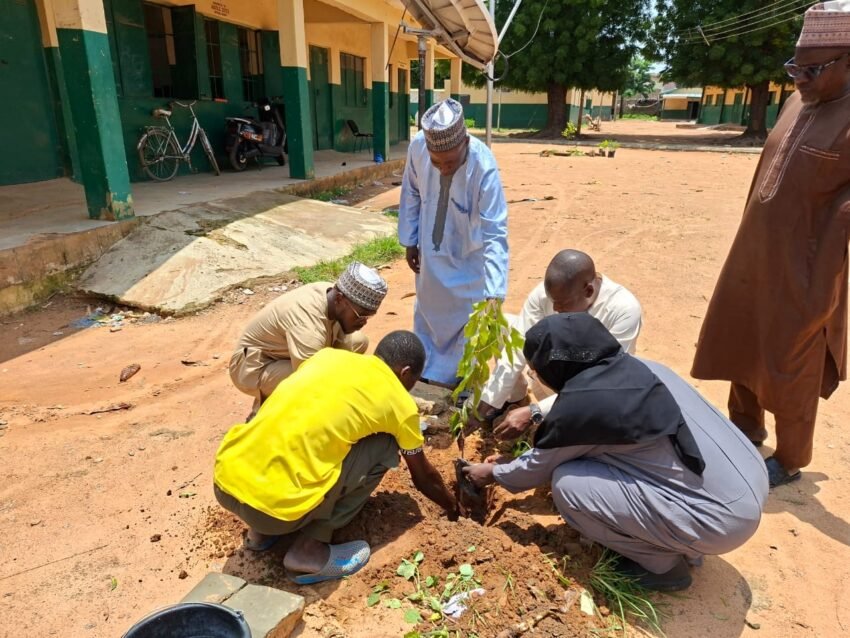
The Centre for Information Technology and Development (CITAD) has launched a tree-planting exercise in public secondary schools in Kano State to combat desertification, strengthen climate resilience, preserve biodiversity and revive threatened traditional and indigenous tree species.
The initiative was launched on Tuesday at the Special Education School, Tudun Maliki, Kano, by the Executive Director of CITAD, Mr Yunusa Zakari Ya’u.
Ya’u said the initiative was aimed at encouraging students to take active roles in environmental protection and promote tree planting in their communities.
He said the students would also be encouraged to become advocates for environmental protection and contribute to efforts to build a greener and more resilient future.
“The initiative will extend to all public secondary schools across the state, empowering students to become champions of environmental protection and a greener future,” Ya’u said.
He said CITAD had trained teachers from selected secondary schools in Kano on the promotion of indigenous tree planting.
According to him, the training was part of the organisation’s efforts to address desertification, improve communities’ resilience to climate change and preserve biodiversity.
Ya’u said Nigeria was endowed with a wide variety of indigenous trees across its ecological zones, from the rainforests in the south to the savannah areas in the north.
He, however, said climate change and the continued cutting down of trees for cooking and other human needs were threatening the survival of indigenous tree species.
“Climate change and our culture of cutting down trees for cooking and other human consumption have become threats to our indigenous trees,” he said.
The executive director said failure to replace trees cut down could worsen environmental and social problems, including soil erosion, rising local temperatures, declining air quality and destruction of wildlife habitats.
He added that trees provided shade, helped control flooding, reduced soil erosion and supported biodiversity.
Ya’u said inadequate vegetation could accelerate land degradation and contribute to the expansion of desert-like conditions, particularly in vulnerable areas.
He thanked the Kano State Ministry of Water Resources, Environment and Climate Change for supporting the initiative with more than 750 tree seedlings.
He also commended the Kano State Senior Secondary Schools Management Board (KSSSMB) and the Kano State Science and Technical Schools Board for their support and collaboration towards the implementation of the initiative.
Ya’u said the Senior Secondary Schools Management Board had provided space for CITAD to establish a nursery where the seedlings would be kept before distribution for planting.
The Principal and Director of the school, Mr Shehu Sani, commended CITAD for bringing the tree-planting exercise to the institution.
Sani said, to his knowledge, it was the first time a non-governmental organisation had visited the school with such an intervention.
“This is the first time that a non-governmental organisation has come to the school with this kind of intervention,” Sani said.
He said the school had selected 10 students and appointed them as prefects responsible for supervising the newly planted trees.
According to him, the students would help ensure that the trees were properly protected and maintained.
Sani said the involvement of the students would also make tree protection part of their regular environmental responsibilities rather than a one-off exercise.
CITAD said the school-based approach was designed to give students practical experience in environmental conservation and encourage them to extend tree planting and protection efforts to their communities.
The organisation said replacing trees lost to human activities was necessary to reduce environmental pressure caused by deforestation and land degradation.
It added that the exercise would be expanded to more public secondary schools across Kano State.