
By Mustapha Salisu
The Advancing Children’s Rights Initiative (ACRI) has called on education stakeholders to support innovative interventions aimed at addressing the out-of-school children crisis, particularly among Almajiri and other street-connected children.
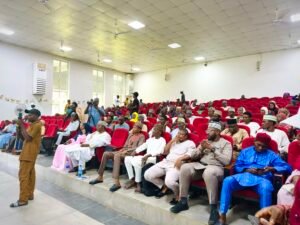
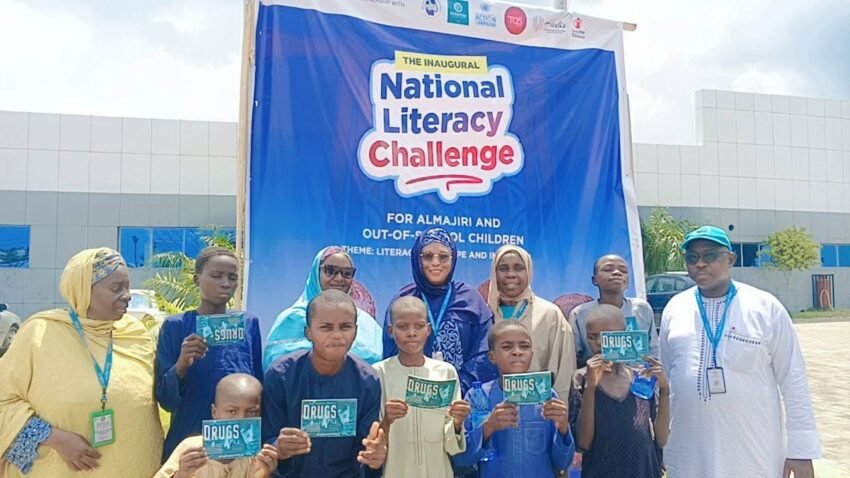
Programs Manager of the initiative, Mubarak Haruna, made the call on Saturday while speaking at the National Literacy Challenge for Almajiri and Out-of-School Children, where the learning achievements of children who participated in a three-month foundational literacy programme were celebrated.
Haruna said the children, often associated with stories of marginalisation and exclusion, were given an opportunity to demonstrate their learning abilities and challenge existing perceptions about Almajiri children.
He said the initiative used Jolly Phonics to teach foundational literacy, describing the impact of the three-month project as significant.
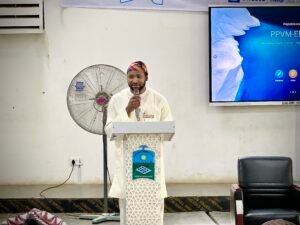
According to him, the children were drawn from schools within the existing network of the National Commission for Almajiri and Out-of-School Children Education, making it possible to assess their progress after the intervention.
Haruna explained that Jolly Phonics uses letter sounds rather than relying solely on the conventional teaching of alphabets, making it easier for children to develop foundational reading skills.
He said the programme was implemented with the support of Universal Learning Solutions, whose teachers were trained to deliver the Jolly Phonics methodology, describing the outcome as significant.
The Programs Manager said the initiative was also seeking to bring relevant stakeholders together to identify how the approach could be incorporated into ongoing education reforms targeting Almajiri children.
He added that stakeholder support would be critical to sustaining the intervention and expanding its potential to reach more children affected by exclusion from formal education.
Also speaking, Technical Adviser to the Kano State Governor on Educational Reform, Haladu Muhammad, said the government was interested in assessing the potential of the approach and exploring how it could be adopted to improve literacy among Almajiri children.
Muhammad said the initiative was particularly relevant given the state’s out-of-school children challenge, noting that a recent survey put the figure at about 875,000 in Kano, with Almajiri children making up a significant proportion.
He said the Kano Government had so far registered about 14,000 Qur’anic schools as part of efforts to integrate them into a recognised schooling system, while the registration exercise was ongoing.
Muhammad explained that the 2025 National Almajiri Policy recognises Qur’anic education as schooling when literacy, numeracy, language and introductory science, among other components, are incorporated into the learning system.
He said the government was working towards integrating more Qur’anic schools into the recognised education system and commended ACRI for piloting an approach that could potentially be scaled up across the state.
On his part, Education Program Coordinator with Save the Children International, Kano Office, Husseini Tibola, said the organisation viewed Almajiri and out-of-school children as potential learners with capacities that are often underestimated.
Tibola said providing the children with the right opportunities could help develop their abilities and enable them to contribute meaningfully to the state and the country.
He commended ACRI for taking the initiative to change public perceptions about Almajiri and out-of-school children, describing the programme as an important demonstration of collaboration among stakeholders.
Haruna urged members of the public to change their perception of Almajiri children, saying the children had demonstrated that with the right opportunities, they could achieve significant learning outcomes.