

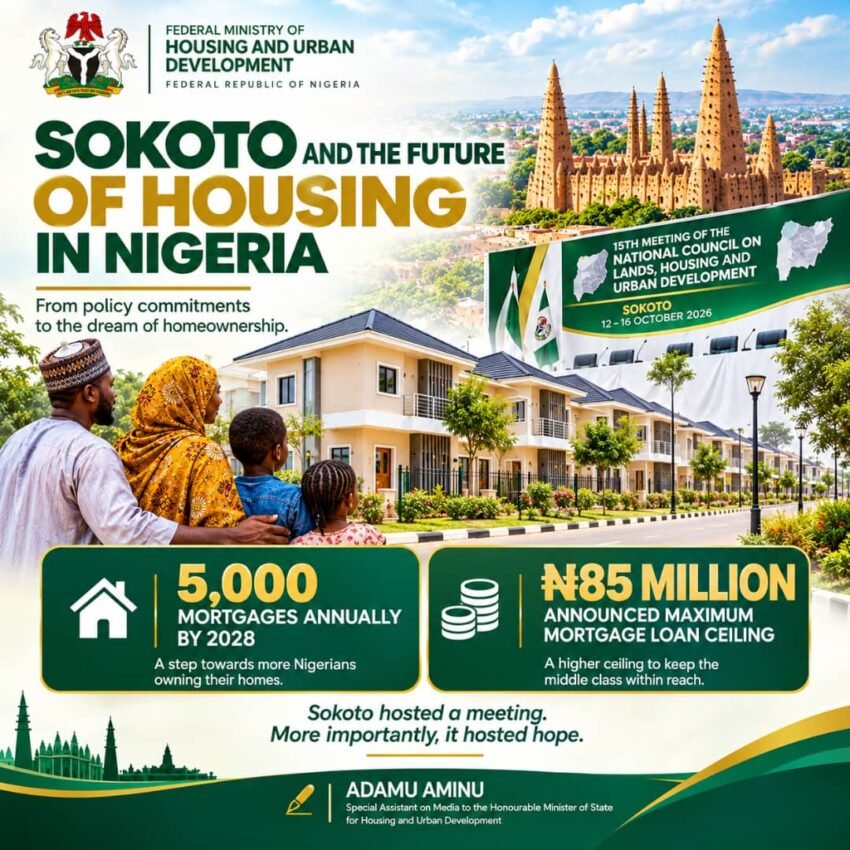
Sokoto And The Future Of Housing In Nigeria
By Adamu Aminu.
When the early morning sun rises over the ancient city of Sokoto, it casts its light over centuries of history, quiet streets and enduring traditions.
It was under this calm but powerful light that stakeholders from across Nigeria gathered for the 15th Meeting of the National Council on Lands, Housing and Urban Development, It was not just another meeting on the calendar. It was a convergence of ideas, a meeting of minds on how Nigerians should live and where they should live.
For too long, the story of housing in Nigeria has been a story of struggle. For the young civil servant in Abuja, for the teacher in Sokoto, for the trader in the market in Kano, owning a home feels like a distant dream.
The cost keeps rising, the mortgage system remains weak, and many are left to build bit by bit, year after year, with no clear end in sight.
This challenge is national. Our housing deficit is not just about the number of houses. It is about the quality of lives lived within them. It is about overcrowded rooms, high rents in our cities and rural-urban migration that strains our infrastructure.
It was in response to this reality that Sokoto delivered a message of hope.
At the opening of the Council, the Honourable Minister of Housing and Urban Development, Dr. Muttaqa Rabe Darma, announced two key targets that set the tone for deliberations.
First, the Federal Government intends to deliver 5,000 mortgages annually by 2028. Second, the maximum mortgage loan will be increased from N50 million to N85 million. The engagement was subsequently sustained by the Honourable Minister of State, Hon. Yusuf Abdullahi Ata.
These numbers may look simple, but their meaning is deep.
Five thousand mortgages is not just a statistic. It is five thousand families moving from renting to owning. It is five thousand doors opening to dignity, stability and economic participation. It shows a clear shift from scattered, ad-hoc projects to a structured, finance-driven system that can reach ordinary Nigerians. It is a move from building houses to building homeowners.
The increase from N50 million to N85 million is also a response to reality. The price of cement, iron, land and labour has changed significantly in the last two years. To keep the old ceiling would be to keep many Nigerians out of the formal housing system. Raising it is a practical and humane decision that keeps the middle class within the formal housing net.
Beyond the figures, the Council focused on the foundations. The Honourable Minister further disclosed that reforms are underway to strengthen the Federal Mortgage Bank of Nigeria and to improve the efficiency of the National Housing Fund. These are the pillars upon which sustainable housing stands. Without a strong mortgage bank, there is no long-term finance. Without a credible National Housing Fund, there is no savings culture for housing.
What Sokoto has therefore given us is more than a communique. It has given us direction.
The National Council is the highest policy-making body for housing in Nigeria. It is where policy meets the people, where the Federal and state governments agree on how to shape our cities and secure land titles.
If implemented faithfully, with the collaboration of state governments, the Sokoto resolutions will ease the burden on Nigerians and give fresh life to the Renewed Hope Agenda of President Bola Ahmed Tinubu.
In the final analysis, shelter is more than a structure. It is the first law of human dignity. A man without a roof is a man without an address in the affairs of his nation. A nation that cannot house its people cannot truly claim to have developed.
To dwell is to belong. Housing is not just about blocks and mortar. It is about security, identity and the future. It is where a child learns his first words and where a family plans its tomorrow. When government makes housing accessible, it does not just build estates. It builds citizens and builds stability.
That is the deeper work before the Federal Ministry of Housing and Urban Development. Sokoto has provided the roadmap. What remains is diligent implementation, for the sake of every Nigerian who still dreams of holding the key to his own home.
Sokoto hosted a meeting. More importantly, it hosted hope. And hope, when backed by policy, becomes a home.
Adamu Aminu, Special Assistant on Media to the Hon. Minister of State, FMHUD, writes from Kano.