
From Tongnaan Bawa Jos
The Plateau State Government says local government councils across the state are implementing projects in infrastructure, healthcare, education, security and rural electrification as part of efforts to strengthen grassroots development under Governor Caleb Manasseh Mutfwang’s administration.
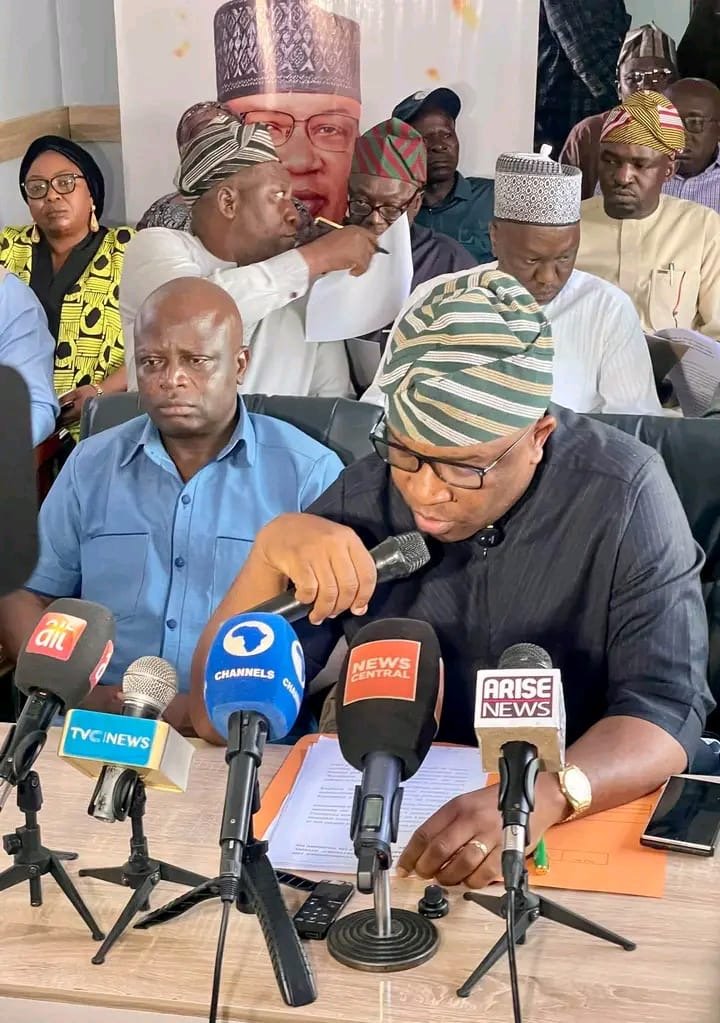
The Commissioner for Local Government and Chieftaincy Affairs, Hon. Chief Ephraim Usman Gar, disclosed this on Thursday, November 5, 2026, while presenting the findings of a statewide inspection of projects executed by the 17 local government councils.
Speaking during a press briefing at the ministry’s headquarters along British America, Jos, Gar said the inspection revealed various completed and ongoing projects across the three senatorial zones, adding that the council chairmen had demonstrated commitment to the governor’s The Time Is Now agenda.
He explained that the exercise was designed to assess project implementation, ensure accountability in the utilisation of public funds, verify compliance with quality standards and strengthen collaboration between the state government, local councils and traditional institutions.
The inspection team comprised ministry officials, the Governor’s Special Adviser on Local Government and Chieftaincy Affairs, Hon. Jonathan Dabo, journalists and representatives of civil society organisations.
Giving a breakdown of the findings, Gar said projects inspected in the Southern Senatorial Zone included the remodelling of youth centres, mini stadiums, Computer-Based Test (CBT) centres, legislative chambers, solar-powered streetlights, primary healthcare centres, motorised boreholes and housing estates for legislators.
The team also inspected the Wase Rock Radio and Television Station and facilities at the temporary headquarters of the Nigerian Army’s 175 Infantry Motorcycle Battalion, which the commissioner said reflected the councils’ contributions to security and peacebuilding.
In the Central Senatorial Zone, projects inspected included the 23-kilometre Gugur Road in Kanke, the remodelled Dengi Multipurpose Hall, primary healthcare centres, a 1,500-capacity event hall in Mangu and a 200-capacity anatomy laboratory at Plateau State University, Bokkos.
Gar described the anatomy laboratory as a major intervention funded by the Association of Local Governments of Nigeria (ALGON), noting that the facility had been completed and handed over to the university, awaiting commissioning by Governor Mutfwang.
Other projects in the zone included the Palace of the Ngolong Ngas and the provision of transformers for rural electrification.
In the Northern Senatorial Zone, the commissioner listed primary healthcare centres at Sabon Gari, Chinye-Miango, Garba Daho and Furaka, alongside rural electrification projects in Miango, council secretariat complexes, ICT centres and ultra-modern markets at Rishari-Rutara and Zarakon.
He also highlighted the construction of bridges linking Farin Gada to Rusau and Vwang to Kogot, as well as police outposts and town halls at Kwang and Kuru.
Assessing the overall performance of the councils, Gar expressed satisfaction with the range of projects inspected, although he acknowledged that the level of implementation varied among the 17 local government areas.
He maintained that the projects were largely determined by the specific needs and priorities of individual communities.
On the issue of local government autonomy, the commissioner argued that the debate should extend beyond the release and control of funds to include accountability, administrative efficiency and the capacity of councils to deliver tangible development at the grassroots.
He further dismissed suggestions of interference by the state government in the financial decisions of local councils, insisting that Governor Mutfwang had neither dictated nor interfered with how the chairmen utilised their resources.
According to him, the state government had also provided support to local councils whenever necessary, urging stakeholders to focus on strengthening local government administration and ensuring effective transition processes.
On security, Gar disclosed that the councils were strengthening community-based security arrangements through the formal registration and training of vigilante personnel.
He said the personnel had undergone three months of training by the Nigeria Security and Civil Defence Corps (NSCDC) to improve intelligence gathering and collaboration with conventional security agencies in tackling criminal activities.
Earlier, the Plateau State Chairman of the Nigeria Union of Journalists (NUJ), Ayuku Pwaspo, commended the commissioner for providing journalists with the opportunity to obtain firsthand information on projects executed by the councils.
Pwaspo, however, called for greater media participation in subsequent inspection exercises to encourage independent assessment, transparency and credible reporting of development activities across the state.
In his closing remarks, Gar appreciated Governor Mutfwang for providing an enabling environment for the ministry and local government councils.
He also acknowledged the contributions of traditional institutions, council chairmen, journalists and civil society organisations, expressing optimism that the inspected projects would contribute to the administration’s grassroots development objectives across Plateau State.