

By Mustapha Salisu
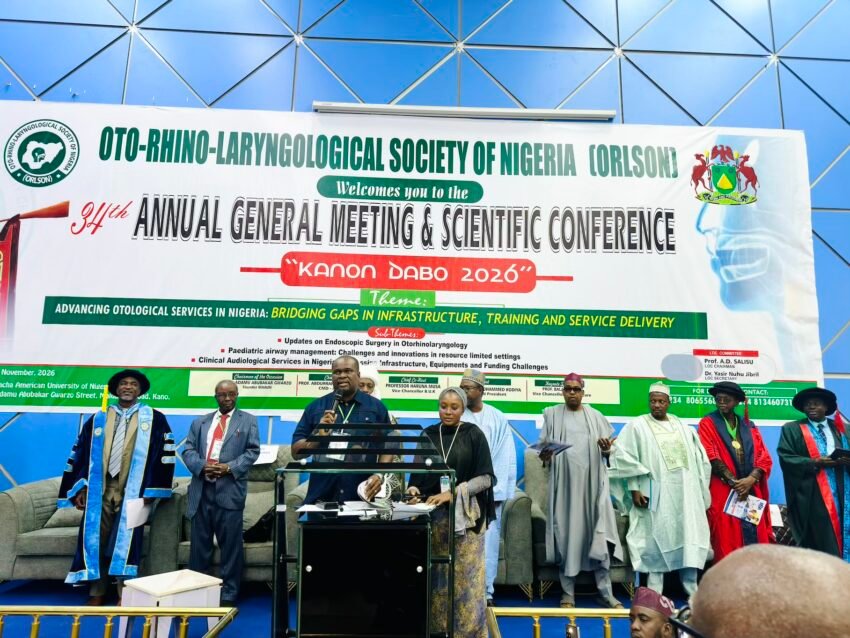
The Otorhinolaryngological Society of Nigeria (ORLSON) has called on federal and state governments to urgently address gaps in specialised ear and hearing healthcare through increased investment in medical infrastructure, specialist training and affordable treatment services.
The Society’s National President, Professor Aliyu Mohammed Kodiya, made the call at the opening of its 34th Annual General Meeting and Scientific Conference in Kano, warning that limited access to quality ear care continues to undermine efforts to prevent hearing impairment and improve patients’ quality of life.
Professor Kodiya described hearing healthcare as fundamental to human development, social inclusion and national productivity, stressing that access to quality services should not depend on geographical location or financial capacity.
He called for stronger collaboration between ORLSON, government, training institutions, development partners and the private sector to address inadequate infrastructure, manpower shortages and limited access to hearing rehabilitation.
The President also advocated the establishment of regional centres of excellence, expanded specialist training, early detection of hearing impairment and affordable rehabilitation services.
Earlier, the Chairman of the Local Organising Committee, Professor Abubakar Danjuma Salisu, welcomed participants to Kano, describing the conference as an opportunity to address critical challenges confronting ear, nose and throat healthcare in Nigeria.
He commended the Founder of Maryam Abacha American University of Nigeria, Professor Adamu Abubakar Gwarzo, for supporting the conference as its principal sponsor and Chairman of the Opening Ceremony.
Professor Salisu noted that otology had received inadequate attention despite the growing number of patients presenting with ear-related conditions, including preventable hearing loss and other complications.
He identified inadequate surgical equipment, limited training facilities and poor access to specialised services as major challenges, calling for modern microsurgical facilities and functional temporal bone dissection laboratories.
The LOC Chairman also advocated the integration of ear and hearing services into primary healthcare, particularly in rural communities, while emphasising the need to train middle-level ENT specialists.
In his keynote address, the Vice Chancellor of the Federal University of Health Sciences, Azare, Bauchi State, Professor Bala Audu, disclosed that between eight and nine million Nigerians live with some degree of hearing loss.
He said many cases were preventable, identifying chronic ear infections, excessive noise exposure and drug-induced hearing damage among the contributing factors.
Professor Audu called for the establishment of regional centres of excellence, stronger public-private partnerships and investment in biomedical technicians to ensure the maintenance of specialised medical equipment.
On manpower development, he expressed concern over the shortage of ENT surgeons, audiologists and trained nurses, worsened by the migration of skilled professionals.
He recommended improved remuneration, specialised fellowship programmes, international collaborations and functional training laboratories. He also advocated expanding middle-level specialist training through the West African College of Surgeons.
Professor Audu further called for the integration of ear healthcare into primary healthcare and school health programmes, inclusion of hearing rehabilitation in the National Health Insurance Authority and compulsory hearing screening for newborn babies.
He also highlighted the importance of endoscopic surgery and improved paediatric airway management, stressing the need for modern equipment, simulation-based training and coordinated emergency response.
The conference was declared open by the Vice Chancellor of Bayero University, Kano, Professor Haruna Musa. The four-day event, tagged Kano Dabo 2026, runs from November 18 to 21, with discussions also covering endoscopic surgery, paediatric airway management and challenges affecting clinical audiological services in Nigeria.