

A review of Pariolodo and KJ’s spoken word production by Adesoyin Aderanti
When I moved to Abuja, I was excited to step into the vibrant poetry community. Yet, I barely did; each event left me feeling like I couldn’t truly belong. But Pari Olodo’s events are different.
Sometime in 2024, I saw Pariolodo’s one-man performance and immediately knew his art was one I wanted to experience again. See, it takes guts to stage a performance; it takes some level of old-wine audacity (like believing poetry is the next thing after weed) to entertain an audience of over a hundred for two hours, largely alone on stage, with poetry. So, I was hyped for A Match Made in Hell by Pariolodo and KJ.
Still, I struggled to step in. I had a movie evening on the same day, and I was not a crazy fan of comedies, particularly the ones within the context of marriage. But at the last minute, I decided to step into Pariolodo and KJ’s production world.
II
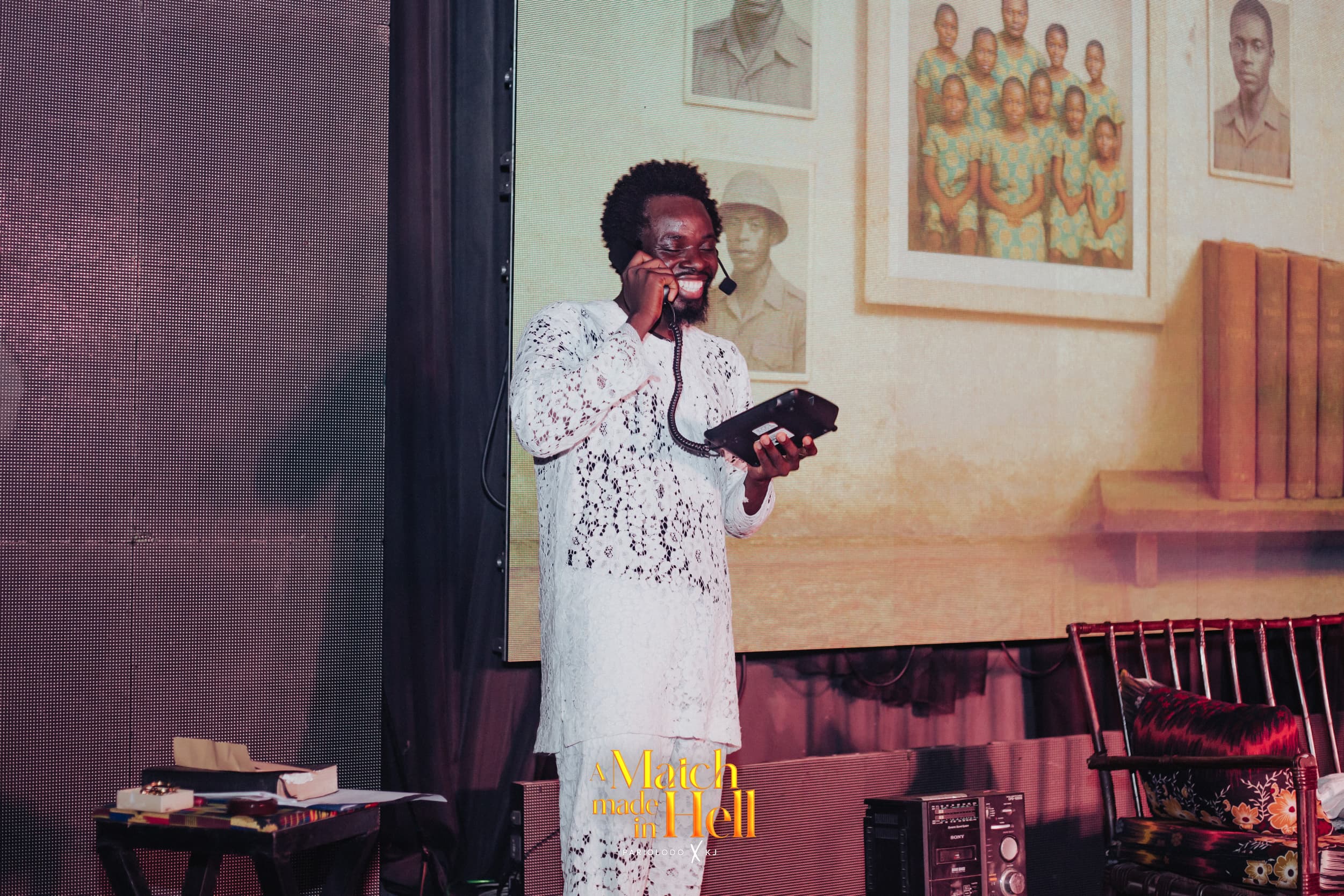
I step in, mid-performance. KJ’s oleku pulls me to front-row seat. The intimacy of the stage catches me, a dim screen at the centrepiece, flanked by an old TV, a radio, and a wooden chair, instantly transporting me to the 1970s, almost like walking into an Ade Love set.

The story unravels easily, the marriage of a flighty Igbo woman and a Yoruba man becoming the vessel for exploring pre-independence struggles, tribalism, gender wars, nepotism, and even hope.
The male lead strikes me immediately. He emotes with ease, moving fluidly from one emotion to another, building tension so well that both his highs and lows are felt collectively by the audience, carefully carrying me in the seams of his white, flowing agbada. The female lead, on the other hand, seems to hover between mid and high-level emotions. At first, I cannot connect with her, but as the production progresses, her characterisation opens up and her comic timing draws me in. Her character (a flighty woman who enjoys the benefits of the failing system but bolts at the sight of trouble) feels uncomfortably familiar. She reminds me of us: how we complain about someone jumping bank queues, yet rush to jump life queues riding on the backs of others.
Together, their dynamic somehow works. She is funny, volatile, and hypocritical in a way that reflects our own contradictions, while he becomes a paradigm of them: a minister without certificates, a man who loves his wife but also causes many of his own problems, a dreamer of a brighter future who still exploits the system for personal gain. He is us, just as she is us.
III
I struggle to follow the female lead, her lines feel performed, but not immersed in the flow of the production. I see an actor acting, rather than the character living. I also struggle with some lines across both leads. They are nice but regular, like cold pap on a drizzly Saturday morning; nice to have, but better gone.
The catchphrases amuse and confuse me. I love catchphrases, but I detest 2020s catchphrases in pre-independence settings. They make the audience laugh, but they take us out of the scene and bring us to the present for a moment. They leave us wondering if we are in 2025 or in the year the production wants us in.
I also struggle with the lightning which seems to only go on and off. Life is grey, the production explores the greys yet the lightning seems to only move from light to dark. If used more effectively, it could have deepened the storytelling even further.
IV
When I remember A Match Made in Hell, I will say:
“The lights leave, the big screen glows, the female lead sits in the wooden chair at the center of the stage, flanked by the box TV and cupboard, her gele tilts forward; such nostalgia for a generation redacted on stage.”

V
The production reminds me of Elnathan John’s Becoming Nigerian, especially during the duet about sharing the national cake. The synergy of the symbolic cough followed by the line, I am pregnant, captivates me. It is a spark of hope, so simple yet so resonant, birthing the sense of a better generation.
The production ends on this note of hope. And though I struggle to mingle afterwards (my shyness and anxiety often leave me tongue-tied unless I already have something concrete to say), I leave satisfied. It is time and money well spent.
It also leaves me reflecting on the blurred lines between spoken word productions and stage plays; this production blurs those lines often, but in a way that enriches the experience.
Finally, sitting in that theatre reminds me of how expensive it is for creatives to build platforms for themselves in this economy, and how many never get the chance. This production, despite those odds, is proof of what is still possible, and that is perhaps the most inspiring part.