

By Mustapha Salisu
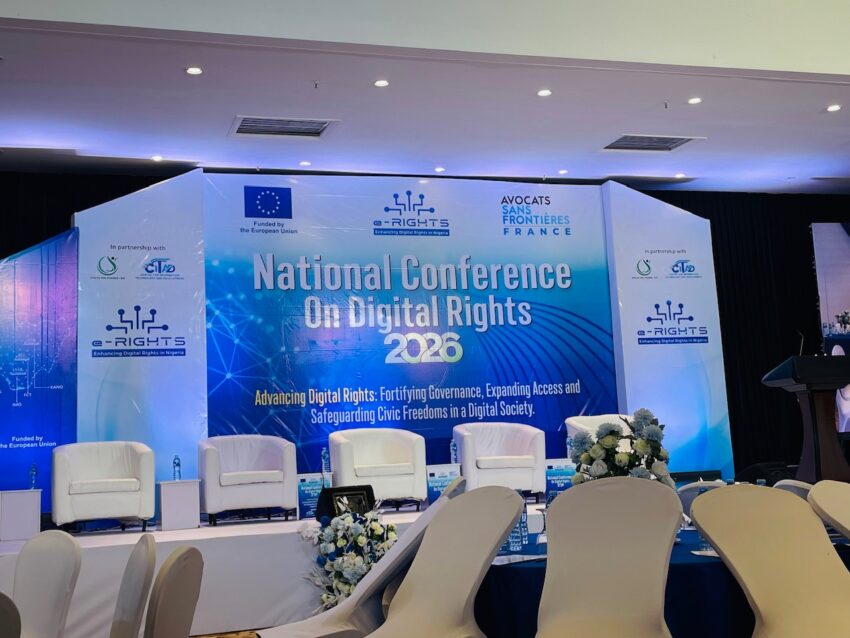
Avocats Sans Frontières France (ASF France), in partnership with the Centre for Information Technology and Development (CITAD) and Spaces for Change, with support from the European Union and other co-funders, on Thursday hosted the National Conference on Digital Rights 2026 at the Abuja Continental Hotel.
The conference, themed “Advancing Digital Rights: Fortifying Governance, Expanding Access and Safeguarding Civic Freedoms in a Digital Society,” brought together stakeholders from government institutions, civil society, the private sector, and the media to deliberate on the state of digital rights and civic freedoms in Nigeria’s digital ecosystem.
In her welcome address, Angela Uwandu Uzoma-Iwuchukwu, Country Director of ASF France, Nigeria, emphasized the urgent need to ensure that human rights enjoyed offline are equally protected in the digital space.
“Our screens matter, our privacy matters, our data matters. Digital evolution should enhance our enjoyment of human rights and never impair it. Unfortunately, what we have today is far from this ideal” she said.
Uzoma-Iwuchukwu noted the growing concerns around privacy breaches, online censorship, and digital authoritarianism, which continue to undermine freedom of expression in Nigeria. She cited instances where individuals were detained for expressing legitimate opinions on social media, calling for stronger protections against misuse of cybercrime laws.
She further highlighted key achievements of the ongoing three-year project implemented by ASF France and its partners, including institutionalizing digital rights training and expanding stakeholder engagement across sectors.
The ASF France Country Director stressed that the protection of digital freedoms requires a multi-stakeholder approach, involving collaboration between government, private sector actors, and civil society groups.
“We must ensure that no voice is silenced. The press and citizens alike must be free to use digital platforms to hold government accountable without fear of surveillance or repression” she added.
Uzoma-Iwuchukwu also called on the Nigerian government to take proactive steps in ensuring responsible legislation that upholds privacy, protects user data, and promotes digital inclusion.
Also in his remarks, the Executive Director of the Centre for Information Technology and Development (CITAD), Malam Y. Z. Ya’u, has urged the Nigerian government at all levels to provide a safer environment for digital rights actors, where everyone can operate freely without interference.
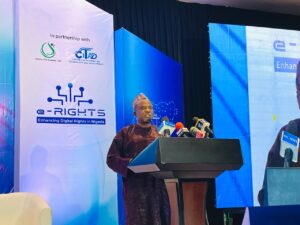
Ya’u said the government must guarantee digital rights for citizens, while calling on civil society organisations and other relevant stakeholders to develop a national policy framework that will curb the activities of actors abusing public rights in the digital space.
On her part, Victoria Ibezin-Ohaeri, Executive Director of Spaces for Change, urged participants to think critically and align their reflections with the theme of the conference.
She emphasized the need to move beyond outdated digital narratives such as complaints about deleted social media posts to more progressive and solution-driven discussions that can advance Nigeria’s digital growth, noting that “Nigeria remains a star nation in Africa’s digital landscape.”
Highlights of the conference included goodwill messages, keynote addresses, panel sessions, presentations, networking opportunities, and other engaging activities.