


By Mariya Shuaibu Suleiman
Feminist advocates from across Africa came together on Wednesday to chart coordinated action against sexual violence and push for the ratification and enforcement of the African Union Convention to End Violence Against Women and Girls (AU-CEVAWG).
The three-hour convening, Sisterhood Beyond Borders: Mobilizing the Pan-African Feminist Movement to End Sexual Violence, was organised by Baobab for Women’s Human Rights in collaboration with Project Alert, Brave Heart Initiative and African Centre for Democracy and Human Rights Studies (ACDHRS).
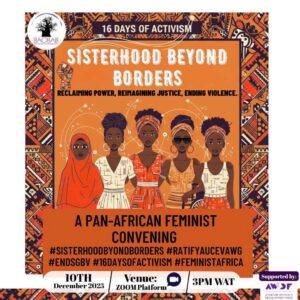
The event, held virtually on 10 December to mark International Human Rights Day and the global 16 Days of Activism Against Gender-Based Violence, brought together more than 160 participants, including legal practitioners, grassroots organisers, feminist scholars, policymakers, and young advocates.
Baobab’s Executive Director, Bunmi Dipo-Salami, said the convening sought to bridge the gap between progressive legal frameworks and the lived realities of survivors.
“Across the continent, we have laws, protocols and commitments, but survivors continue to face impunity, silence and weak enforcement. This convening is about transforming feminist solidarity into political action that delivers justice,” she said.
She noted that while instruments like the Maputo Protocol exist, weak domestication and enforcement continue to undermine women’s access to justice. Feminist movements, she stressed, must now move from advocacy to accountability.
FEMNET Board Chairperson, Carole Ageng’o, called for a coordinated continental response, describing sexual violence as a systemic crisis requiring Pan-African solutions.
“Violence against women and girls is not confined to one country or region. It is a Pan-African problem, and it demands a Pan-African feminist response that is organised, strategic and sustained,” she noted.
She also highlighted that ending violence against women and girls is a decolonial and Pan-African feminist mission.
“We must hold duty bearers accountable and confront the colonial legal systems and patriarchal norms that have made violence seem acceptable, lawful, or even profitable—through the Maputo Protocol, AU-CEVAWG, and national laws,” Ms Ageng’o added.
Delivering the keynote address, AU Special Rapporteur on the Rights of Women in Africa, Janet Salleh-Ndjie, described AU-CEVAWG as the continent’s most comprehensive legal instrument for tackling sexual violence.
“The convention builds on the Maputo Protocol while responding to emerging forms of violence, including technology-facilitated abuse, conflict-related sexual violence and harmful practices,” she said.
Focusing on Article 12, Ms Salleh-Ndjie said the convention provides survivor-centred justice, including free legal aid, specialised courts, and survivor-friendly procedures. She urged African Union member states to ratify and domesticate it quickly.
“There is both a political and moral obligation on states to act,” she said, pledging technical support from her office to countries willing to take concrete steps toward implementation.
She added that amid the global rollback of women’s rights, difficult conflicts persist across the continent.
“Now, more than ever, we must choose collaboration over division. While debate is important, we must safeguard our quality power against regression. Let us honor diverse perspectives while remaining united around a common purpose. Advancing justice and equality is only possible through intentional collective action.”
On her part, Executive Director of the African Centre for Democracy and Human Rights Studies, Hannah Forster
emphasised the role of civil society.
“Ratification alone will not end sexual violence unless backed by sustained legislative reform, judicial accountability and monitoring. Feminist movements must move from celebrating adoption of laws to demanding enforcement with timelines and consequences,” she said.
A panel on legal accountability featured Mariam Abdu of the Nigerian Feminist Forum and Namuchana Mushabati of WiLDAF Zambia.
Ms Abdu highlighted systemic challenges in Nigeria, including corruption, survivor-unfriendly court processes, and delays discouraging survivors from pursuing justice.
Ms Mushabati shared lessons from Zambia, noting that while specialised courts exist, inadequate funding and training continue to limit their effectiveness. She said domestication of AU-CEVAWG must include budgetary commitment and institutional reform.
Another panel explored digital advocacy and intergenerational mobilisation, with speakers highlighting digital spaces as both sites of abuse and tools for feminist organising.
Veteran activist Josephine Effah-Chukwuma of Project Alert cautioned against over-reliance on digital campaigns, stressing the importance of physical survivor support such as shelters, counselling, and court accompaniment.
Young feminist Priscilla Usiobaifo of Brave Heart Initiative said digital advocacy can amplify grassroots action, citing cases where online mobilisation led to arrests and prosecutions while driving offline community engagement.
Journalist Kathleen Ndongmo of News Central TV highlighted the media’s responsibility to report sexual violence ethically, particularly in conflict-affected regions, while Omolara Balogun of WACSI called for sustainable funding models to strengthen feminist organisations beyond short-term projects.
A key outcome was the launch of the Pan-African Feminist Solidarity Network (PAFSO), unveiled by Chisom Akwue, programme officer at Baobab.
“PAFSO is not an idea for the future. It is a structure for action now,” she said.
The network will coordinate cross-border advocacy for AU-CEVAWG ratification, support women human rights defenders, institutionalise youth leadership, and create a shared digital knowledge hub.
Ms Ageng’o welcomed the initiative, stressing that youth innovation and experienced leadership must work together to strengthen the movement.
The convening also adopted the Pan-African Feminist Solidarity Pledge, committing participants to demand AU-CEVAWG ratification, centre survivors in advocacy, hold governments accountable, and build sustainable, intergenerational movements.
Ms Dipo-Salami noted the dialogue provided both legal frameworks and a movement structure for advancing justice.
“We now have the tools and the network. The task ahead is to ensure that governments act and that survivors see real change,” she noted.
However, participants reaffirmed their commitment to the pledge, promising to return as PAFSO ambassadors, coordinate advocacy campaigns, hold governments accountable, centre survivors’ needs, strengthen cross-border feminist solidarity, and actively monitor progress to ensure meaningful access to justice for survivors of sexual violence across Africa.