By Mohammed Ismail
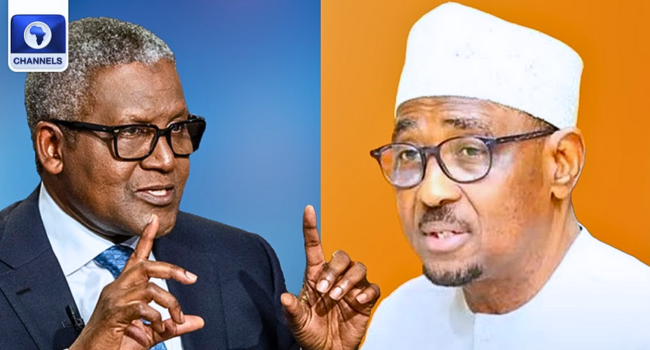
The recent degeneration of the open conflict between Africa’s richest man, Aliko Dangote, and Ahmed Farouk, the immediate past chief executive of the Nigerian Midstream and Downstream Petroleum Regulatory Authority (NMDPRA), into a full-blown public war has torn the veil off one of Nigeria’s most opaque and innately corrupt systems; the oil sector.
What initially appeared to be a regulatory impasse has quickly morphed into a full blown battle that exposes the contradictions, hypocrisies, and entrenched interests that define Nigeria’s oil and gas economy.
It must be stated from the outset that this fight is not being waged in the interest of the Nigerian masses. The ordinary citizen, who has borne the brunt of decades of fuel scarcity, subsidy scams, and economic sabotage, remains a spectator in a contest driven by greed, quest for economic control and intra elite power struggles.
Since crude oil was discovered, Nigerians have largely stood at the short end of a system that rewards rent-seeking, punishes productivity, and converts national wealth into private pockets.
Dangote’s accusation of misuse of office against Farouk should not have come to anyone with understanding of the deep corruption in the oil and gas sector as a surprise. Our surprise if any, should be on the little amount involved or the minuteness of the corruption allegations.
At its core, the Dangote–Farouk confrontation is a clash between two inimical forces. On one side stands a ferocious capitalist whose business model thrives on market dominance and near-absolute monopoly.
On the other, is a cold-blooded rentier system that has perfected the art of state capture, regulatory manipulation, and institutionalized corruption. Both sides are products of Nigeria’s deep rooted economic system that thrives on injustice and inequality.
Dangote, a renowned industrialist, has over the years built an empire that dominates Nigeria’s food, beverages, sugar, salt, and cement sectors. His business acumen while often celebrated has come at a significant cost to competition.
Entire industries have effectively been turned into one-man affairs, with smaller players either absorbed, strangled, or forced out. Prices, supply chains, and market access have frequently tilted in his favour, leaving consumers with little choice and competitors with little breathing space.
His prolonged altercations with Abdulsamad Rabiu over control of the cement sector remain a reference point.
That battle revealed how industrial power in Nigeria is sharpened against the state and the people for the expediency of personal or group interests rather than the good of all. This becomes apt considering the tax, import waivers, preferential policies, and regulatory soft landing extended to Dangote by previous administrations which helped him to assert complete dominance over competitors.
Because of emerging interests, following Dangote’s major investment in the oil and gas sector through the Dangote refinery, a major crack in his relationship with the oil cabal appeared.
The construction of the $20 billion Dangote Refinery, the largest in Africa and among the most sophisticated globally, altered the erstwhile balance.
For decades, the oil sector has thrived on contrived elite’s collusion in promoting their class interest above national interests. Through the deliberate extermination of government’s own refineries, they made Nigeria to solely depend on importation to meet local needs alongside the concomitant scourges of subsidies, round trippings, job losses and arbitrage. To cut the story short, the petroleum sector was designed to reward inefficiency because inefficiency brings substantial profits to the oil cabal.
The Dangote’s refinery project openly threatened this rentier architecture. But unlike cement or sugar, oil is the lifeblood of Nigeria’s economy. Therefore, control of fuel importation, licensing, and pricing has sustained a powerful cabal of politicians, bureaucrats, marketers, and middlemen which Dangote threatens to disrupt.
The operationalization of the Dangote refinery becomes a serious threat to the interests of the cabal because it is very clear, they will lose out if local refining succeed, as scarcity, dependency, and opacity are the oxygen of their wealth.
This explains why Dangote, a beneficiary of elite consensus, suddenly found himself swimming against the tide and subjected to acute regulatory hostility. The same system that once facilitated his monopolies now perceived his refinery as an existential threat. The conflict with Farouk and the NMDPRA is therefore, not about technical compliance but about who controls the downstream oil narrative in a post-subsidy Nigeria.
For years, billions of dollars were allocated for the turnaround maintenance of Nigeria’s four state-owned refineries in Port Harcourt, Warri, and Kaduna. These funds vanished into a black hole, leaving the refineries in permanent comatose states.
Despite producing no fuel, they continued to gulp public funds through salaries, contracts, and overheads subjecting Nigerians to double whammy; first for maintenance that never worked, and again for imported and sometimes substandard fuel sold at inflated prices.
At a point, the corruption within the Nigerian National Petroleum Company (NNPC) became so perverse that the corporation stopped contributing to national revenue. Instead of being a source of fiscal stability, it became a drain, shielded from scrutiny by claims of “subsidy under-recovery” and opaque accounting practices. The oil sector effectively operated as a parallel state within a state.
It may be recalled that recently, the oil sector was in the news for the wrong reasons following the alleged discovery of over N200trn of unaccounted oil funds by the national assembly.
Against this background, Dangote’s refinery appears both as a solution and a problem. While it promises local refining capacity and reduced import dependence, it also raises legitimate fears of replacing a corrupt public monopoly with a private one.
A single refinery controlling supply in a deregulated market carries the risk of price manipulation, market exclusion, and unchecked power, especially in a country with weak competition laws and compromised regulators.
Thus, the Dangote–Farouk war should not be romanticized. It is a fight between entrenched forces, and a collision between monopoly, capitalism and rentier corruption.
What the country needs is neither the sanctification of big capital nor the defense of a rotten regulatory elite. It needs transparent institutions, genuine competition, strong enforcement mechanism and a restructured oil sector that prioritizes public interest over elite enrichment.
Until that happens, conflicts like this will continue to surface, while the underlying system of exploitation remains firmly intact.
In the end, the tragedy is that Nigeria’s oil wealth continues to serve as a battleground for elite supremacy rather than a foundation for national development. And until both monopoly capitalism and rentier corruption are confronted together, the ordinary Nigerian will remain the ultimate loser in wars he did not start and has no control.
But despite my reservations against Dangote due to his monopolistic tendencies, I will still side with him as a patriotic Nigerian because the interest he is pursuing is more beneficial to Nigerians than the interests of the Farouks of this world.
My reasons are not far fetched; they are borne out of an innate patriotic favor to protect the interest of Nigeria and its masses.
The operation of Dangote refinery has already substantially impacted on the country’s GDP. It has also opened thousands of direct and indirect jobs. It will also attract foreign exchange to Nigeria and in the long run crash the dollar in the forex market. It will also ensure uninterrupted supply of cheaper, better and affordable energy to all Nigerians.
To add to this mix is the fact that the refinery will carry out tremendous CSR to Nigerians as well as pay tax to the government. Regardless of my view of Dangote, his refinery is more beneficial to Nigerians than the selfish, cut throat and unpatriotic interests of the oil cabal whose interests are at cross purposes with Nigeria’s drive to greatness.
Ismail, is the Editor-in-chief of FACTCHECKNEWS.