

By Mariya Shuaibu Suleiman
For decades, Nigeria’s economic debates have revolved around macroeconomic reforms, infrastructure, oil revenue, fiscal discipline and jobn creation. But at a policy dialogue in Abuja on Tuesday, development experts posed a more foundational question: When does Nigeria’s economic future actually begin?
The answer, they argued, lies in the earliest years of life, a period often overlooked in national planning.
The World Bank says investing in early childhood development is not only a social responsibility but an economic strategy with some of the highest returns available to governments.
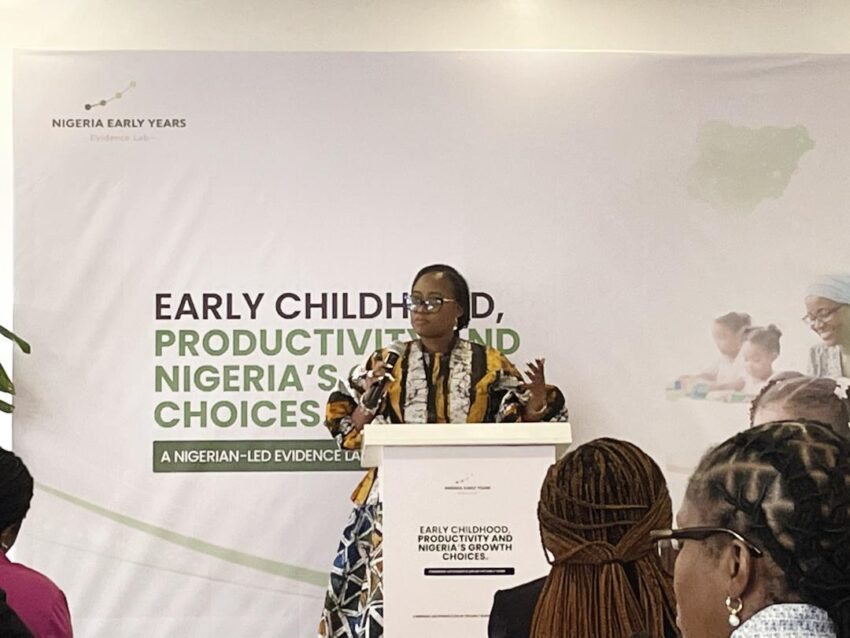
At the Early Childhood, Productivity and Nigeria’s Growth Choices dialogue, organised by SBM Intelligence in collaboration with the World Bank, the Bank’s Lead on Early Years, Ritgak Tilley-Gyado, said evidence shows that early interventions yield long-term productivity gains.
“Early childhood investment is not social spending. It is economic strategy,” she said.
According to the World Bank, every $1 invested in early childhood development can yield up to $13 in returns through improved productivity, higher lifetime earnings and reduced social costs.
A productivity crisis in the making
Beyond the global data, speakers at the event linked early childhood outcomes directly to Nigeria’s present realities.
The Managing Partner of SBM Intelligence, Ikemesit Effiong, described early childhood deprivation as a productivity challenge with long-term economic consequences.
He noted that while Nigeria’s under-five mortality rate has declined in recent years, neonatal mortality remains high.
“In plain language, almost half of the children we lose before age five die in the first month of life,” Mr Effiong said.
He argued that early childhood indicators are not merely health statistics but signals of broader structural weaknesses that affect education outcomes, workforce readiness and adult earnings.
According to him, addressing early childhood requires coordinated thinking beyond clinics and classrooms.
“Addressing early childhood requires thinking beyond clinics and classrooms to include caregiving, sanitation, nutrition, and institutional coordination,” he said.
Why the earliest years matter
Scientific research shows that the first five years of life are critical for brain development. Neural connections that shape language, emotional regulation, learning capacity and problem-solving skills are formed during this period.
Ms Tilley-Gyado warned that inequalities visible in adulthood often originate in these early years.
“By the time policy begins reacting to inequality in adolescence or adulthood, many gaps have already taken root,” she warns.
“We spend billions trying to fix problems in adulthood that begin before a child turns five.”
For many Nigerian families, limited access to adequate nutrition, healthcare and early stimulation means that children begin school already disadvantaged, a gap that can widen over time.
Demographic dividend or demographic risk
Nigeria’s large and growing youth population is often described as a potential demographic dividend a scenario in which a sizeable working-age population drives economic expansion.
But Joe Abah, Country Director of DAI Global LLC, warned that failing to invest in early childhood could turn that dividend into a demographic burden.
“A country’s most important resource is its people. If you have a young, developing country where the majority of the population are children, then you either have the potential for a demographic dividend or you are heading toward a demographic disaster if you fail to invest in them,” he said.
He emphasised that inadequate nutrition, poor healthcare and weak caregiving environments affect children’s brain development from infancy.
“When children do not receive adequate nutrition, proper healthcare, responsible caregiving, and protection from harm, we are essentially raising a generation of young people who are already disadvantaged at the very start of their lives,” Mr Abah said. “That is the challenge we are dealing with. It is a very serious problem.”
Not just sectors, but systems
A recurring theme at the dialogue was the need for cross-sector coordination.
“Children do not grow in sectors. They grow within families, communities, environments, and systems that operate simultaneously,” Ms Tilley-Gyado said.
Health interventions without nutrition support may yield limited gains. School enrolment without safe water, sanitation and stable caregiving may not translate into meaningful learning outcomes.
Experts argued that integrated planning across health, education, sanitation and social protection systems is essential to maximise developmental impact.
A long economic lens
Speakers at the event urged policymakers to adopt a longer-term economic perspective.
Children who are currently between zero and five years old will enter Nigeria’s labour force by mid-century, a period during which the country hopes to strengthen industrialisation, expand non-oil revenue and improve global competitiveness.
“Demographics alone do not guarantee prosperity. A young population becomes an asset only when its youngest children develop the capabilities to thrive as adults,” Ms Tilley-Gyado said.
She concluded with a reminder that economic planning must account for generational timelines.
“The Nigeria of 2050 is already growing in Nigerian homes today,” she said. “The question before us is whether policies are growing with it.”
The dialogue underscored a growing consensus among development experts that early childhood development should not be treated as peripheral welfare policy, but as a central pillar of Nigeria’s human capital strategy.
As the country pursues macroeconomic reforms and structural adjustments, speakers argued that the durability of those reforms will ultimately depend on the strength of the next generation and the investments made in their earliest years.