

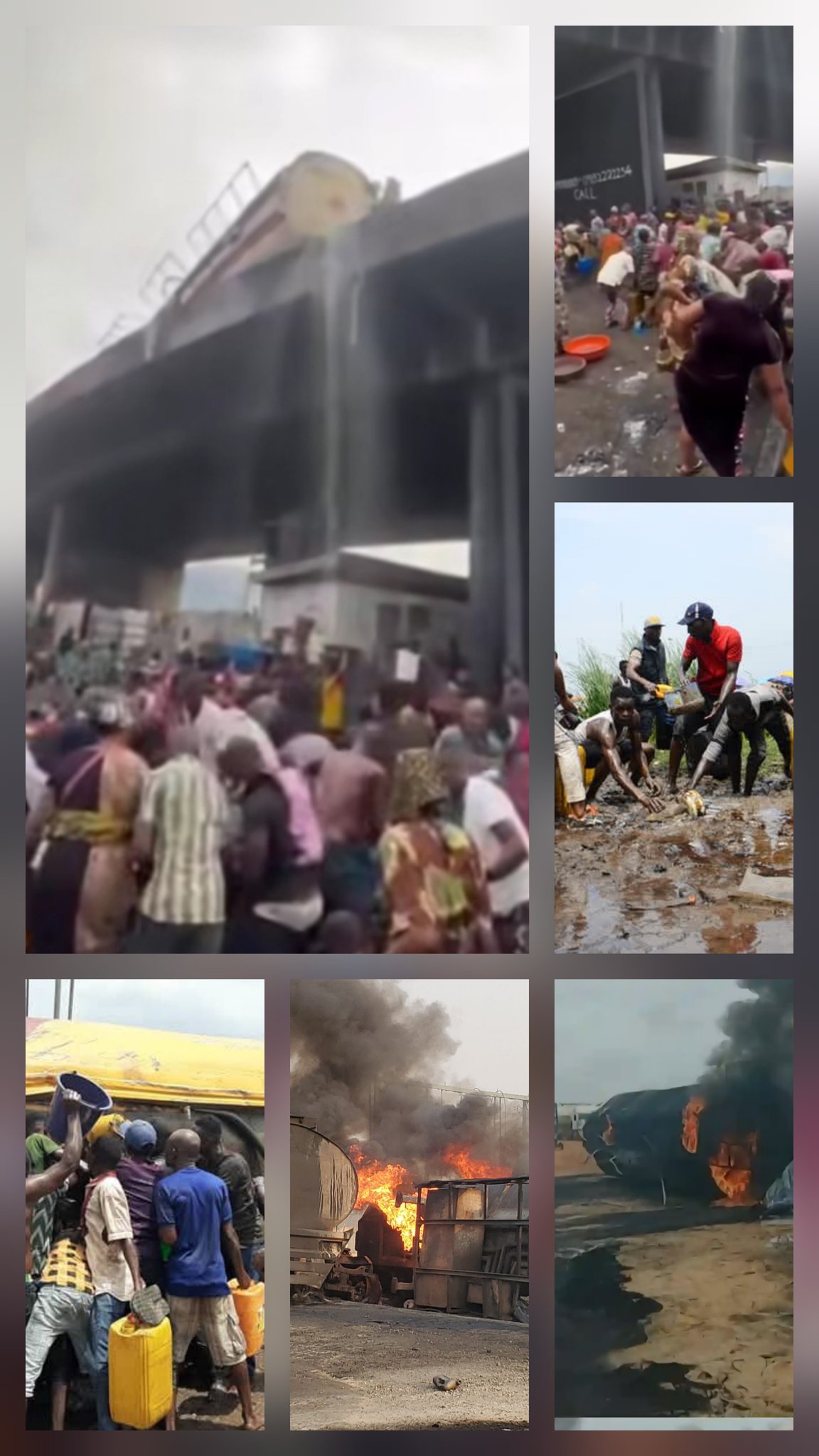
The Controller-General of the Federal Fire Service (FFS), Olumode Samuel Adeyemi, has warned Nigerians against the dangerous and life-threatening practice of scooping fuel from overturned or accident-involved tanker trucks, describing it as reckless and a major cause of avoidable deaths across the country.
The warning was contained in a statement issued on Sunday by the National Public Relations Officer and Head of Corporate Services of the Service, DCF P. O. Abraham.
According to the statement, the caution followed a viral video showing individuals scooping fuel from a fallen tanker on the Tincan–Liverpool Bridge in Apapa, Lagos. Although it was later confirmed that the tanker was conveying diesel, the Controller-General stressed that the type of product involved does not in any way reduce the grave danger posed by such actions.
“Whether petrol or diesel, scooping fuel from accident-involved tankers is extremely dangerous and has repeatedly led to catastrophic loss of lives and property,” the statement quoted the Controller-General as saying.
The Federal Fire Service disclosed that official records from relevant authorities indicate that no fewer than 411 Nigerians lost their lives in 2024 alone while attempting to scoop petrol or diesel from crashed tankers, making fuel scooping one of the leading causes of post-accident fatalities nationwide.
The statement noted that states such as Niger, Jigawa, Enugu, Kogi and Rivers have recorded tragic incidents where individuals rushed to scoop fuel from overturned tankers, only for ignition to occur, resulting in massive loss of lives and destruction of property.
“These recurring tragedies follow a familiar and painful pattern,” the Service said. “Once ignition occurs, fire spreads rapidly and uncontrollably, leaving victims with little or no chance of escape and overwhelming emergency responders.”
Explaining why fuel scooping is extremely dangerous, the Federal Fire Service warned that spilled fuel produces highly flammable vapour capable of igniting from a spark, cigarette ember, engine heat or static discharge. It added that tankers involved in crashes are often structurally unstable, increasing the likelihood of rupture or explosion.
The Service further cautioned that crowding around spill sites significantly heightens the risk and complicates rescue operations, stressing that diesel, though less volatile than petrol, can still ignite and cause severe burns, especially when vapour accumulates or is exposed to heat.
Emphasising the seriousness of the issue, the Controller-General said:
“No quantity of fuel is worth a human life. Nigerians must prioritise safety over material gain.”
The Federal Fire Service advised members of the public to stay far away from accident scenes involving fuel tankers, immediately notify emergency responders, cooperate fully with them, avoid touching, scooping or inhaling spilled fuel, and actively discourage others from crowding accident sites.
The statement added that the Controller-General reaffirmed the Service’s commitment to sustained public sensitisation, improved emergency coordination and stronger inter-agency collaboration aimed at reducing tanker-related fatalities nationwide.
Members of the public were urged to contact the Federal Fire Service via 0803 200 3557 in the event of fire or related emergencies.