

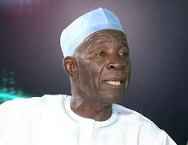
Galadima’s Failed Script: How An Evidence-Free Allegation Unravelled Under Scrutiny
By Shariff Aminu Ahlan
The recent press briefing by the Kano State Government has done what facts always do when brought to bear on political fiction: exposed the hollowness of Alhaji Buba Galadima’s allegations against His Excellency, Governor Abba Kabir Yusuf, and the Director of the DSS in Kano State.
What was presented as a dramatic revelation has crumbled under constitutional clarity, institutional fact, and basic logical scrutiny. The government’s response was structured and unequivocal: the allegations are baseless, malicious, and politically engineered to manufacture tension where none organically exists.
The most fundamental error in Galadima’s narrative is one that should disqualify it from serious consideration: the false premise that the Kano State Government controls the DSS. The DSS is established under the National Security Agencies Act of 1986, reports through the National Security Adviser to the President, and its Director General is a federal appointee. Its operational decisions flow entirely from federal authority, not from any state governor.
To suggest that Governor Yusuf directs the DSS against opposition is to misrepresent the Nigerian constitutional order so fundamentally that it raises serious questions about either Galadima’s understanding of the system he claims to defend, or his willingness to speak truthfully about it.
It is instructive to examine not only what Galadima said, but why he said it when he said it. His political journey across multiple parties, and his well-documented diminishing influence in his home state of Yobe, provide essential context. His decision to launch this offensive at precisely the moment of Governor Yusuf’s political realignment, and the disruption of patronage arrangements that realignment produced, is not coincidental. It is a strategy.
When political influence fades, noise becomes a substitute for substance. The louder the allegation, the larger the platform, regardless of whether the allegation is true.
Galadima’s portrayal of lawful security actions as political persecution is among the most dishonest elements of his narrative. The actions referenced were responses to specific complaints involving the deliberate use of digital platforms to defame individuals and incite disorder, conduct that falls squarely within the scope of Nigeria’s Cybercrime (Prohibition, Prevention, etc.) Act of 2015.
No responsible government will remain passive while individuals exploit digital platforms to threaten social stability under the guise of activism. The DSS Director in Kano has conducted the institution’s affairs professionally and within lawful procedure. The characterisation of this as a crackdown is a narrative construct, not a factual account.
Governor Yusuf’s democratic credentials are not in question. He came to power in 2023 through a competitive election acknowledged as among the most significant in Kano’s recent history. Since then, opposition figures have continued to operate freely, the media functions without hindrance, and civil society remains active. These are not the conditions of a state closing its democratic space.
At the heart of this episode is a reality Galadima’s narrative is constructed to obscure. Governor Yusuf has demonstrated independent leadership, refusing to subordinate Kano’s interests to actors whose primary concern is the preservation of patronage arrangements that served themselves rather than the public. That independence has disrupted certain networks. The campaign against the Governor is therefore less about democracy and more about the frustration of political displacement. Naming this honestly is not cynicism. It is the analytical clarity the Nigerian public deserves.
Kano remains committed to democratic governance, the rule of law, and peaceful coexistence. Security agencies will continue performing their constitutional duties professionally. And Governor Yusuf’s administration will continue to govern and deliver, demonstrating through action that its democratic credentials are beyond question.
Galadima’s script has failed not because it was suppressed, but because it could not withstand scrutiny. Noise cannot overshadow performance. Fabrication cannot defeat credibility. And orchestrated allegations cannot diminish a governor whose standing is rooted in popular legitimacy and a demonstrable record of service. The people of Kano are watching. They are informed. And they are not deceived.