

By Hadiza Musa Yusuf
The Executive Chairman of the Jigawa State Universal Basic Education Board (SUBEB), Prof. Haruna Musa, has said the state government is fully aware of the challenges facing basic education, particularly school infrastructure and WASH facilities, and is taking steps to address them.
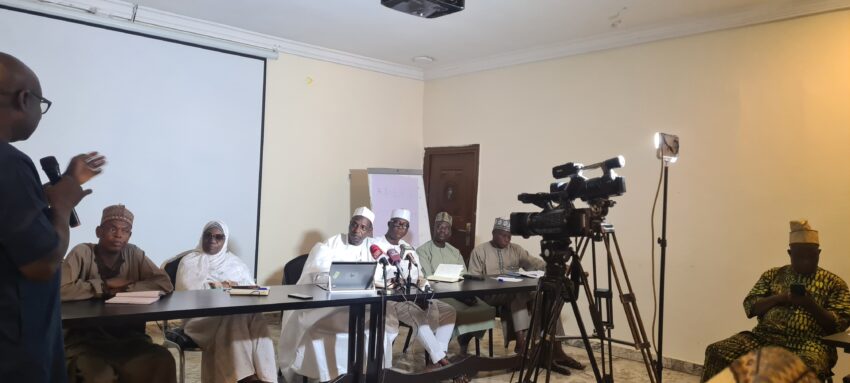
Musa made this known during a media dialogue held after a media tour of selected schools across Jigawa State, organised by UNICEF, where journalists assessed the condition of classrooms and sanitation facilities.
“We are aware of our challenges and we are working towards fixing them. Learning cannot stop simply because there are no functional toilets in some schools. We will get there.”
He disclosed that Jigawa State currently has 2,727 primary schools and 618 junior secondary schools, bringing the total number of public basic schools to 3,345.
According to him, there are 8,689 toilets across schools in the state, with 6,585 in primary schools and 2,104 in junior secondary schools.
The SUBEB chairman explained that the state has put systems in place for strategic renovation, operation and maintenance of school facilities, with a long-term target set for 2030.
“All hands are on deck. Of course, resources are limited, but education remains a priority for us,” he said.
He added that WASH issues are among the challenges the state is addressing.
He also revealed that the state is carrying out house-to-house campaigns to encourage children who are not in school to return, while a technical committee has been tasked with identifying best practices, climate-resilient structures and ways to strengthen community ownership of school facilities.
According to him, the state has also signed a performance bond to improve accountability in the education sector.
Speaking at the dialogue, the Technical Adviser to the Jigawa State Governor on Basic Education, Dr. Hauwa Mustapha Babura, stressed the importance of WASH facilities in keeping children, especially girls, in school.
“WASH is very important to us in Jigawa State, if we truly want children to be retained in school,” she said.
“We don’t want our girls to just survive; we want them to thrive.”
Dr. Babura noted that lack of privacy and sanitation often forces girls to drop out of school.
She also acknowledged the challenges posed by the state’s terrain and inherited infrastructure issues.
“Even the soil has issues in Jigawa. You build, and it collapses. We need to know why. We are doing a lot, but we also inherited a lot. We have just spent two years, give us the next two years, and we will achieve even more,” she said,
On her part, Dr. Sussan Akila, UNICEF Advocacy and Risk Communication Specialist, commended Jigawa State for being the first state in Nigeria to declare Open Defecation Free (ODF).
“Declaring a state ODF is not just about sanitation; it is about the health of the people, especially children and women who are most vulnerable,” she said.
However, she raised concerns over national data, citing a 2021 WASH survey which showed that only 11 per cent of schools have basic WASH amenities with the state having just 2%.
She warned that poor WASH conditions expose children and women to serious health risks and affect school enrolment and retention.
Dr. Sussan called on Jigawa State to build on its sanitation success by becoming a model for basic WASH facilities in schools, particularly in rural areas.