

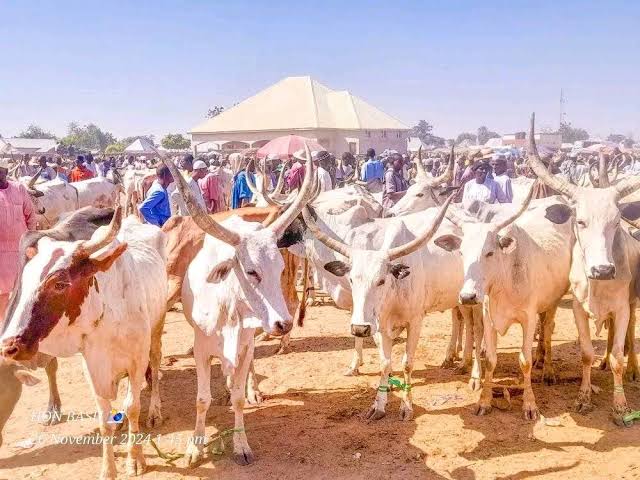
Kano’s Livestock Market Booms,Amidst Surging Use of “Sha Ka Fashe”
By Salisu Ibrahim Fagge with reports from Abbas Ibrahim, Mohammed Kabir Yau,Abdullahi Yusuf,Mustapha Muhammad and Kabiru Fulatan
Livestock business is thriving in Kano markets, as Nigeria’s growing appetite for meat, milk, and leather expands.
As Livestock Markets in Wudil, Dambatta, Ladin Makole, and a host of others boom with activities to meet the rising demand for meat and leather, the business of livestock trade is facing challenges of under regulation, amidst reported misuse of fattening drugs known as “Sha Ka Fashe” on animals.
An investigation conducted by our team of reporters revealed a critical regulatory vacuum, a development that’s apparently jeopardizing public health and weakens economic stability of the people.
This special report highlights a gradual shift towards the unethical practices, as some livestock dealers resort to the use of illicit “fattening” substances, which appears unhealthy and a threat to the entire livestock value chain.
Report shows that some dealers are allegedly prone to using fattening substances — a weight-gain drugs popularly referred to as “Sha Ka Fashe” — to artificially fatten cattle and sheep. Although, the practice is basically to attract buyers, however, the impact is raising concerns on the safety and quality of the animal meat.
Our investigations revealed that the substance “Sha ka fashe” was mainly associated with the use for human weight gain, but it is gradually gaining acceptability among livestock dealers that were reportedly administering it to cattle and sheep to make them gain weight rapidly, in order to attract buyers.
However, Experts warn that the associated effects of these practices could unleash antimicrobial resistance and Mad Cow Disease which can cause harm to human health, while the unsuspecting buyers experiences economic loss.
THE GROWING CONCERN
The growing practice is becoming so alarming, putting animals, farmers, and consumers at risk — while the development calls for urgent government regulation.
Malam Muhammad Balarabe, who spoke with our correspondents said, he eventually experienced significant financial loss as he purchased a “very big cow that’s “healthy-looking” but eventually deteriorated and later died within days of purchase.
Balarabe called for prompt provision of regulatory & legal framework to ensure proper control of the practice.
Our team of reporters also found out that if the practice remained unchecked it is like — a ticking time bomb for the animal & human health, while the nation risks losing breeds, farmers, and food security.
Experts however, are of the view that the practice could equally spark antimicrobial resistance and Mad Cow Disease, particularly as Livestock dealers who reportedly administer “Sha ka fashe” are doing so to rapidly bulk up animals for economic reasons, but in the long run, they are causing animals to suffer severe diarrhea, infections, and at times, sudden death.
In the course of our investigations, Mrs. Alice Attabor, an Assistant Director and second in command to the Kano State, Coordinator NAFDAC, Kano State office, revealed that the agency had cracked down and destroyed fake agrochemicals, seized offensive drugs from manufacturers, and prosecuted some offenders. “So far, the agency has destroyed a significant consignment of fake agrochemicals and prosecutes offenders under Sections 5 & 6 of the NAFDAC Act”, she said.
According to her, factories producing unregistered animal medicines have been sealed, with operators prosecuted facing up to 5 years imprisonment.
When contacted also on the matter, the Director of Public Health and Epidemiology, Dr. Abubakar Sani Inuwa of the Ministry of Livestock in Kano, said although the Ministry has yet to receive formal complaints on livestock fattening drugs, yet measures are proactively taken in addressing issues that could affect public health.
The Ministry, Dr.Inuwa said, had stepped up measures to register livestock premises in the State in order to tighten regulations, effectively track dealers of veterinary drugs, livestock feeds, dairy products, and meat sellers.
“We need public understanding to help us in achieving our target and curb the malpractice,” he said.
While the government is stepping up effort to tighten control, and turn the risk into opportunity, experts are of the view that the “choice before the government is very clear: “regulate the practice or reap the chaos.”
Although views among livestock sellers vary, some admit that the animals are given the substance to help them gain weight, while others said it is being done to make the animals appear healthy in the eyes of buyers.
A businessman, Malam Musa Suleiman, recalled how about two years ago around Eid el-Kabir festivities, he purchased a cow for sacrifice. “When I brought the cow home, it appeared fat, strong, and very healthy, however, the next morning, I found it (the cow) lying on the ground, suffering from severe diarrhea.
Eventually, it did not serve the purpose. I had to slaughter it before the Eid and bear the loss. A year after, I purchased another cow, and unfortunately experienced the same problem. This time, instead of slaughtering the animal, I was advised to call a veterinarian, which I did.
The veterinarian collected a sample of the cow’s faeces, sent it to the laboratory for testing and the result showed the cow had been given fattening drugs, which caused it to appear healthy at first but later had severe diarrhea and became weak.
After two experiences, I decided to stop buying cows directly from the market. I now buy calves and rear them myself until the time of sacrifice, to avoid such losses.
WHY GOVT MUST ACT NOW:
Public concerns over the issue of drug residue in animals are becoming a trend, and experts warn that improper use of veterinary drugs could have serious implications for human health. “Drug residues in meat may contribute to antimicrobial resistance, a condition in which the body becomes resistant to medications, leading to multiple negative consequences for society”, Dr. Abubakar Inuwa told our reporter. As an expert, he said that, the state government’s proactive measures are effectively assisting in curbing misuse and excesses as well as avoiding “fattening” scams.
A livestock dealer, Danjummai Lawan, suggested the need to enforce Animal welfare measures to protect the animals from improper treatment, particularly when they are being transported to states outside Kano, as well as penalize cruelty against them while also mandating vaccinations on the animals.
Lawan was of the view that rewarding good farmers, and providing subsidies for certified producers, educating them on the safety, and risk of the unethical practice on the animals and human beings, could reduce the practice and minimise the hazards of producing unregulated meat.
Another dealer, Malam Bala Balarabe said, when government support ethical producers — subsidies for certified farms, ensure public awareness by educating people on the dangers of unregulated meat, the sector would grow without associated risks.
Both experts, buyers and dealers opinions expressed pointed to the need for prompt government attention to act now and avoid watching the sector turn “toxic” that threaten human health.
As Malam Rabi’u A Yakasai said, “there is an urgent need for the establishment of Halal Abattoir that would be managed by competent veterinary health officials, people who can ensure safe livestock value chain production and eventually assist in addressing the problems.