

Kano’s Neighborhood Watch Corps Launch:How Sen. Kwankwaso Debunked Opposition’s Claim Of Grassroots Support
By Shehu Adamu
Introduction
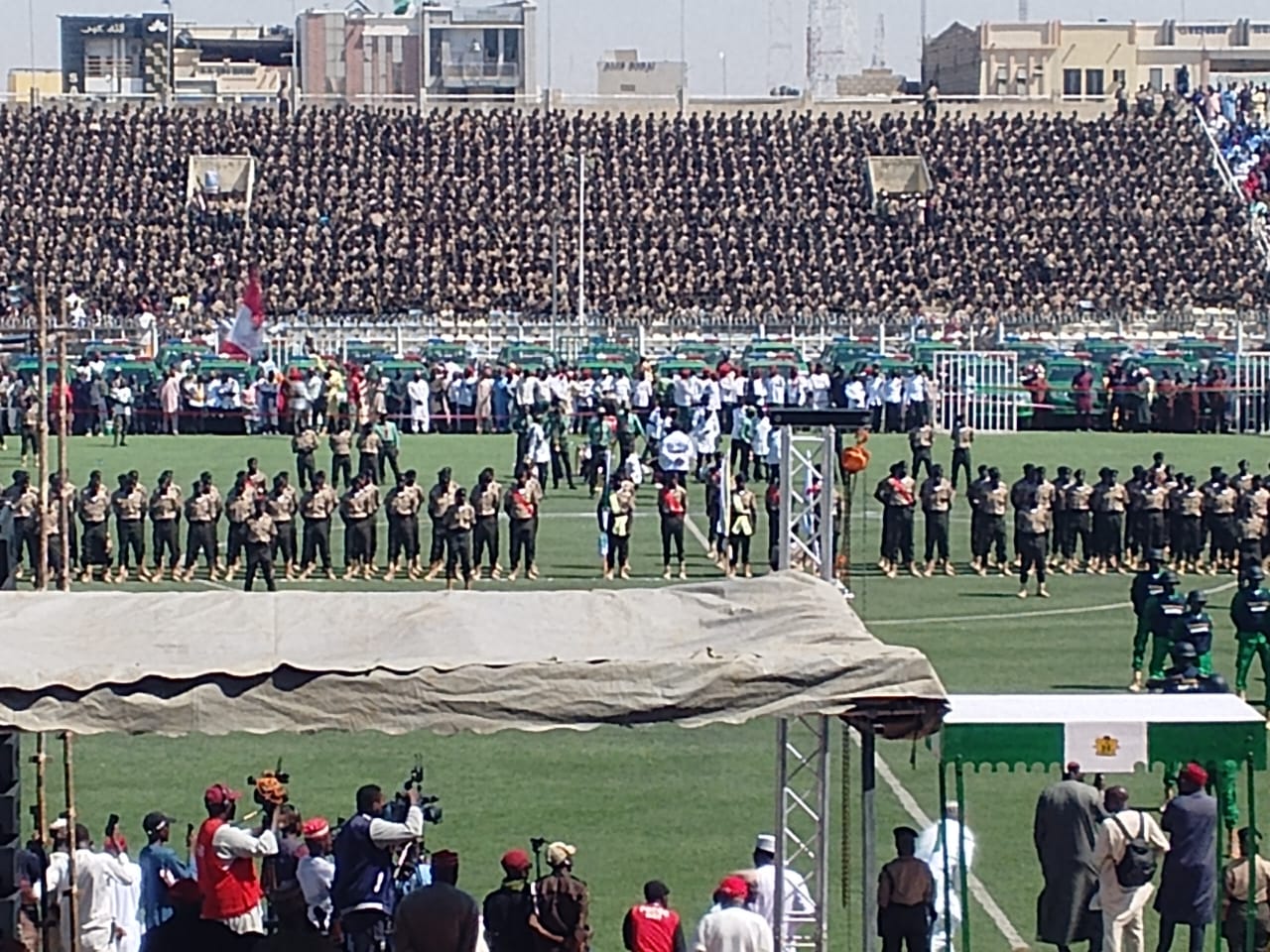
The passing out parade of members of the Kano State Neighbourhood Security Watch Corps was more than a ceremonial exercise. It was a symbolic moment that once again brought into sharp focus the enduring political relevance of Senator Rabi’u Musa Kwankwaso and the grassroots-driven Kwankwasiyya Movement in Kano State. At a time when opposition elements continue to claim dominance at the grassroots, recent events—political, social, and developmental—have exposed the fragility of such claims and reaffirmed where the real mass support lies.
Since its emergence as a people-oriented political movement, Kwankwasiyya has consistently shaped Kano’s political landscape, surviving elite resistance, institutional obstacles, and federal pressure while retaining the loyalty of the ordinary people.
The Roots of Kwankwasiyya’s Grassroots Appeal Since 2011
The modern Kwankwasiyya Movement took firm root after 2011, following Senator Kwankwaso’s return as Governor of Kano State. His administration prioritised talakawa-oriented governance, massive investments in education, infrastructure, health, and human capital development. The iconic red cap became more than a political symbol; it represented inclusion, dignity, and hope for thousands of ordinary Kano citizens.
From foreign scholarships to urban renewal, from rural road networks to healthcare revitalisation, the Kwankwasiyya philosophy translated governance into visible benefits. This period cemented an emotional and political bond between Kwankwaso and the grassroots—one that has endured beyond party platforms and electoral cycles.
Defeating Incumbency: A History of Political Upsets
The 2003 Political Earthquake
Although Kwankwaso was controversially removed from office after his first term, the political consciousness he awakened among Kano voters laid the foundation for future electoral revolts. His structure survived displacement and repression, transforming into a resilient movement rather than a temporary political machine.
The 2019 Setback and Federal Intervention
The 2019 governorship election remains a defining episode in Kano politics. The Kwankwasiyya-backed candidate had effectively defeated the incumbent administration at the polls. However, the unprecedented declaration of the election as inconclusive—widely viewed as a federal intervention—altered the natural course of the people’s will. What followed was a rerun that returned the incumbent under heavily disputed circumstances.
Despite this setback, the episode further strengthened Kwankwasiyya’s grassroots credibility, as many voters interpreted the outcome not as a rejection of the movement, but as proof of its strength and the fear it inspired among political opponents.
The 2023 Redemption
In 2023, Kano voters delivered a decisive verdict. Against the full weight of incumbency, federal alignment, and internal sabotage, the NNPP-led Kwankwasiyya Movement defeated the ruling APC to reclaim the Government House through Governor Abba Kabir Yusuf. This victory reaffirmed a consistent historical pattern: whenever the people’s votes count, Kwankwasiyya prevails.
The APC Crisis and the Collapse of Opposition Claims
The current political scenario within the Kano State APC is defined by deep internal fractures, leadership crises, and mass defections. The once formidable ruling party has been reduced to a coalition of competing factions, lacking ideological coherence and grassroots trust.
Many former APC loyalists—especially at ward and local government levels—have either openly joined the NNPP or quietly aligned with Kwankwasiyya structures. The inability of the APC to reconcile its internal contradictions has created a vacuum that Kwankwasiyya continues to fill with discipline, clarity of purpose, and popular legitimacy.
PDP and ADC: Political Shadows Without Substance
The People’s Democratic Party (PDP), once a major force in Kano politics, has virtually ceased to exist as a competitive structure in the state. Years of defections, weak leadership, and absence of grassroots engagement have rendered the party politically irrelevant.
Similarly, the newly established African Democratic Congress (ADC) has failed to demonstrate any meaningful presence or mobilisation capacity in Kano. Without structures, loyal followership, or credible leadership, ADC remains a theoretical opposition rather than a practical alternative.
In contrast, Kwankwasiyya operates as a living movement—embedded in communities, markets, campuses, and social networks across the state.
Governance as Proof: NNPP’s Infrastructural Drive Under Abba Kabir Yusuf
Beyond politics, the NNPP-led administration under Governor Abba Kabir Yusuf has reinforced Kwankwasiyya’s popularity through governance. The administration has embarked on:
Massive urban and rural road rehabilitation projects
Revitalisation of public schools and hospitals
Restoration and expansion of water supply infrastructure
Renewed investment in education and teacher welfare
Strengthening of community-based security, including the Neighbourhood Security Watch Corps
These interventions resonate directly with the everyday realities of Kano residents, further entrenching the perception of Kwankwasiyya as a movement that governs with empathy and purpose.
Looking Ahead to 2027: Kwankwasiyya’s Upper Hand
As Nigeria approaches the 2027 general elections, the political indicators in Kano overwhelmingly favour the NNPP Kwankwasiyya Movement. With a united structure, a popular sitting governor, a legendary political leader in Senator Kwankwaso, and a fragmented opposition, the balance of forces is clear.
The movement’s history demonstrates a simple truth: Kwankwasiyya does not rely on elite endorsements—it relies on the people. And in Kano politics, the people have consistently proven to be the ultimate deciders.
Conclusion
The passing out parade of the Kano State Neighbourhood Security Watch Corps was not just a security milestone—it was a political statement. It underscored continuity, grassroots trust, and governance rooted in community needs. Despite opposition claims, the reality on the ground tells a different story.
From 2011 to 2023, and now looking toward 2027, Kwankwasiyya remains the most authentic expression of popular political will in Kano State—tested by adversity, strengthened by resistance, and validated repeatedly at the ballot box.
Shehu Adamu is a public analyst on sports and politics