

By Mustapha Salisu
The Special Agro-Industrial Processing Zones (SAPZ) Programme in Kano State has organised a one-day media sensitisation training on Behaviour Change Communication (BCC) for improved nutrition, aimed at strengthening the role of the media in promoting positive nutrition practices across the state.
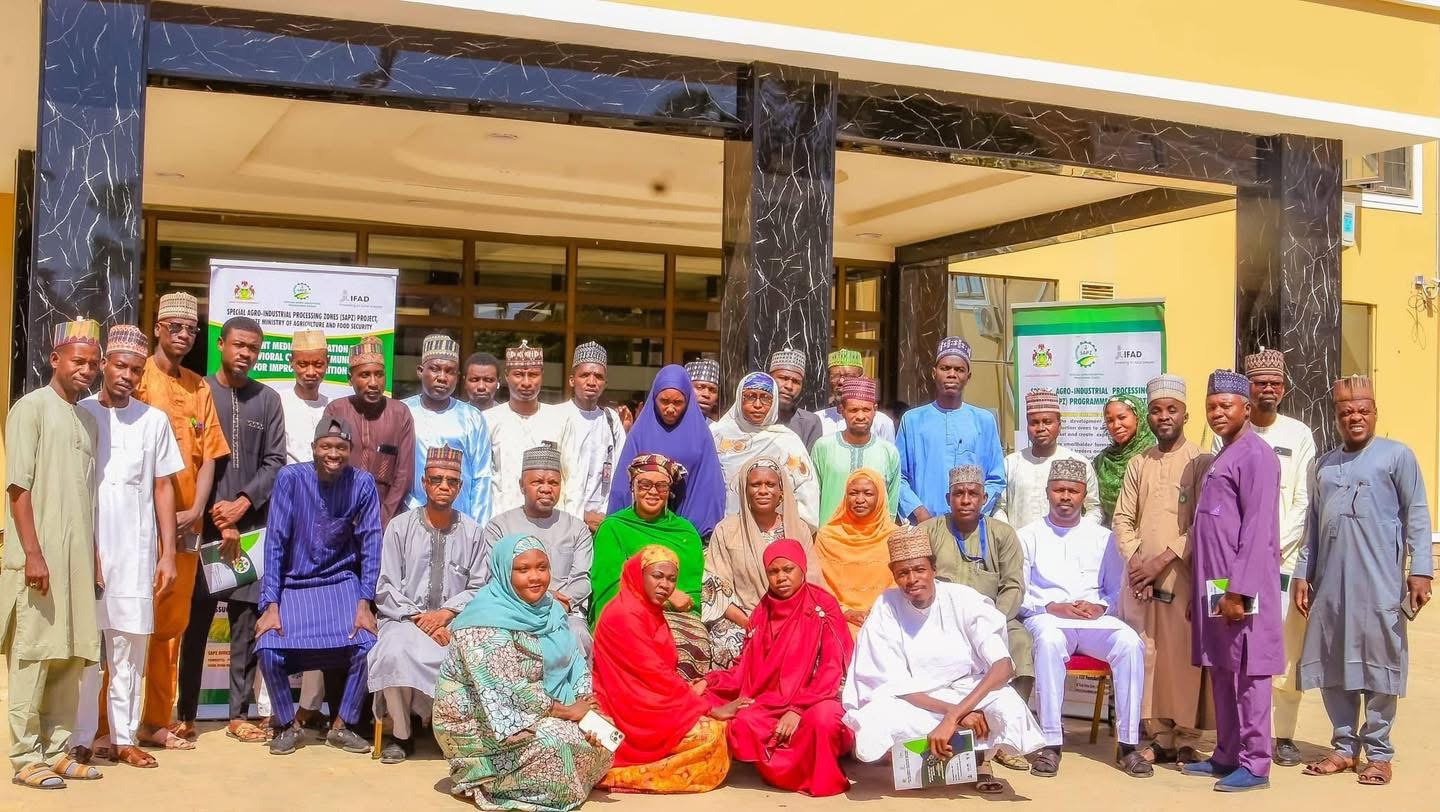
The joint One-day media sensitisation workshop organised by SAPZ Programme Kano State in collaboration with the Ministry of Health and Ministry of Agriculture and Natural Resources, Kano State, held on Wednesday 31st December, 2025 in Kano, brought together journaalists and other media practitioners, health educators, nutrition focal persons and smallholder farmers from the 8 LGAs of SAPZ catchment areas and other relevant stakeholders.
The training, theme “From Information to Action: Media’s Role in Driving Nutrition Behaviour Change, ” was aimed at strengthening participants’ understanding of the SAPZ programme and enhancing their capacity to effectively communicate nutrition-sensitive messages to the public.
It also sought to equip the media with accurate information and promote sustained partnerships for consistent and impactful coverage of nutrition issues in the state, The National Knowledge Management and Communication Officer, Babangida Shehu, gave an overview of SAPZ Programme concept, it’s Development Objectives to deepen the participants understanding on the programme initiative.
Speaking at the event, the Knowledge Management and Communication Officer of the SAPZ Kano Programme, Kano State, Hajiya Rabi Mustafa Sadiq, said the training was designed to raise awareness among media professionals on the critical role of Behaviour Change Communication (BCC)in improving dietary habits and nutrition outcomes.
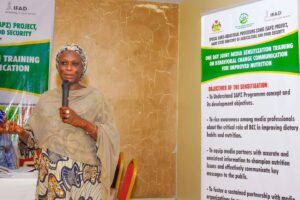
She noted that the programme also aims to provide journalists with accurate and consistent information that would enable them to effectively champion nutrition issues and disseminate key messages to the public.
Hajiya Rabi disclosed that the SAPZ project is currently supporting over 14,000 households in Kano State through nutrition-sensitive interventions, including intercropping activities involving bio-fortified crops such as high iron/zinc rice.
According to her, bio-fortified commodities contain higher levels of essential micronutrients needed by the human body, and their consumption can significantly improve the intake of vitamin A, iron and zinc among project beneficiaries.
“Increased production of these commodities will also enhance the availability of nutritious food for smallholder farming households, thereby contributing to improved household nutrition,” she added.
Delivering a paper titled “Fundamentals of Behaviour Change Communication and Its Role in Improving Nutrition Outcomes in Kano State,” Dr. Ruqayyah Yusuf Aliyu of the Department of Mass Communication, Bayero University Kano (BUK), underscored the critical role of journalists in influencing dietary behaviour through awareness creation and evidence-based reporting.
She explained that although behaviour change is often challenging, the media can play a pivotal role in shaping attitudes towards balanced diets through deliberate, strategic and sustained communication.
Dr. Ruqayyah described behaviour change as a gradual process that involves modifying actions and mindsets over time through consistent and targeted messaging.
Facilitators at the workshop highlighted the severity of malnutrition in Kano State, citing UNICEF data for 2025, which indicates that 51.9 per cent of children in the state are stunted, while the prevalence of underweight among children under five stands at 42.6 per cent.
They noted that malnutrition has far-reaching consequences, negatively affecting children’s growth and development, women’s health and overall community productivity.
Other challenges identified during the training included inadequate knowledge among rural farmers on best practices for sesame cultivation, resulting in losses during harvesting, storage and processing.
In his address, the Permanent Secretary of the Kano State Ministry of Agriculture and Natural Resources, Dr. Bashir Sunusi, reaffirmed the state government’s commitment to achieving food security.
He cited ongoing investments in dam rehabilitation, irrigation facilities, dry-season farming initiatives, as well as the recruitment of 1,038 personnel to strengthen service delivery in the agricultural sector.
The training concluded with a call for proactive media engagement on nutrition issues and the establishment and inauguration of a technical working committee by the Permanent Secretary Kano State Ministry of Health, Alhaji Bashir Aminu to champion Behaviour Change Communication for improved nutrition in Kano State, with monitoring mechanisms established to track its activities.