

From Sani Gazas Chinade Damaturu
For years, local government officials in Adamawa State sat through countless training sessions often listening quietly, taking notes, and leaving everything unchanged. But a recent two-day workshop broke that cycle. This time, the participants brought something different: honesty.
Instead of passive listening, council officials openly interrogated financial discrepancies in their own records, reflected publicly on institutional weaknesses, and committed to measurable reforms. Organisers described the shift as a move from passive compliance to active ownership a breakthrough in local governance.
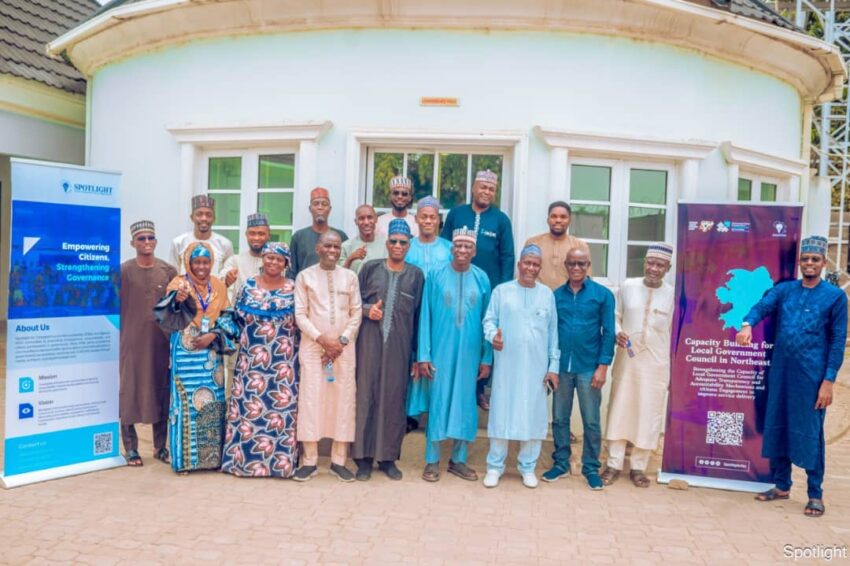
The capacity strengthening workshop,organised by Spotlight for Transparency and Accountability Initiative (Spotlight NG) with support from the Nigeria Youth Futures Fund (NYFF), tackled a core governance challenge: the disconnect between public resources and public benefit at the grassroots level.
Yet the real story, according to those present, was the unprecedented willingness of local leaders to confront uncomfortable truths.
For communities in Northeast Nigeria still reeling from conflict, displacement, and economic hardship, such honesty has been long overdue. Ineffective governance has meant underfunded schools, poor health centres, and crumbling infrastructure. Now, for the first time, officials are admitting the problem and vowing to fix it.
Muazu Alhaji Modu, CEO of Spotlight NG, noted that the training was designed to go beyond theory.
“Local government plays a critical role in delivering basic social services.
“A functional and accountable system is essential for meaningful improvements.
This is why we are deliberately investing in transparency, accountability, and active citizen participation,”said Mr Muazu.
Participants were introduced to financial transparency frameworks and civic technology like Bayani AI. But organisers stressed that technology alone is insufficient. Its impact, they said, depends entirely on whether institutions embrace transparency and citizens can engage with data meaningfully. In Adamawa, that embrace has now begun.
The workshop concluded with a quiet but powerful reaffirmation: rebuilding trust in public institutions must start from the ground up with empowered officials, informed citizens, and accountability as the norm.
In Adamawa, that process may have just taken its most honest step yet. And for the communities who have waited too long for basic services, that is very good news indeed.