

By Umar Dankano, Yola
The Alkalanci Organization, in collaboration with the Foreign, Commonwealth and Development Office (FCDO), with funding support from the Integrated Security Fund (ISF), West Africa Unit, has urged religious leaders to leverage their influence in tackling fake news and disinformation ahead of the 2027 general elections.
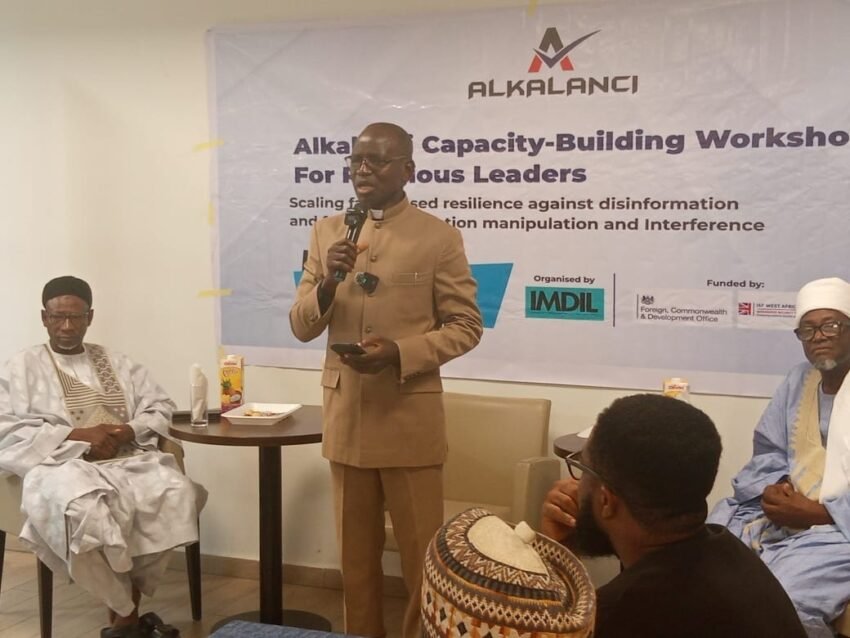
The Program Manager of Alkalanci Organization, Ms. Bamas Victoria, gave the charge while delivering her keynote address at a two-day training workshop organised for 20 selected religious leaders in Adamawa State.
She said the growing dangers and negative impact of false information circulated through social media platforms informed the decision to organise the training.
Victoria explained that the relevance, respect and influence commanded by religious leaders across the two major faiths of Islam and Christianity informed their selection, noting that they could reach large congregations across different communities.
She said the organisation was adopting a train-the-trainer model through which selected participants would acquire media and information literacy skills and subsequently transfer the knowledge to their followers and communities.
According to her, the theme of the workshop, “Scaling Faith-Based Resilience Against Disinformation and FIMI,” was designed to address disturbing developments in the country’s information space, particularly the growing monetisation of fake news, propaganda and sensational content.
The programme manager added that the organisation had established a monitoring and evaluation mechanism to assess the impact of the training and determine whether participants were effectively transferring the knowledge acquired to their respective communities.
In their separate remarks, the Chairman of the Christian Association of Nigeria (CAN), Rev. Joel Manzo, and the Secretary of Jama’atu Nasril Islam (JNI), Mallam Bappare Umar Kem, expressed satisfaction with the training and commended the organisers for the initiative.
They described the intervention as timely and relevant, noting that it would broaden participants’ knowledge and equip them with the necessary skills to educate members of their respective communities on responsible information consumption and sharing.
Some participants interviewed at the venue expressed optimism that the intervention would help address misconceptions surrounding information sharing, particularly the use of derogatory and abusive language across various communication platforms.
Our correspondent reports that similar capacity-building workshops have been conducted in other locations, including Kano, Sokoto, Kaduna, Gombe, Abuja and the neighbouring Maradi Region of the Republic of Niger.