

By Zulaiha Danjuma
The Pad That Burns
“I had only started using the new expensive pad when the burning started.”
Ceecee says it quietly, like she is still checking if it’s normal to say it out loud.
She stopped using that particular brand immediately. But the rashes had already spread.
Scroll through TikTok, X, WhatsApp and Facebook in Nigeria and you will see her. Not her face, but her complaint.
“Which pad do you use that doesn’t give itching?”, “Pads are harmful to women now”, “Pads are fake now, it gives me rashes”, “The wings don’t even have gum again.” These are comments you’d see from hundreds of Nigerian women across social media complaining about the state of sanitary pads in Nigeria.
For an adolescent girl, a pad is supposed to be a best friend. It locks in moisture, prevents leakage, gives confidence to go to school, to work, and to carry out daily activities.
But that best friend is now being called fake, chemical-filled, light, plastic, irritating.
“Pads are no longer of good quality. Most of them can’t hold flow, they have become lighter than usual. And the wings do not have sufficient gum to keep them locked,” Ceecee says.
She narrates a horrible experience she encountered while using a renowned and expensive pad brand which gave her a vaginal rash and landed her in a pharmacy for treatment.
“I went to a pharmacy to buy drugs for the rash when it started.” She won’t say how much she paid. Only that a menstrual product she bought to protect herself forced her to spend again to heal herself.
Ceecee admits she still uses pads, just not that brand. “Yes, I am still using pads,” she says. However, when asked if she knew about other menstrual products like period cups and period pants, she was honest: “I don’t really know much about the other products, that’s why I still continue using pads.”
That gap — between pain and information — is why social media is loud. There has been an uproar of increasingly dissatisfied and frustrated women using pads for menstrual hygiene in Nigeria. Several videos, tweets and posts document personal experiences about the declining quality and efficiency of pads.
However, a more damning account came after 16 major disposable sanitary pad brands were tested and 17 Volatile Organic Compounds (VOCs) were detected in them.
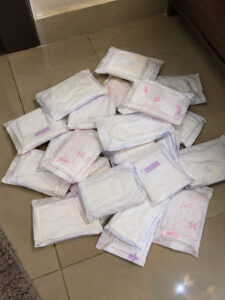
The research was conducted by the Nigeria Defence Academy (NDA) and the Air Force Institute of Technology (AFIT). Together, they found that everyday sanitary pads sold in Nigeria contain a hidden cocktail of 17 different Volatile Organic Compounds (VOCs) that cause immediate discomfort like painful skin irritation, itching, and rashes, while posing severe long-term risks like menstrual cycle changes, decreased menstruation, uterine diseases, fertility issues, and even cancer.
In Nigeria, sanitary pads are listed by the National Agency for Food and Drug Administration and Control (NAFDAC) as medical devices. NAFDAC’s online Greenbook contains registered sanitary pad products, including products manufactured in Nigeria and products for which Nigerian companies are listed as applicants.
As of press time, NAFDAC has not published an independent laboratory test on VOCs in pads. However, the concerns have reached the National Assembly. On September 23, 2026, Senator Ireti Kingibe urged NAFDAC and the Standards Organisation of Nigeria (SON) to investigate the findings on VOCs in disposable sanitary pads. In a statement, she said, “The health, safety and well-being of women and girls across our nation must remain a national priority” and urged regulators to “immediately investigate these findings, conduct comprehensive safety assessments”.
Despite the uproar about sanitary pad safety across social media, and now the National Assembly, a large number of Nigerian women like Ceecee do not have enough information about other sanitary product options, or even organic and biodegradable pads.
But some women are filling this gap themselves.
The Search For An Alternative
Nkiruka was at a retreat camp when she had her worst period. Not the bleeding. The itching.
“Period itself is not the best scenario a woman would want to be in outside,” she says, her voice tight, breathing up and down. “Then attach the itchiness, the discomfort and at that point it just becomes a losing game.”
For 17 years, Nkiruka used sanitary pads. Yet, she battled serious rashes, serious itching, and bumps she never imagined would come from using pads to manage her menses.
“Aside from the boils I suffered, pads were no longer very comfortable for me, as a heavy bleeder,” she says. She explains how she couldn’t dress how she wanted, as she was constantly worrying about leakages.
This frustration led her to switch to baby diapers. But that transition wasn’t pleasant either.
“You know how diapers can be — it is big. When you wear it you know you are wearing something.”
Frustrated by her diaper option, she started searching online for alternatives. On one of her searches, Nkiruka stumbled on a video about tampons.
“I saw a video where people were talking about tampons, and I have seen movies where the word tampon was mentioned.”
For a moment, Nkiruka felt she might have found a better option than pads and a more comfortable alternative to diapers. But her enthusiasm quickly died when another video popped up on TikTok.
“I then saw another video that warned about toxic shock syndrome associated with tampons.” That warning scared Nkiruka. Yet again she found herself confused and uncertain about the right sanitary product for her.
Then, an unexpected TikTok algorithm push shone through for Nkiruka.
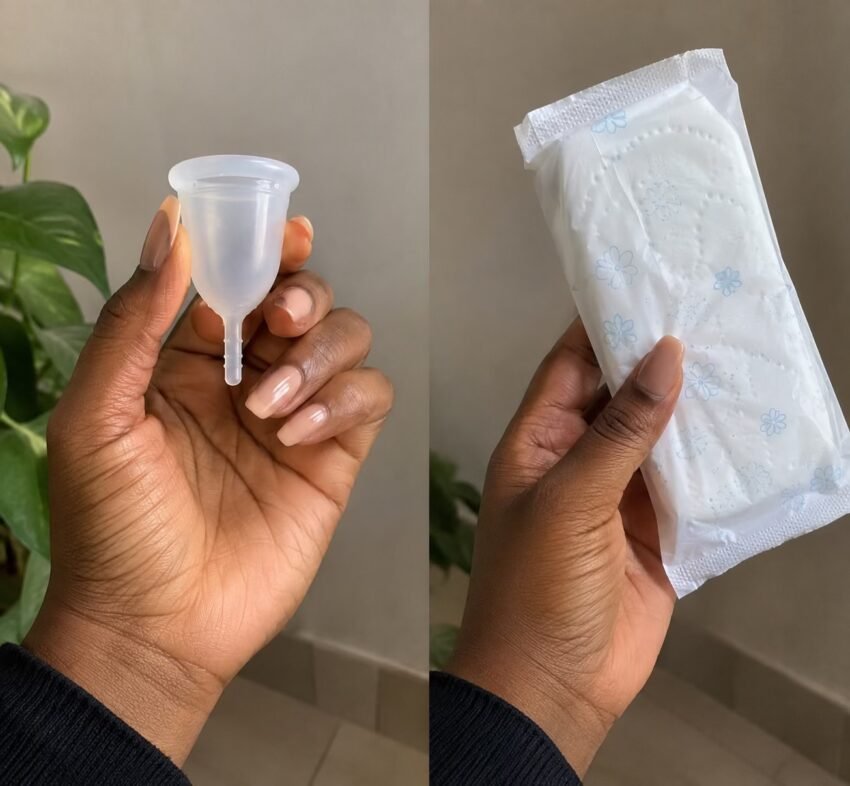
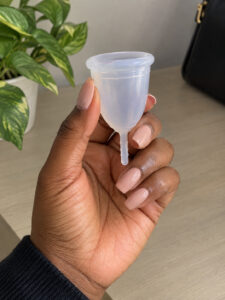
TikTok showed her a different option; a small bell-shaped cup made of medical silicone. Not something that sits outside and absorbs, but something that sits inside and collects. These were menstrual cups or period cups as they are frequently called.
A menstrual cup is a bell-shaped, highly flexible silicone cup that you insert into the vagina to collect period blood. They are said to hold three times more blood than a pad, and can stay up to 12 hours. It requires you to empty it when full, wash or rinse it and reuse it.
Even though Nkiruka had found this option, she still had concerns. Her general worry was if the cup would give her the comfort she had so much sought.
“My fear was how does the cup enter inside — is it big?” she says. “That would be defeating the cause. Because I want comfort while on my period.”
The first month she didn’t trust it. She wore the cup and layered a pad over it, just because she feared it might leak. It never leaked.
Nkiruka explains that her first month came with uncertainties because she had used sanitary pads for 17 years of her life. And she naturally felt anxious. However, after the first month she found cups less unsettling.
“By the second month of using the period cup, it became second nature.”
Now, Nkiruka says she sleeps without layering herself due to fear of stains as she did when she used pads and baby diapers.
When asked how she knew when her cup was full, she replied, “You will know it’s full. Somehow you’d know, I can’t explain it, you’d just know,” she said as she burst into a smooth and light laughter.
Nkiruka confidently upholds her choice. According to her, she switched not just because of comfort or TikTok influence but for health.
“When I was using pads, I experienced very painful, recurring boils,” she said. The boils came always during her period, and went after her period. She ignored it the first time. But due to its recurrent and irritating nature she had to seek medical help.
Nkiruka recalls how she had to visit the hospital to see a gynecologist, who gave her antibiotics and drained the boils because it had formed pus. “It was a very horrible and painful experience. That was the starting point of me wanting to switch,” she says.
This conviction led her to introduce her sister to menstrual cups.
Asked whether the technicalities of inserting and emptying a cup could pose a challenge to women at work, she says, “I work from home, so personally rinsing it is easy.” But she attests she sees how it might cause challenges for a woman in a market or a school toilet without clean water. However, her sister, who does not work from home and uses menstrual cups too, has never complained.
Nkiruka is happy and content with her choice, which cost 3,000 Naira for the cup and 5,000 Naira in total including shipping and pickup on Jumia.
“And for nine months and counting, I have been using the same cup. Menstrual cups are much more economical and environmentally friendly,” she says.
Despite a growing number of Nigerian women like Nkiruka who completely stopped their painful, recurring menstrual boils by abandoning sanitary pads for menstrual cups — severe infections that previously required gynecologists, antibiotics and surgical drainage — many women still have strong reservations about choosing the cup.
Read Part 2: Her Menstrual Journey: The Health Cost of Bleeding in Nigeria (II)