

By Zulaiha Danjuma
Among them is Nushra, a young woman in her 20s who feels the menstrual cup could cost her virginity and force her to endure the thought of an invasive kit inside her vagina.
“I have heard about it but I think it will break my virginity, so it’s something I can’t even think of,” she says, cringing.
She has seen videos online raising concerns about sanitary pads in Nigeria, but she feels cups and any other invasive option are not made for women who have not had sex.
“I saw a video on Instagram of a female doctor talking about how to use a menstrual cup and that it will be inserted into the vagina. When I heard her say that, my body cringed,” Nushra says, her face in a grimace. “It’s not that many women don’t know pads now in Nigeria are not that good, but options like menstrual cups are uncomfortable for many of us honestly.”

Like Nushra, this fear that cups will break hymens and disvirgin girls is a global concern, especially in societies where the preservation of women’s chastity is revered.
Speaking to Dr. Maryam Nasir Aliyu of the Department of Human Anatomy, Northwest University, Kano. She says, we are confusing biology with social anxiety.

“Actually I need to explain very clearly that virginity is a social concept, not a biological one,” she says. “Medically when we talk about virginity we talk about someone who has not engaged in any form of sexual intercourse. That is a virgin medically. But for the social construct it actually means breakage of the hymen.”
The hymen itself, she explains, is not a seal that proves purity. It is a very thin and flexible tissue covering the vaginal opening that can stretch naturally. A simple walk or exercise, even before menstruation starts, can break it.
“So a menstrual cup may stretch or may tear the hymen, that does not mean the girl or young woman is no longer a virgin. Mind you, the hymen may have broken before menstruation has started… that does not mean the girl is sexually active.”
For young women like Nushra who are still anxious, she recommends starting smart. There are different types of cups, and there are soft, smaller, more flexible ones made specifically for young girls who have not had sexual contact.
On whether a 15-year-old virgin can safely use it, she is clear: “Yes, a 15-year-old can use a menstrual cup safely. There is no age limit actually. If she is okay with it, why not. But if she is anxious about the whole process then I recommend she shouldn’t use it.”
Because fear itself, she says, is what makes it painful.
“First of all, the mindset. Someone has to actually relax. While the muscles are relaxed it is easier to insert the menstrual cup, as opposed to when the person is tense, that will also make the muscles tense, kind of locking the vaginal opening shut, so that may be painful or uncomfortable.”
Insertion, she explains, is all about the technique. There is a folding technique that reduces the cup to half its size before it goes in, so only a small portion enters before it opens. A dab of clean water or any water-based lubricant on the rim makes it easier. And angle matters.
“The vaginal canal is slanted, so when inserting a menstrual cup the woman should also insert it slanted towards the back of the spine, as opposed to just putting it straight up.”
If pads gave Nkiruka boils with pus that needed drainage, can cups also cause infection, especially in Nigeria where school and work toilets don’t have clean water?
For Nushra, who has to use a school toilet with no water, and for young women in offices with one fetid bucket in the bathroom, the question is real: If pads cause boils on the outside, what will a cup cause on the inside?
Dr. Maryam doesn’t sugarcoat it. “If you are using menstrual cups without washing your hands or washing your hands with contaminated water, it can actually introduce bacteria especially Staphylococcus and E. coli which can enter the vaginal canal and cause serious conditions including toxic shock syndrome which can actually kill.”
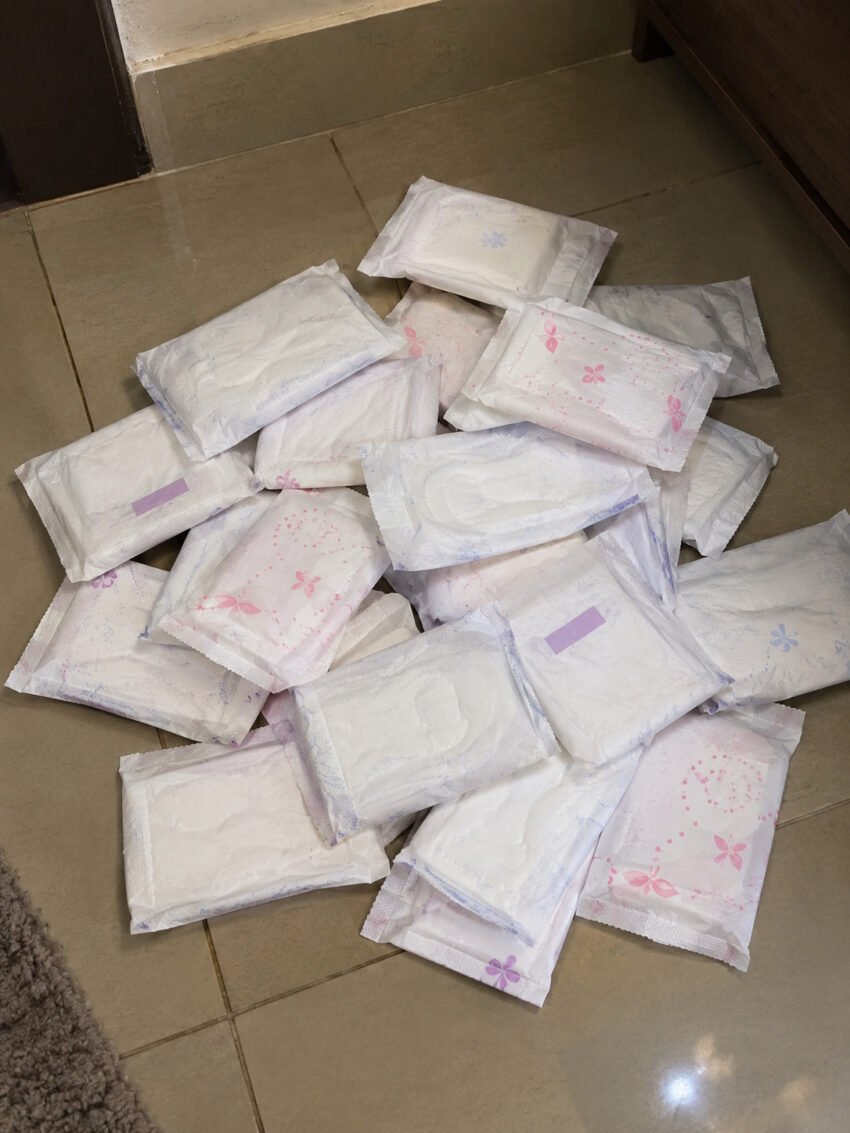
This is where, she argues, cups paradoxically become safer than pads in Nigeria. A pad, soaked in heat and blood, becomes a bacteria farm if you don’t change it every 3 to 6 hours – four times a day. A cup, because it traps blood inside itself instead of letting it sit against the skin, can stay for up to 12 hours. And you don’t have to empty it in that dirty school toilet at all.
But, if you must, she has a workaround built for Nigerian realities; Dr. Maryam says, carry your own clean bottle of water. Slip into the bathroom, empty, rinse with your own water, reinsert. “For the real sanitization of the cup it involves boiling the cup in clean rolling water for 5 to 10 minutes, and this can be done at home”.
Aside from being a doctor of anatomy, Dr. Maryam is also a woman, a mother and a wife. She describes product choice as personal preference.
“For me as my personal choice I prefer to use tampons. Personally, I use tampons because I find tampons more comfortable. I just insert a tampon and go about my business. I feel very comfortable with them. I don’t have to contend with the squishy sounds of sanitary pads, or the discomfort of having to wear a sanitary pad especially as a very active person,” she says. “I also do use menstrual cups too, especially when I’m bleeding heavily.”
Finding the right product has pushed many Nigerian women to experiment with materials never designed for periods. Like Nkiruka, who resorted to baby diapers while searching for something that wouldn’t burn her.
Dr. Maryam warns against that desperation.
“Baby diapers have the same chemicals I mentioned that are found in average sanitary pads and more plastic which can actually worsen the boils and issues of contact dermatitis. And using raw cotton wool will leave fibers that can stick to the body and this can cultivate bacteria,” she says. “I strongly advise women not to use untested and unsterilized materials for menstrual hygiene.”
For a safer bridge, she points to what is now available in markets: 100% organic cotton pads, though a bit more expensive than regular ones, and reusable sanitary pads made from cotton that are gentler for transition. Whatever a woman chooses, she says, it should be explored gradually, not rapidly, with accurate information.
That need for safe, affordable options is what is driving a new weave of Nigerian innovations. “PantiPads,” a biodegradable, plastic-free sanitary pad made from banana leaves, corn husk and cassava peels, was created by 16-year-old Raheema Auwal Panti from Niger State. She started at 14, motivated by period stigma in her community. The invention made her a global finalist for the 2026 Earth Prize, but as of late 2026, it is still in early scaling stages and not yet widely sold in stores.

Another is “Girlified Pads,” which uses upcycled banana stem fiber. Started as a chemical physics research project at the University of Jos by Oghenekevwe William Emadago and Prayer Nwagboso to combat period poverty, it runs a hybrid model – selling commercially while distributing free or subsidized pads to schoolgirls. Its retail is still mostly in Jos, with personal orders outside Jos fulfilled via WhatsApp or SMS through local agents.
For women who do not want to insert anything at all, the alternative is reusable pads. And here, math is what convinces most women.
A 2026 cost-effectiveness analysis from Bayero University, Kano, compared disposable and reusable pads in Nigeria. The study found that a disposable pad user spends an average of ₦1,425 per cycle, while a reusable pad user spends about ₦413 per cycle.
Over one year, that is ₦17,100 for disposable versus ₦4,956 for reusable. Over five years, the researchers estimated a total cost of ₦85,500 for disposable pads compared to ₦24,780 for reusable pads – a saving of ₦60,720.
Nkiruka’s own experience mirrors this. A pack of disposable pads now goes for about ₦1,200. For a heavy bleeder who uses two packs a month, that is ₦2,400 a month, or ₦28,800 a year that disappears every month.
Her menstrual cup cost ₦3,000 for the cup and ₦5,000 in total including shipping and pickup on Jumia. Nine months and counting, she is still using the same cup. Year One cost: ₦5,000. Year Two cost: ₦0.
The choice of which menstrual product women should use is and will always be a personal preference for every woman, however providing the right information for making informed choices is paramount on issues of women’s menstrual hygiene and sanitary management.
This is not a story about cups being better than pads. It is a story about women’s health, consumer protection and the availability of the right information about suitable menstrual product options, to allow women to observe menstruation in safety and dignity.
Note: Some names in this article were changed at the request of sources while others real names were maintained.
Read Part 1: Her Menstrual Journey: The Health Cost of Bleeding in Nigeria (I)