

By Adamu S. Ladan fcai
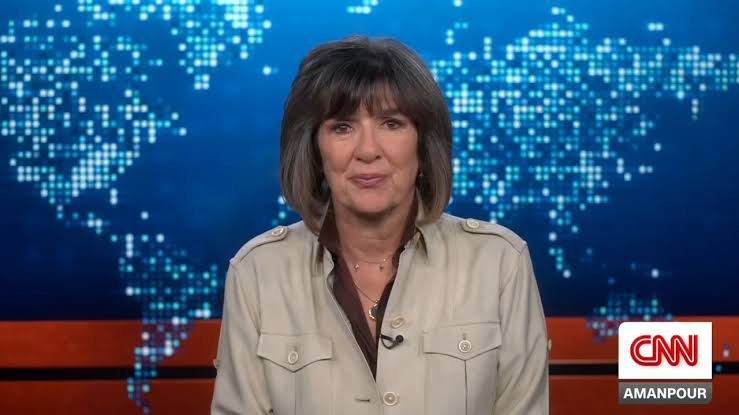
Christiane Amanpour’s planned departure from CNN in June 2027, after more than four decades with the network, marks a defining moment in an extraordinary television career. As reported by the Associated Press and The Guardian, it also offers an opportunity to reflect on a journalist whose reporting has shaped global understanding of war, diplomacy, human rights and human suffering.
Joining CNN in 1983 as an entry-level assistant, Amanpour rose through the ranks to become one of the network’s leading international correspondents. Her coverage of the 1990–91 Gulf War brought her international recognition, and she subsequently became CNN’s Chief International Anchor.
Her legacy extends beyond interviews with presidents, prime ministers and military leaders. It rests on her determination to ask difficult questions, challenge official narratives and bring the experiences of ordinary people caught in conflict to international audiences. Her honours include multiple News and Documentary Emmy Awards, four Peabody Awards and the 2019 International Emmy Directorate Award.
As she prepares to leave CNN, independent journalism faces mounting challenges. Reporting from conflict zones such as Gaza and Ukraine remains dangerous and politically contested, while international institutions established to promote peace, security and respect for international law face growing pressure.
Against this backdrop, Amanpour’s career offers enduring lessons in professional courage, perseverance and the responsibility to place the public interest above political, financial and personal considerations.
JOURNALISM FROM THE FRONTLINES
Amanpour established her reputation through reporting from some of the world’s most dangerous conflict zones. She covered the Gulf War from Baghdad and the Bosnian war and siege of Sarajevo between 1992 and 1995. Her reports drew international attention to ethnic cleansing, detention camps and the 1995 Srebrenica massacre.
She subsequently reported from Rwanda in the aftermath of the 1994 genocide, Afghanistan following the September 11 attacks, Iraq during and after the 2003 invasion, and conflicts involving Syria, Islamic State and Ukraine following Russia’s full-scale invasion in 2022.
Her work demonstrated that war is about more than territory, military strategy and geopolitical calculations. It is also about displaced families, shattered communities and civilians whose lives are transformed by decisions made in distant political and military centres.
Such reporting demands courage, patience, meticulous verification and the determination to pursue facts despite danger, intimidation or pressure. It also requires the discipline to scrutinise powerful interests without compromising accuracy and fairness.
Although Nigeria has not featured as prominently in Amanpour’s conflict reporting as Europe and the Middle East, her wider work on governance, democracy and accountability offers valuable lessons for Nigeria’s media and political institutions. International scrutiny of Nigeria remains important because developments in Africa’s most populous country have significant implications for regional stability and global affairs.
JOURNALISM AND INTERNATIONAL RELATIONS
One of Amanpour’s enduring contributions has been her ability to make complex international affairs accessible without reducing them to simplistic explanations.
Her interviews with political leaders, including Muammar Gaddafi, Bashar al-Assad and Hassan Rouhani, illustrate the importance of questioning those in power about human rights, political responsibility and the consequences of their decisions. Her interviews with Ukrainian President Volodymyr Zelenskyy have also helped audiences understand the political and security implications of Russia’s war with Ukraine.
Diplomacy relies on negotiations, official statements and compromise. Journalism performs a complementary but distinct function: testing official claims, investigating competing accounts and explaining the consequences of political decisions.
A journalist’s responsibility is not to make diplomacy convenient or political leaders comfortable. It is to help the public understand what is being negotiated, whose interests are at stake and whether official explanations withstand scrutiny.
For practitioners of conflict-sensitive journalism, one fundamental lesson is that journalism cannot, on its own, end wars or guarantee peace. It can, however, establish facts, expose abuses, amplify neglected voices and equip citizens to evaluate decisions taken in their name. Its records may also inform subsequent investigations, historical research and assessments of whether governments and armed groups have acted lawfully or responsibly.
This responsibility becomes even more important when international institutions face challenges to their authority. Journalists must scrutinise not only states and armed groups but also the shortcomings of institutions established to protect civilians, uphold international law and promote peaceful coexistence.
THE COURAGE TO QUESTION POWER
Born in London in 1958 and raised partly in Tehran, Amanpour studied journalism at the University of Rhode Island before joining CNN in 1983. Her career illustrates a fundamental principle: access to power is valuable only when it does not compromise editorial independence.
Journalism loses credibility when it becomes captive to censorship, political pressure, commercial interests or ideological loyalties, or when popularity takes precedence over accuracy.
Amanpour’s longstanding emphasis on truth over false neutrality is particularly instructive. She has argued that journalists should not treat truth and falsehood as equivalent positions. Her approach underscores the importance of verifying claims, challenging misleading narratives and upholding fairness without compromising evidence.
For aspiring journalists, the lesson is clear. Courage without verification can become recklessness, while access without independence can become complicity. Professional journalism demands the courage to ask difficult questions and the patience to establish the facts, even when the answers are inconvenient to powerful interests.
These principles have particular relevance in Nigeria, where the media plays a critical role in democratic governance, public accountability and national development.
NIGERIA’S MEDIA: PARTISANSHIP OVER PROFESSIONALISM
Nigeria has a proud tradition of courageous journalism. From the struggle against colonial rule and military dictatorship to the restoration and consolidation of democratic governance, journalists have played significant roles in defending civil liberties, exposing abuses and holding public officials accountable.
Yet the profession continues to face serious ethical challenges. Among some practitioners, financial inducements, political patronage and partisan loyalties threaten to overshadow professional standards and the public interest.
The problem is not that journalists should be insulated from commercial realities or prohibited from holding political opinions. Media organisations must generate revenue to survive, while journalists retain their rights as citizens. The concern arises when money, political affiliation or personal advantage determines what is reported, what is suppressed and how public issues are presented.
When financial considerations dictate editorial judgement, journalism risks becoming a commodity rather than a public service. When political loyalty takes precedence over evidence, journalists risk becoming instruments of propaganda rather than independent interpreters of events. And when access to political officeholders matters more than holding them accountable, the media abandons one of its most important democratic responsibilities.
These tendencies are particularly troubling in a country where citizens depend on credible information to assess government performance, understand insecurity, evaluate public policies and make informed political choices.
The consequences extend beyond individual journalists and media organisations. Partisan reporting can deepen political divisions, distort public debate and erode public confidence in the media. Financially motivated misinformation can mislead citizens, while selective reporting can shield powerful interests from legitimate scrutiny.
This is not to suggest that Nigeria lacks principled journalists. Many practitioners continue to work under difficult conditions, often with limited resources and inadequate institutional protection, to establish the facts and uphold professional standards. Their commitment deserves recognition.
Nevertheless, the profession must confront its ethical shortcomings honestly. Media owners must protect editorial independence, editors must insist on verification and fairness, and journalists must resist inducements that compromise their judgement. Professional associations and journalism training institutions must also reinforce ethical standards and promote accountability.
It is against this background that Amanpour’s career stands out as an example worth studying. Her professional journey demonstrates the value of patience, perseverance and conviction in the face of pressure, danger and competing interests. It reminds Nigerian journalists that credibility is earned through consistent professional conduct, not political proximity, financial reward or public visibility.
The challenge is not to replicate Amanpour’s career but to uphold the principles that have sustained it: independence, courage, accuracy, fairness and an unwavering commitment to the public’s right to know.
For Nigerian journalism, these are not merely admirable ideals. They are essential conditions for restoring public trust, strengthening democracy and ensuring that the media remains accountable to the people it serves.
Adamu S Ladan fcai
adamusladadamu@gmail.com