

By Dr. Musa Abdullahi Sufi
In a region where insecurity, communal tensions, farmer-herder conflicts, banditry, displacement, and social divisions have continued to challenge development efforts, a quiet but potentially transformative revolution is taking place in Katsina State, Nigeria.
Rather than relying solely on conventional security responses, Katsina is increasingly investing in something often overlooked but fundamentally powerful: the capacity of people and institutions to prevent conflicts before they erupt.
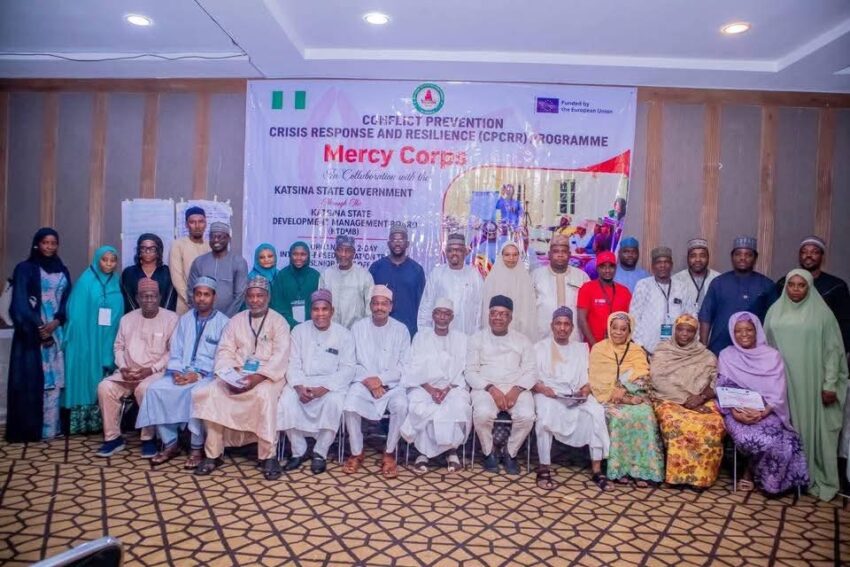
This week in Kano, senior government officials, women peace advocates, development practitioners, media professionals, and key stakeholders gathered for an intensive two-day training on Interest-Based Negotiation and Mediation (IBN+M) under the European Union-funded Conflict Prevention, Crisis Response and Resilience (CPCRR) Programme.
While many may view such workshops as routine capacity-building exercises, the significance of this engagement extends far beyond a training hall. It represents a strategic shift toward institutionalizing peacebuilding as a permanent feature of governance.
For Katsina State, this may well be one of the most important investments being made for future generations.
A DIFFERENT APPROACH TO SECURITY
Across Africa and many parts of the world, governments often respond to insecurity through military operations, law enforcement interventions, and emergency measures.
While such approaches remain necessary, experts increasingly acknowledge that force alone cannot solve complex conflicts rooted in poverty, exclusion, mistrust, resource competition, misinformation, and social grievances.
Sustainable peace requires something deeper requires dialogue, negotiation and sustain mediation. Most importantly, it requires institutions capable of identifying tensions early and resolving disputes before they escalate into violence.
This philosophy lies at the heart of the CPCRR Programme, funded by the European Union and implemented by the International Organization for Migration (IOM) in partnership with Mercy Corps and the Centre for Democracy and Development (CDD), working closely with the Katsina State Government through the Katsina State Development Management Board (KTDMB).
The programme seeks to strengthen resilience, promote peaceful coexistence, and improve local capacities for conflict prevention and crisis response across Northwest Nigeria.
WHY THIS TRAINING MATTERS
The training brought together members of the CPCRR Steering Committee, High-Level Women Advocates (HiLWA), government officials, and selected media practitioners.
Participants underwent practical sessions on conflict management, negotiation simulations, dialogue facilitation, mediation techniques, and the internationally recognized Interest-Based Negotiation and Mediation framework.
Facilitated by conflict resolution experts Lynda Emmanuel and Tig Gang, the sessions challenged participants to rethink traditional approaches to conflict resolution.
One key lesson repeatedly emphasized throughout the engagement was simple yet profound: People often fight over positions, but peace is achieved when we understand interests.
When communities, groups, institutions, or individuals move beyond rigid positions and begin exploring underlying interests, opportunities for compromise, cooperation, and sustainable solutions emerge.
This principle has been successfully applied in peace processes around the world, from community disputes in Africa to international diplomatic negotiations.
The challenge now is how to embed such approaches into government systems.
GOVERNOR RADDA’S PEACEBUILDING VISION
The training also highlights a broader governance philosophy increasingly visible under the leadership of Katsina State Governor, Malam Dr. Dikko Umaru Radda.
While security remains a major concern in the state, the administration appears to recognize that sustainable peace requires a whole-of-society approach.
This includes strengthening institutions, empowering communities, engaging women and youth, supporting local dialogue mechanisms, and building trust between citizens and government.
The Katsina State Development Management Board, under the leadership of Dr. Mustapha Shehu, has emerged as a key platform for coordinating development interventions and ensuring that peacebuilding becomes integrated into broader governance and development planning processes.
During the training, Dr. Shehu emphasized a critical reality often ignored in security discussions. As Food security, nutrition, education, healthcare, economic growth, youth empowerment, and community development cannot flourish without peace.
Farmers need safe access to their farmlands. Children need secure learning environments. Women need protection and opportunities. Businesses require stability to grow. Development requires peace. The relationship is inseparable.
FROM PROJECTS TO INSTITUTIONS
One of the most important outcomes of the engagement was the commitment to institutionalize peacebuilding mechanisms across government Ministries, Departments, and Agencies (MDAs).
This represents a major shift. Too often, development projects end when donor funding expires. The challenge across many developing countries is sustainability.
What happens when the project closes What happens when the consultants leave?What happens when external funding ends? Are some of the questions need to be addressed right from project inception.
Participants acknowledged that the future success of the CPCRR Programme depends not merely on activities implemented today but on the ability of institutions to sustain the gains long after the programme concludes.
Institutionalization means that conflict-sensitive approaches become embedded within governance systems. It means mediation becomes part of decision-making. It means dialogue becomes a standard response to emerging tensions. It means peacebuilding becomes everybody’s responsibility. This is the foundation upon which resilient societies are built.
THE CRITICAL ROLE OF WOMEN
Another noteworthy feature of the training was the inclusion of High-Level Women Advocates.
Globally, evidence consistently demonstrates that peace processes are more effective and sustainable when women actively participate.
Women often serve as first responders to community tensions, social mediators within families, and influential voices within local networks. Yet they remain underrepresented in many peace and security initiatives.
By integrating women into peacebuilding frameworks, Katsina is strengthening one of its most valuable assets for social cohesion and conflict prevention. The long-term dividends could be enormous.
THE MEDIA AS A PEACE ACTOR
Perhaps one of the most significant aspects of the programme was the engagement of media practitioners. The media plays a powerful role in either escalating tensions or promoting peace.
Responsible journalism can provide accurate information, counter misinformation, amplify community voices, encourage dialogue, and foster accountability. Conversely, irresponsible reporting can inflame divisions and deepen conflicts.
By equipping journalists with conflict-sensitive reporting skills and mediation awareness, the programme recognizes that peacebuilding is not solely the responsibility of government or security agencies. It is a collective societal effort. The media is a strategic partner in that mission.
LESSONS FOR NORTHERN NIGERIA
The Katsina experience offers important lessons for other states across Northern Nigeria and beyond. Many states continue to grapple with insecurity, communal disputes, violent extremism, resource conflicts, and social fragmentation.
While security operations remain necessary, the Katsina model demonstrates the importance of investing in prevention rather than merely responding to crises. Conflict prevention is cheaper than conflict recovery. Dialogue is less costly than violence. And social cohesion is more sustainable than coercion.
States that prioritize institutional peacebuilding today may ultimately spend less on emergency responses tomorrow.
For this reason, governors, policymakers, development partners, traditional institutions, civil society organizations, and community leaders across Northern Nigeria should carefully examine and replicate elements of the Katsina model.
BUILDING PEACE FOR FUTURE GENERATIONS
Perhaps the most powerful message emerging from the two-day engagement is that peace is not an event. It is a process that cannot be achieved through enforcement alone and can be sustained through trust.
Peace can be strengthened through inclusion, flourishes through responsive institutions.
Peace-building requires vision, patience and partnerships. Most importantly, it requires people who are willing to invest today for a future they may never personally witness.
The CPCRR Programme and the commitment demonstrated by the Katsina State Government represent precisely such an investment.
If sustained, these efforts could help create a more resilient Katsina where communities coexist peacefully, institutions respond effectively, development initiatives thrive, and future generations inherit stronger foundations than those available today.
As the training concluded in Kano, one message resonated among participants: Peace is not merely the absence of conflict. It is the presence of strong institutions, inclusive governance, social cohesion, and collective action. And in Katsina State, the journey toward that vision is increasingly taking shape.
SIDES Media Comment
The successful training on Interest-Based Negotiation and Mediation (IBN+M) organized under the Conflict Prevention, Crisis Response and Resilience (CPCRR) Programme demonstrates that sustainable peace is built not only through security interventions but also through dialogue, trust-building, institutional strengthening, and inclusive participation.
SIDES Media commends the Katsina State Government, the Katsina State Development Management Board (KTDMB), the European Union, the International Organization for Migration (IOM), Mercy Corps, the Centre for Democracy and Development (CDD), and all stakeholders for investing in a proactive approach to peacebuilding.
At a time when many communities across Northern Nigeria continue to face security and social cohesion challenges, this initiative offers a practical model for strengthening resilience and preventing conflicts before they escalate into crises. The inclusion of government officials, women advocates, community stakeholders, and media practitioners reflects the reality that peacebuilding is most effective when it is inclusive and community-driven.
SIDES Media believes that the institutionalization of peacebuilding mechanisms within government systems is one of the most significant outcomes of this engagement. Sustainable peace cannot depend solely on projects or temporary interventions; it must become an integral part of governance, development planning, service delivery, and community engagement.
We particularly commend the leadership of His Excellency, Governor Malam Dr. Dikko Umaru Radda, CON, for supporting initiatives that prioritize peace, social cohesion, and human development. The commitment demonstrated by the Katsina State Government reinforces the understanding that security, food security, education, healthcare, economic growth, and sustainable development are interconnected.
SIDES Media calls on other state governments across Northern Nigeria and the country at large to study and replicate similar peacebuilding initiatives. Investing in conflict prevention, mediation, dialogue, and social inclusion remains one of the most cost-effective and sustainable pathways to development.
Peace is not merely the absence of violence. Peace is the presence of justice, inclusion, opportunity, strong institutions, and collective responsibility.
The future of Northern Nigeria depends on our ability to build communities where dialogue prevails over division, understanding over confrontation, and collaboration over conflict.
Dr. Musa Abdullahi Sufi
Senior Vision Director, SIDES
Development Communication Specialist.
SIDES Media: Promoting Development, Peace, Innovation, and Social Transformation.