

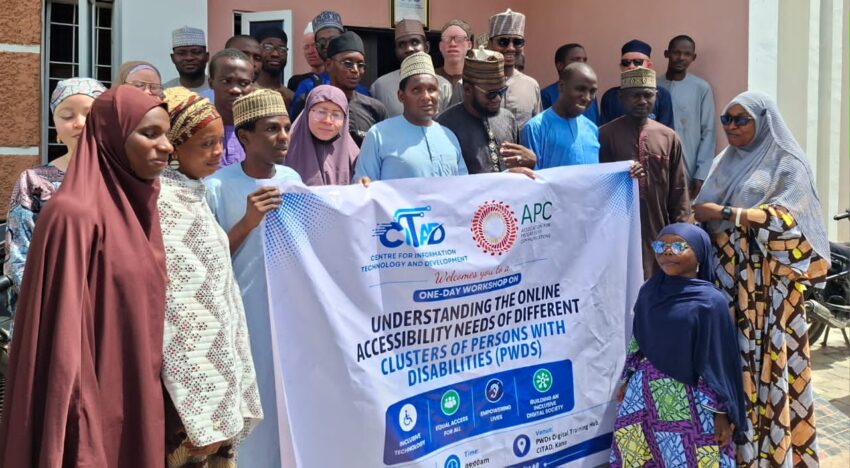
The Centre for Information Technology and Development (CITAD) has raised concern that persons with disabilities in Nigeria are still being left behind in the country’s digital space, despite existing laws aimed at protecting their rights.
The concern was expressed on Thursday during a one-day workshop that brought together various disability groups to examine challenges they face in accessing online services and digital platforms.
The workshop was organised by CITAD with support from the Association for Progressive Communications under the Campaign for Improved Accessibility of Government Websites and Portals initiative.
Speaking at the event, the Executive Director of CITAD, Malam Y.Z. Ya’u represented by the Senior Programme Officer, Isah Garba said digital exclusion remains widespread due to poorly designed websites, expensive assistive technologies, and unstable internet access.
He noted that the slow enforcement of the Discrimination Against Persons with Disabilities (Prohibition) Act, 2018, has further widened the gap in access to online public services.
According to him, many government and public service websites are still not designed with accessibility features such as screen-reader compatibility, alt text for images, proper navigation structures, and keyboard-only functionality, making them difficult for visually impaired users to operate.
“Persons with disabilities in Nigeria continue to face serious barriers in the digital space, ranging from inaccessible website designs to the high cost of assistive tools and poor internet connectivity,” he said.
Also speaking, CITAD’s Coordinator for Persons with Disabilities, Hamza Aminu Fagge, explained that the Campaign for Improved Accessibility of Government Websites and Portals (CIAGOP) was created to identify and address gaps in digital accessibility.
He said the initiative focuses on assessing government websites, producing evidence on accessibility challenges, and engaging stakeholders to improve compliance with global accessibility standards.
Fagge added that CITAD continues to collaborate with disability communities and public institutions to promote inclusive digital environments that ensure equal access to information and services.
He further revealed that feedback from engagements shows that many government platforms remain either partially accessible or completely unusable for some categories of persons with disabilities, thereby restricting access to essential public services.
Participants at the workshop, meanwhile, urged stronger enforcement of accessibility standards and called on government agencies to ensure that all digital platforms are designed to be inclusive and user-friendly for everyone, regardless of disability.