

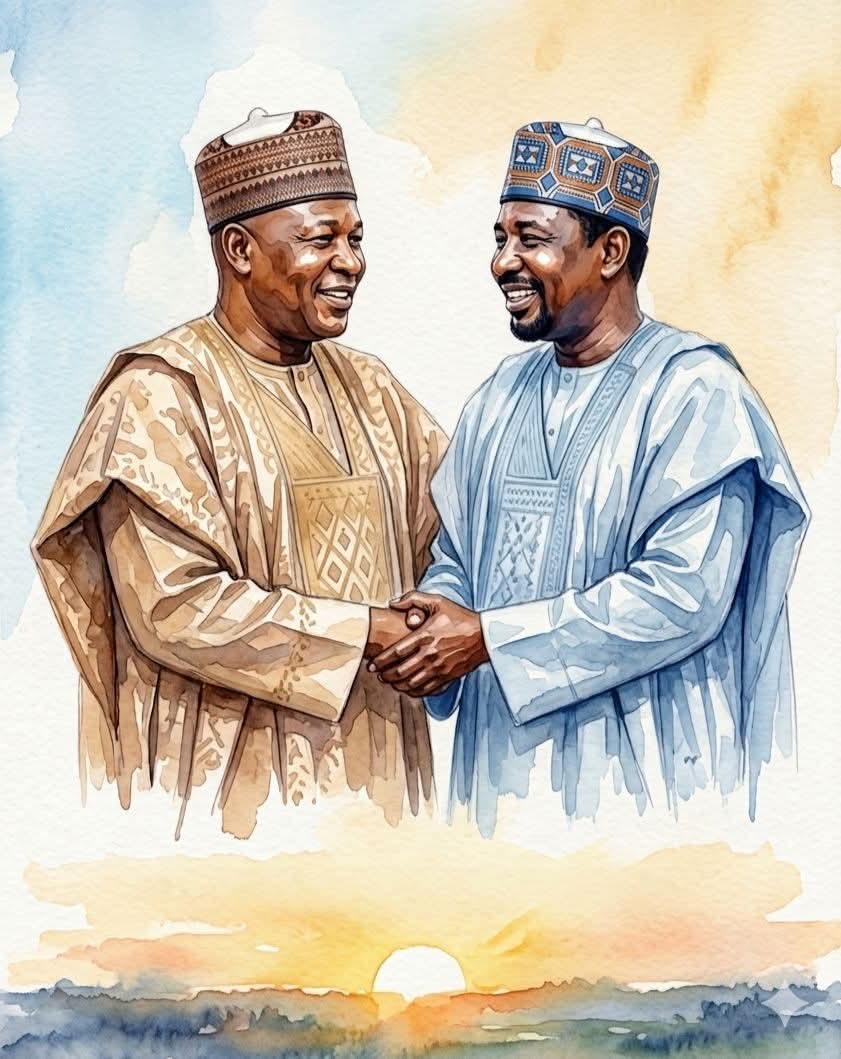
Consensus And Continuity: Kano APC’s Calculated Compromise
By Adamu Aminu
The resolution of the Kano North Senatorial dispute marks a significant moment for the All Progressives Congress (APC) in Kano State.
For a party that has repeatedly seen internal contests spill into public acrimony, the decision to resolve the matter behind closed doors signals a shift toward managed consensus rather than open confrontation.
Governor Abba Kabir Yusuf’s intervention, backed by President Bola Ahmed Tinubu and Vice President Kashim Shettima, underscores the importance of consensus politics in a region often characterized by intense competition.
In Kano, where political loyalty is volatile and factional networks run deep, such high-level involvement is rarely symbolic.
It indicates that the dispute was seen not as a local matter alone, but as a test case for party cohesion ahead of 2027 general elections.
By withdrawing his ambition, the former Minister of State for Housing and Urban Development Abdullahi Tijjani Muhammad Gwarzo (ATM) avoided a prolonged contest with Deputy Senate President Barau I. Jibrin.
The withdrawal was not framed as a defeat, but as a concession in service of party unity.
In practical terms, it prevents a bruising primary that could have drained resources, deepened mistrust, and provided ammunition for opposition parties.
His decision reflects a broader strategy within the APC to minimize internal divisions ahead of the 2027 general elections. In a party where factional disputes have historically weakened electoral strength, this compromise is both practical and symbolic. It suggests that survival now outweighs personal ambition, at least for the moment.
The move also highlights the growing role of national figures in local disputes. Tinubu and Shettima’s involvement signals that the APC leadership views Kano as a critical battleground, where unity is essential for maintaining influence in the North West. Kano’s electoral weight makes it a prize neither the party nor its rivals can afford to lose.
By stepping in early, the national leadership aimed to prevent the kind of fragmentation that cost the APC ground in other states during the 2023 cycle.
Governor Yusuf’s ability to broker peace in both Kano North and Kano Central further positions him as a stabilizing figure within the party’s state structure. His role suggests a preference for negotiation over litigation and for settlement over prolonged contestation.
This approach may not satisfy every aspirant, but it reduces the risk of open rebellion within the ranks.
For Senator Barau, the withdrawal consolidates his position and strengthens his leadership profile without the cost of a bitter fight. For Gwarzo, it demonstrates loyalty and discipline, qualities that may earn him future recognition within the party hierarchy. In a system where patience is often rewarded with appointments and concessions later, restraint can be a form of leverage.
Ultimately, the reconciliation is less about personalities and more about party survival. The APC in Kano cannot afford another cycle of self-inflicted wounds if it intends to hold the state.
In a political climate where fragmentation can cost dearly, the party’s calculated compromise reflects a deliberate effort to project unity, continuity, and collective strength. The message is clear: internal disputes must be contained before they become public liabilities.
Yet the question remains, when ambition is set aside under pressure rather than through conviction, will the reconciliation hold beyond the next election cycle, or is this consensus only as sustainable as the next opportunity for rivalry?
Adamu Aminu writes from Abuja.