

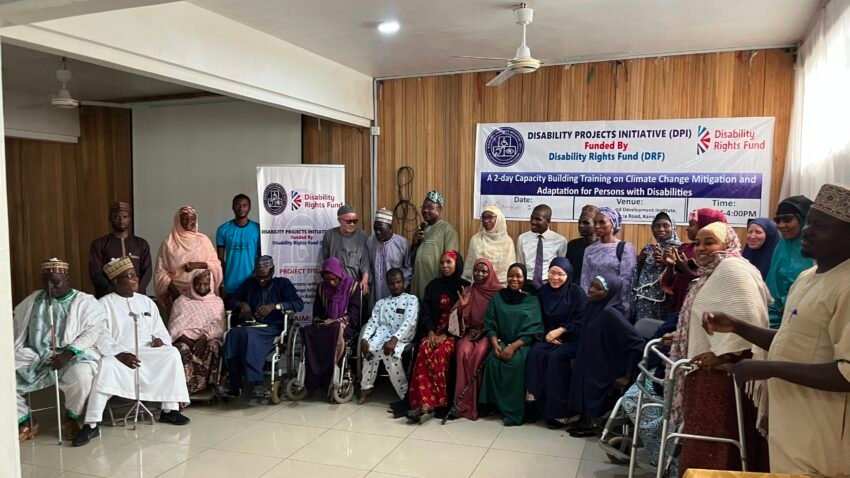
By Mustapha Salisu
The Disability Projects Initiative (DPI), with support from the Disability Rights Fund (DRF), has trained 100 Persons with Disabilities (PWDs) on climate change mitigation and adaptation in Kano State.
The training was conducted through four cohorts under the project, “Empowering Persons with Disabilities for Climate Change Mitigation and Adaptation in Kano State, Nigeria.” The fourth and final cohort was held from August 17 to 18, 2026, in Kano.
The project seeks to promote the inclusion of Persons with Disabilities in climate change programmes, policies and decision-making processes, particularly in climate action and environmental governance.
According to DPI, the completion of the fourth cohort marks the end of the project’s capacity-building phase, which followed a baseline study on the effects of climate change and related hazards on Persons with Disabilities in Kano State.
The study examined the specific vulnerabilities and barriers faced by PWDs while also identifying opportunities for strengthening their participation in climate action.
Participants in the four cohorts included both male and female Persons with Disabilities from different groups, including people with visual and hearing impairments, physical disabilities, albinism, dwarfism and spinal cord injuries.
The training focused on the causes and effects of climate change, mitigation and adaptation strategies, resilience and inclusive climate action. Participants were also encouraged to identify climate-related challenges affecting PWDs in their communities and explore practical responses.
DPI said the training provided an opportunity for participants with different disabilities to share experiences and deepen their understanding of the need for accessibility and meaningful participation in climate-related planning and decision-making.
The initiative also emphasised that Persons with Disabilities should not be treated only as beneficiaries of climate interventions but as rights-holders, advocates, community leaders and agents of change who should participate in developing solutions to climate-related challenges.
DPI Moves to Policy Advocacy
With the completion of the capacity-building phase, DPI said the project will now move into policy advocacy, including policy dialogue, policy review, development of a policy brief and training of climate ambassadors.
The organisation is expected to engage government institutions, policymakers, civil society organisations, Disabled Persons’ Organisations, environmental stakeholders and community actors to identify policy gaps and barriers affecting the inclusion of PWDs in climate change mitigation, adaptation, disaster risk reduction and environmental sustainability initiatives.
The policy review will also examine opportunities for strengthening disability inclusion in relevant climate and environmental policies, plans and programmes in Kano State.
DPI said it will develop a policy brief drawing from findings of the baseline study and lessons from the capacity-building programme. The document is expected to provide recommendations for policymakers and other stakeholders on disability-inclusive climate policies, programmes and investments.
The project will also include the training of Climate Ambassadors from among Persons with Disabilities. The ambassadors will be equipped with advocacy skills to raise awareness, mobilise communities and engage policymakers on disability-inclusive climate action.
DPI expressed appreciation to the Disability Rights Fund for its funding support, as well as facilitators, sign language interpreters, participants and project team members who contributed to the implementation of the four cohorts.
The organisation said the next phase would focus on ensuring that Persons with Disabilities have greater representation and participation in climate governance and that disability inclusion remains part of climate action in Kano State.