

From Abdullahi Alhassan, Kaduna
Deputy Governor of Kaduna State, Dr Hadiza Sabuwa Balarabe, has warned that no nation can achieve growth and prosperity when its most productive segment is “wasted” by drug abuse, declaring that the menace has become a national epidemic threatening Nigeria’s human capital.
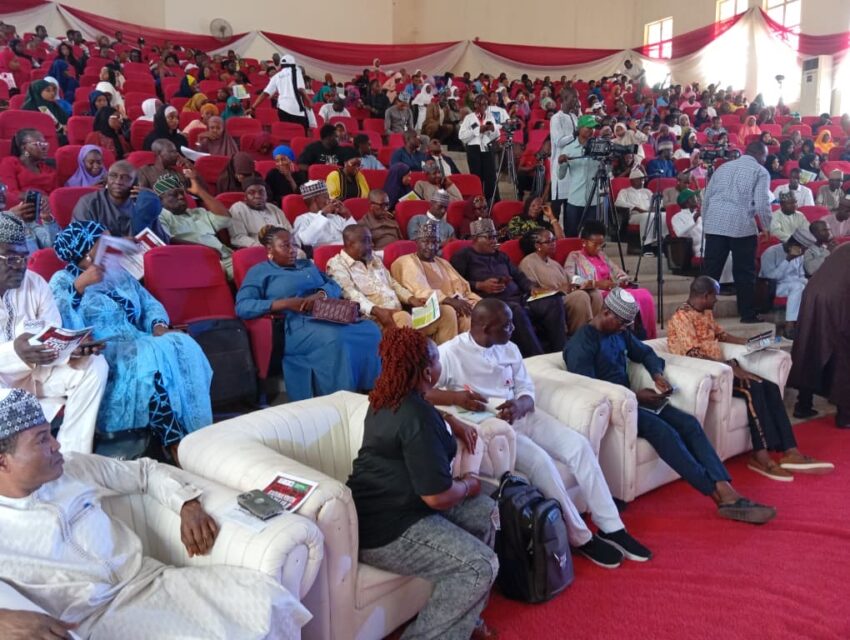
Speaking on Monday at the Nigerian Institute of Public Relations’ Week 2026 Undergraduate Forum at Kaduna State University, she said the country must urgently address the demand side of substance abuse to safeguard its future leaders.
Painting the crisis with “the language of facts,” Balarabe cited the National Drug Use Survey which shows 14.3 million Nigerians are trapped in drug abuse — nearly three times the global average.
She noted that the North-West accounts for about 3 million users, with Kaduna State alone recording a prevalence of around 10 percent, representing nearly half a million people “living in a chemical haze.”
The deputy governor stressed that the figures have names and faces, adding that drug abuse steals mental clarity, drains finances, isolates users, and distorts moral judgment, leaving families in “financial hemorrhage and relationship carnage.”
Dr, Balarabe drew a direct link between substance abuse and violent crime, stating that the Nigerian Drugs Law Enforcement Authority has confirmed that kidnapping, banditry, and terrorism are fueled by drugs.
“When you see a mindless act of violence in the news, know that in almost every case, the perpetrator was high, hallucinating, and hollowed out by drugs,” she said.
She warned that the generational cost is “a brilliant mind of today becomes a permanent patient of tomorrow,” and said the depletion of human capital means “the nation is not just sick; it is lost.”
Sharing a personal reflection, the deputy governor said she, the Vice Chancellor, and the NIPR President were once students “walking these same corridors of confusion and curiosity” 25 to 40 years ago, where temptation and peer pressure existed.
“Many of our mates, brilliant, promising, talented mates, swallowed that pill, took that puff, and were swallowed up. Today, they are not in this hall. They are not in boardrooms.
They are memories, or they are shadows of what they could have been,” she said. She urged students to refuse to be “vulnerable victims” and not let “a temporary high dictate a permanent low.”
She commended Kaduna State as the first and only state to establish a dedicated agency for the demand side of the problem — the Kaduna State Substance Abuse and Mental Health Services Agency (KADSAMHSA) — under Governor Uba Sani.
She said the move has earned Kaduna formal recognition by the United Nations Office on Drugs and Crime as a national benchmark for drug prevention, with its approach dubbed the “Kaduna Model” for shifting from punishment to compassion and from incarceration to rehabilitation.
“We are building the systems to catch youth before they fall, and to lift those who have stumbled,” Balarabe stated.
Addressing students directly, the deputy governor appealed to their “sense of greatness,” urging a new narrative that “it is cooler to be clear-headed than high” and that “productivity is the new high.”
She cautioned them to shun peer pressure and the impulse that “one try won’t hurt,” warning: “Fumbling fingers, fading memory, fragile veins, fractured future — do not let that be your story.” She concluded, “Today, you are students of KASU.
Tomorrow, you are the leaders of Nigeria. Do not let a chemical compound write the final chapter of your life’s story. Refuse to be vulnerable. Choose productivity.”
The keynote address on Addressing vulnerability in prevention of Drug abuse by Director General of the Kaduna State Substance Abuse and Mental Health Services Agency (KADSAMHSA), Mr. Joseph O. Ike, said Kaduna is redefining drug prevention through precision science and integrated care, moving away from decades of “theatre of prevention” anchored on slogans and fear-based campaigns.
Mr, Ike stated that “awareness is not prevention” and that effective policy must identify and neutralise specific risk factors driving substance use among young adults.
He credited Governor Uba Sani’s “deliberate, compassionate, and visionary leadership” for providing the foundation, citing the enactment of the State Mental Health Law in September 2025, which domesticated and operationalised the National Mental Health Act with state resources.
Mr Ike further explained that vulnerability among the 18–25 age group is a scientific measure of risk, not a moral failing. He listed three key factors: a neurobiological gap where the prefrontal cortex, responsible for impulse control, is still developing while the reward-seeking limbic system is at its peak, environmental and academic pressures that push students to seek “tools” rather than “highs” to cope with ‘TDB’ study sessions; and relative deprivation from digital comparison that fuels isolation.
“To counter these, he said KADSAMHSA is building protective factors through social connectedness, cognitive agency, and integrated services that make mental health support available in primary care and on campuses, “making the healthy choice the easy choice.”
Debunking myths sustained by the “War on Drugs” narrative, the DG said scare tactics do not work for young adults and often trigger curiosity rather than deterrence, while framing substance use disorder solely as a “choice” ignores systemic risks like poverty and lack of support.
He stressed that “tough love” and isolation accelerate substance use, noting that the “Kaduna Model” emphasises community-based treatment and recovery that keeps individuals in school and with their families to preserve protective factors.
Mr, Ike said, is the Kaduna State Child Amplified Prevention System (KdCHAMPS), a data-driven, multi-sectoral model adapted from UNODC International Standards to identify vulnerabilities in adolescents and young adults before they escalate into crises.
“Rather than wait for a student to be caught with a substance, KdCHAMPS screens for precursors such as social isolation, academic decline, and untreated trauma, involving the ministries of health and education as well as social services.
He urged KASU to adopt a three-tiered campus approach: universal prevention through routine mental health screenings and non-punitive policies; selective prevention with mentorship for higher-risk groups; and indicated prevention for early intervention without fear of expulsion.
DG Ike maintainted that Kaduna’s work “is not just about drugs” but about the soul of the state and the survival of its next generation of leaders. “We have moved past the era of slogans.
We have entered the era of science, compassion, and precision,” he said, urging students to understand their risks, build protections, and connect with one another.
He reiterated that KADSAMHSA exists to serve, not judge, and called for trading the “War on Drugs” for a “Movement for Health” to build a Kaduna that is mentally resilient, socially connected, and recognised globally for public health excellence.