

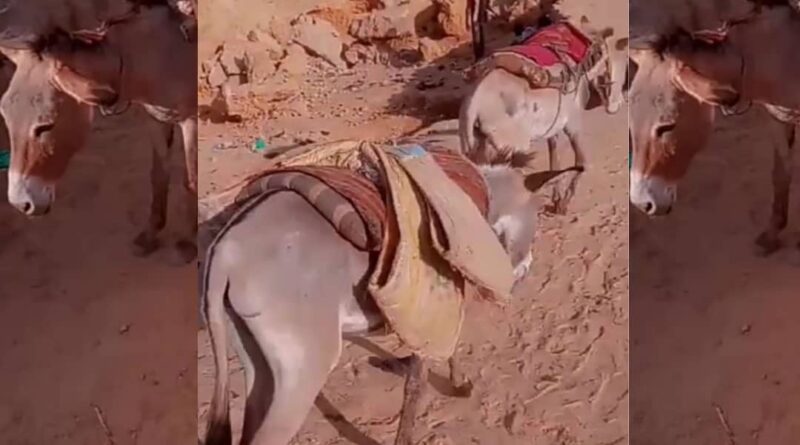
Explainer: Why are Kano donkeys vanishing?
By Zulaiha Danjuma
Have you ever wondered where all the donkeys in Kano went? Donkeys have been a major player in the agricultural and commercial transportation system of old Kano city for decades, in modern times people use them to carry sand and building materials for construction and as water vendors in rural areas. But overtime, the presence of donkeys in and within Kano state is declining.
In rural markets like Bichi, Dawakin Tofa, Laraban abasawa and Gaya which commonly engage in donkey trading for farming and transportation purposes have seen an alarming decline in donkey numbers.
This is due to a disturbing trend of buying donkeys and slaughtering them for body parts trade like skin and genitals. This act has significantly affected the population of donkeys in Kano state and other northern states in Nigeria.
Kano state was a thriving hub for donkey body part trade in the year 2015 to 2017. Reports say it was directly influenced by the high demand of donkey skin and genitals in China for the preparation of traditional Chinese medicine and aphrodisiac consumption.
China’s internal donkey population has faced immense collapse over the years with a decline in donkey population estimated at 90% decrease from a population of 11.2 million donkeys in 1999 to about 1.46 million in 2023. For decades China has used donkey hides (skin) to produce the main ingredient used in Ejiao (A Chinese traditional medicine) used to nourish the blood and treat illnesses like anemia and insomnia.
The huge loss of the donkey population in China is also linked to donkey slaughter for body parts trade majorly for Ejiao medicine production. As China’s donkey population continues to decline, the traditional Chinese medicine (TCM) market is seeking alternative sources for donkey parts, making Africa a prime target for supply.
According to reports the Nigerian Customs Service Kano/Jigawa command said it intercepted and confiscated 3,712 donkey skins and three (3) 100kg bags of donkey genitals in 2023, which it had handed over to the Nigeria Agricultural Quarantine Service (NAQS).
Before that particular seizure by the Kano/Jigawa customs service command, 7,000 donkey genitals were seized at the Lagos Airport on their way to Hong Kong in 2022. The Organized Crime Corruption Reporting Project OCCRP has also reported that 2,820 donkey skins worth $116,000 dollars were intercepted at a riverbank at Bagudo town in Kebbi state near the border between Niger and Benin Republic.
Kano state has nearly lost most of its donkey population given the enormous international demand for donkey parts trade.
Internally, donkey meat consumption in the South-East and South-West parts of Nigeria has also tremendously contributed to the decline of donkeys in the northern part of the country, including Kano state.
Some reports suggest that The Nigerian donkey population was 2 million in the early 80’s and reduced to about 939,107 in 1991. This rapid decrease in donkey numbers in mostly the Northern parts of the country is attributed to the high demand for donkey meat in southeastern and southwestern regions of the country.
However a 2023 report by the World population review places the numbers of donkeys in Nigeria at 1,357,245.
In a recent series of major crack down operations, the Nigerian Customs Service has intercepted several large-scale donkey smuggling attempts, highlighting the country’s growing role in the illicit donkey trade.
Key Seizures:
● 64 donkey skins worth N112.59m bound for China through Cameroon on October 15th 2025
Nigeria’s latest busts on donkey parts smuggling highlight growing conservation concerns and a need for laws that safeguard the well-being of donkey species.