

What happens when preparation meets opportunity?
By Abdulhameed Musa Abdullahi
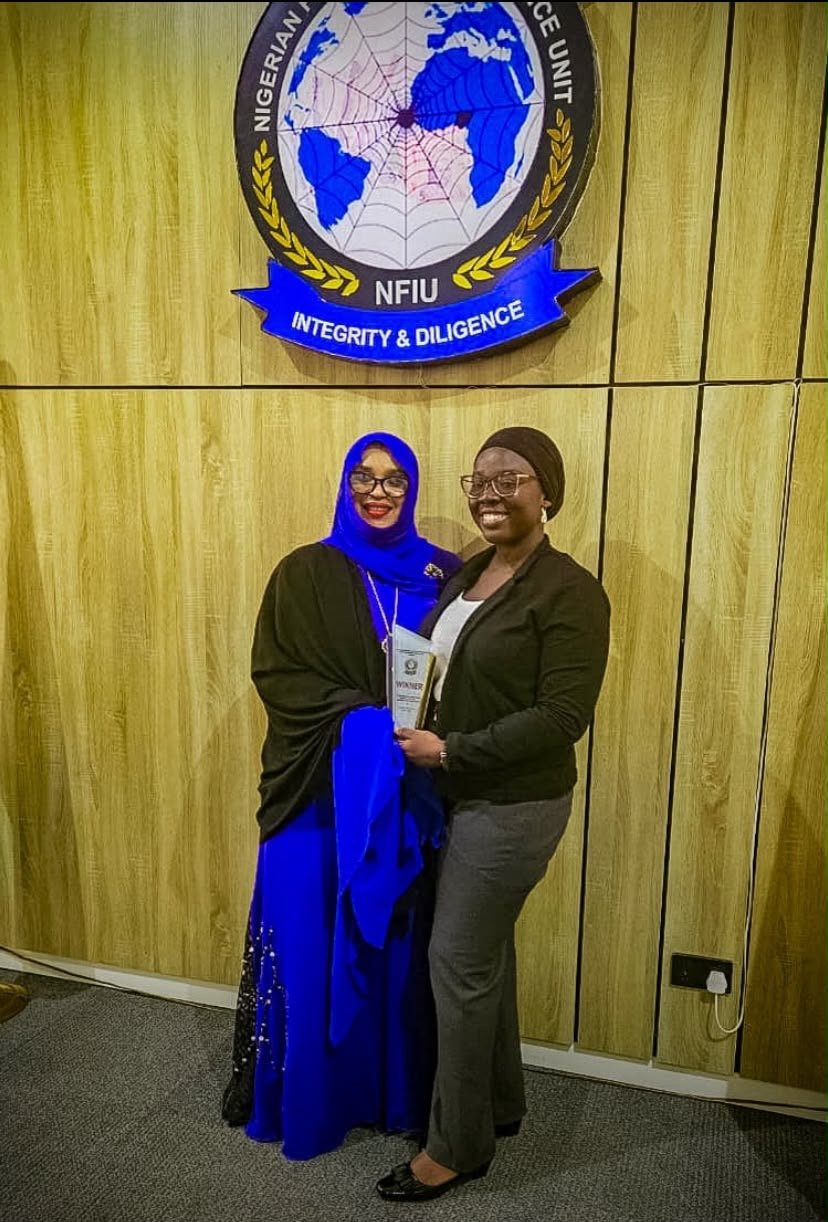
For Amra Onize Salihu, a 500-level Law student of the University of Abuja, it meant representing Nigeria at the 9th GIABA Inter-University Speech Contest in Freetown, Sierra Leone, and emerging as the overall winner after competing against students from across West Africa.
Today, the Nigerian Financial Intelligence Unit (NFIU) received the young champion at its headquarters in Abuja, where the Chief Executive Officer, Hafsat Abubakar Bakari, congratulated her and highlighted the important role young Nigerians can play in promoting transparency, accountability and integrity.
Amra’s achievement is more than a personal success story.
It is evidence of what can happen when institutions create opportunities, universities nurture talent and young people are given platforms to participate.
But perhaps the bigger question is:
How do we turn individual success stories into a sustainable national pipeline of young people participating in financial integrity?
The success of the GIABA Inter-University Speech Contest provides an excellent foundation.
Nigeria could build upon initiatives like this through a more structured Youth and Student Financial Integrity Engagement Framework, connecting students and young professionals to learning, research, innovation, advocacy and regional opportunities in AML/CFT.
And such an initiative should be deliberately multidisciplinary.
Law students will naturally contribute perspectives on legislation, justice and enforcement.
Accounting, Banking, Finance and Economics students can contribute their understanding of financial systems, transactions, auditing and economic risks.
Computer Science, Cybersecurity and Data Science students can explore emerging threats such as cyber-enabled fraud, digital financial crime, cryptocurrency-related risks and the use of technology in financial intelligence.
Political Science, International Relations, Sociology and Criminology students can contribute perspectives on governance, institutions, organised crime and societal drivers of financial crime.
And medical and health-science students should not be left behind.
The healthcare sector is one of the largest and most complex sectors of any economy, involving public expenditure, procurement, pharmaceuticals, insurance, research funding, private healthcare, medical supply chains and multiple financial transactions.
Medical students, pharmacists, laboratory scientists, nurses, public-health students and other health professionals can therefore also benefit from understanding financial integrity, ethical procurement, fraud risks, corruption vulnerabilities and the broader consequences of illicit financial flows on healthcare delivery.
Financial crime is not confined to banks.
It touches virtually every sector of society.
That is why youth engagement in financial integrity should not be restricted to students studying law, finance or economics.
It should include the full spectrum of Nigeria’s young intellectual and professional community.
Imagine a national ecosystem where universities host:
AML/CFT debates and speech competitions;
Financial-integrity essay and research competitions;
Campus awareness programmes;
Youth financial-integrity clubs;
Student ambassador programmes;
Innovation challenges for emerging financial-crime risks;
Interdisciplinary research projects;
Career and mentorship sessions;
Public lectures and policy dialogues;
Digital campaigns addressing cyber-enabled financial crime and fraud;
Opportunities for young Nigerians to participate in regional initiatives through GIABA and other relevant platforms.
And beyond universities, young entrepreneurs, technology communities, professional associations, youth organisations and young professionals can also become important partners.
The objective should not simply be to make young people recipients of awareness.
They should become participants.
They can research.
They can innovate.
They can educate their peers.
They can develop solutions.
They can challenge harmful financial practices.
They can represent Nigeria on regional and international platforms.
Amra’s story therefore deserves celebration—but it also deserves replication.
If one Nigerian student can move from a university competition in Abuja to becoming a West African champion in Freetown, imagine what could happen if thousands of Nigerian students were given structured opportunities to participate in conversations around financial integrity.
The question should therefore not only be:
“Who will be our next Amra?”
It should be:
“How do we create an ecosystem capable of producing thousands of Amras across different disciplines?”
Nigeria’s young people are not merely leaders of tomorrow.
In the fight for transparency, accountability and financial integrity, they can be partners today.